Latin American Pulse for Saturday, October 17, 2026
Latin America Pulse: Brazil's runoff tightens as Flávio shifts on the economy. Mexico-US flights, a Chile-Bolivia thaw, Argentina and Cuba's power cuts. The post Latin American Pulse for Saturday, October 17, 2026 appeared first on The Rio Times .
Latin America Pulse: Brazil runoff tightens as Flávio shifts on economy. Mexico-US aviation, Chile-Bolivia thaw, Argentina surplus, Cuba power cuts., Brazil Defensive repositioning: Flávio pledges fiscal cuts but protects social floors while dodging succession questions., Mexico Institutional distrust: Health officials deny bad food claims as the national mood grinds between grime and glory., Chile Cautious opening: Kast makes a historic Bolivia visit, signing accords while managing old wounds and domestic strains., Argentina Confident consolidation: markets digest Caputo’s surplus promise from Thailand as the peso and reserves hold the line., Colombia Business-first pivot: coal exports to Israel reopen and retail jumps as the state seeks lost ground and growth., Cuba Exhausted patience: another power plant fire deepens the energy crisis, pushing the informal dollar rate to a record., Prediction markets Polymarket gives Flávio Bolsonaro 77.2% and Lula 23.5% to win Brazil’s presidential election, with US$185 million traded (read at 11:16 pm ET on 16 October).
Latin America ended the week holding its breath: Brazil is eight days from a runoff that feels like a knife-edge, Mexico is normalising tense ties with Washington, and the region’s economies are all trying to find solid ground under shifting political weight.
The hemisphere feels like a house with too many doors ajar. From Santiago to Havana, governments are managing old wounds, sudden deals, and fragile calm.
Markets were mostly steady on Friday. Brazil’s Bovespa rose 0.5%, Mexico’s benchmark index rose 1.1%, but Argentina and Colombia slipped, as investors weighed local political heat against global patience.
Flávio Bolsonaro walked into a TV Globo interview on Friday and tried to be both a fiscal hawk and a social guardian. He promised an adjustment worth 1.5% to 2% of GDP, funded by selling public property, securitising debts, and fighting corruption.
Then he refused to touch the real minimum-wage increase, pension floors, or health and education spending. He called the end of the 6×1 work week opportunistic but said he would not reverse it.
The subtext: he needs centrist voters and is terrified of scaring off the poor.
He also dodged hard on family succession. He said the current rule must stand, meaning relatives up to the third degree count as a re-election, effectively barring his father.
The campaign feels less ideological and more like a careful negotiation with the whole country.
For a foreigner in Brazil, this means the policy direction will be less drastic than the rhetoric suggests. The real fight is over control of the narrative, not the architecture of the state.
The Health Ministry spent Friday denying reports of cockroaches and spoiled food at the National Institute of Neurology. The story sat on El Financiero’s front page as a small, sour note about daily public life.
Meanwhile, the US lifted restrictions on Mexican airlines at AIFA and AICM, opening more routes north. It is a concrete thaw in the aviation relationship after years of safety downgrades and slot battles.
The same week, Trump banned unauthorised drones on the border, with a pointed jab at cartels. Mexican officials said the US relationship now absorbs 85% of their time.
The mood is tired: glad for the flight win, exhausted by the constant bilateral drama.
For a foreigner living here, the practical win is real: more flights, more options. But the institutional distrust, from hospital canteens to Trump’s drones, is daily background noise.
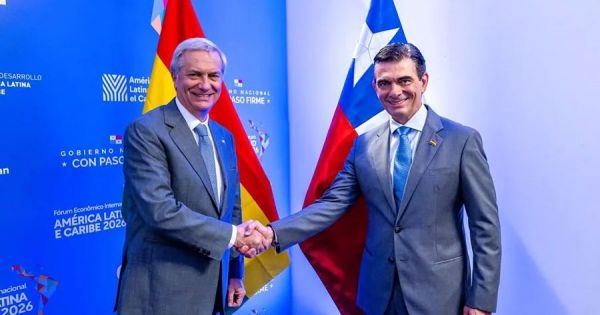
President José Antonio Kast made a historic official visit to Bolivia, the first by a Chilean president to La Paz since 1955. He met Bolivia’s Rodrigo Paz and signed accords covering trade, mining and connectivity.
Paz re-stated Bolivia’s maritime demand but said it could not block development. Kast said, “today we stop turning our backs on each other.”
It is a careful diplomatic dance, using economic need to cool a century-old grudge.
At home, Chile granted parole to the man who attacked protestor Fabiola Campillai, a decision that re-opened a raw wound from the 2019 estallido. And BHP sued a mine union over stoppages.
The country feels split: opening to the region while still fighting internal battles over memory and money. For a foreigner holding assets in Chile, the signal is stability at the top but a slow-burning conflict over social justice that can disrupt the ground level without warning.
Economy Minister Luis Caputo was in Thailand on Friday, telling an audience that Argentina has a financial “surplus” and should keep it for four years. He linked RIGI investment projects to the future lifting of currency controls.
Back home, the Central Bank confirmed reserves crossed the US$50 billion mark. Family loan delinquency fell slightly in August, a tiny relief after July’s high.
But the mood is not pure celebration. Business chambers criticised a court ruling that absolved truckers’ union leaders over a factory blockade.
That deep, old fight between capital and organised labour has not gone away. Kicillof’s profile as a Peronist challenger is rising in the background.
For a foreigner with money in Argentina, the government is projecting confidence, but the social motor can still seize up. The peso feels stable, yet the old political divisions are being re-litigated in the courts and the streets.
The government reopened coal exports to Israel, ending a ban that had cost producers millions of tonnes in sales. Fenalcarbón backed the move, saying it recovers a lost market.
Retail sales jumped 7.3% in August, while industry fell 1.2%. The mood is a patchwork: consumer spending is alive, but manufacturing is weak.
The new head of the CUT union promised to fight for a big minimum-wage rise, setting up a year-end clash.
El Tiempo’s front page carried a story on economic groups reporting profits of 28.8 trillion pesos in 2025. Those numbers are huge, but they live alongside grenade attacks and power-rationing risk.
The country’s business class is trying to feel normal in abnormal conditions.
For a foreigner holding assets in Colombia, the reopening of coal and the retail surge suggest official priority is trade and consumption. But social pressure from unions and uneven growth will keep policy unpredictable.
A fire at the Santa Cruz thermoelectric plant’s Unit 1 knocked out more power. The informal dollar rate hit a record 800 pesos.
The two facts are one story: the island’s energy system is so broken that every failure pushes people further into a parallel dollar economy.