Brazil and Its Neighbours in South America
Ten neighbours, 16,885 km of border, a shared dam and a new road to the Pacific: how Brazil's frontiers shape trade, migration and politics in South America. The post Brazil and Its Neighbours in South America appeared first on The Rio Times .
Brazil neighbours nine South American countries and French Guiana, so events on its borders reach US companies, investors and travellers. Those frontiers carry tens of billions of dollars in trade, migrants leaving Venezuela and a dam that powers two nations.
This guide explains each neighbour, the rivers and bridges that link them, and where Brazil leads or depends on others.
Brazil neighbours ten countries and territories, according to FUNAG , a foundation attached to Brazil’s foreign ministry. Nine are independent states, and the tenth is French Guiana, which belongs to France.
Among South America’s other countries, only Chile and Ecuador have no border with Brazil. The land frontier totals 16,885.7 kilometres, or about 10,492 miles.
About 56% of that line follows rivers, canals and lagoons, by FUNAG’s figures. The rest runs along watersheds, the high ground between river basins, or along straight survey lines.
Eleven Brazilian states touch a foreign border, from Amapá in the far north to Rio Grande do Sul in the south. A 2021 federal ordinance lists 33 Brazilian “twin towns” that face a foreign town across the line.
Here is each neighbour, with the length of its border and the Brazilian states along it:
Most of Brazil’s trade with its neighbours runs south. Brazil founded Mercosur, the South American trade bloc, with Argentina, Paraguay and Uruguay in 1991.
In 2025 those three partners bought US$25.7 billion of Brazilian goods, nearly three-quarters of all sales to neighbours, government trade data show.
Argentina was Brazil’s third-largest trading partner in 2025, after China and the United States. Two-way trade reached US$31.0 billion that year.
Vehicles and parts made up about 43% of 2025 trade in each direction, showing how closely the two car industries are tied. Brazil also bought US$1.26 billion of Argentine wheat.
Since 1991 a joint agency based in Rio de Janeiro, ABACC, has verified the peaceful use of nuclear energy in both countries. Its full name is the Brazilian-Argentine Agency for Accounting and Control of Nuclear Materials .
Politics is cooler. Brazil’s left-wing president, Luiz Inácio Lula da Silva , has clashed in public with Argentina’s libertarian president, Javier Milei.
After Brazil’s first round on 4 October 2026, Milei called Lula a “communist”, the Argentine news site Perfil reported.
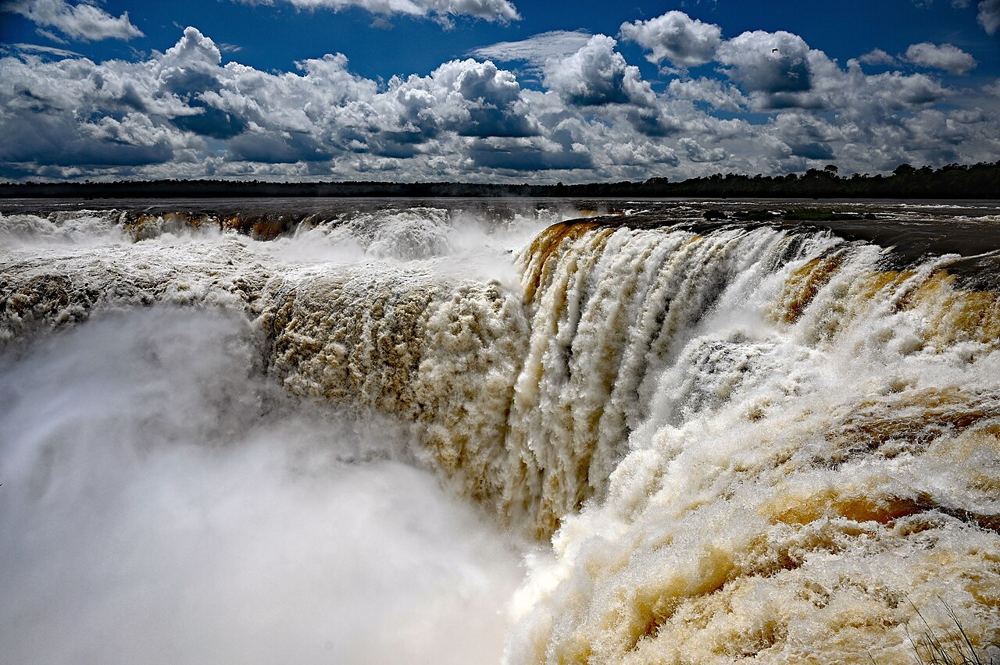
The Iguaçu Falls , nearly three kilometres wide, sit on this border. There the Iguaçu River separates Brazil’s and Argentina’s national parks, UNESCO notes.
Paraguay, with about 6.4 million people in 2025, is tied closely to Brazil by the Paraná River and the Itaipú dam. Electricity was Brazil’s largest import from Paraguay in 2025, worth US$900 million.
Brazil sold Paraguay US$4.0 billion of goods that year, led by machinery and vehicles. The Friendship Bridge links Paraguay’s Ciudad del Este with Foz do Iguaçu in Brazil.
A second crossing, the Integration Bridge, has opened in stages. Private cars from the border towns were due to gain limited access from 14 September 2026, Paraguayan news site RDN reported.
Paraguay’s view of the same frontier is set out in this guide to Paraguay and its neighbours .
Uruguay bought US$3.5 billion of Brazilian goods in 2025. Brazil’s purchases from Uruguay, worth US$2.0 billion, were led by vehicles, cereals and dairy products.
The 1,068 km border lies entirely in Rio Grande do Sul and mixes rivers, lagoons, watersheds and short survey lines. That state holds 11 of Brazil’s 33 official twin towns, facing Argentina or Uruguay.
Brazil neighbours Bolivia along its longest frontier, 3,423.2 km, most of it formed by rivers and canals. The tie that matters most is gas.
The Bolivia-Brazil gas pipeline, known as Gasbol, runs 3,150 km from near Santa Cruz de la Sierra, says TBG , its Brazilian operator. It enters Brazil at Corumbá, has carried gas since July 1999 and reaches south to Rio Grande do Sul.
In 2025 gas made up about 80% of Brazil’s US$1.26 billion in imports from Bolivia. Bolivia is also Mercosur’s newest full member, according to the bloc.
Peru’s 2,995.3 km border runs along Acre and Amazonas states. Brazil exported US$3.2 billion of goods to Peru in 2025 and imported US$1.4 billion.
Colombia meets Brazil only in Amazonas state, along a 1,644.2 km border. Brazil exported US$3.4 billion of goods to Colombia in 2025.
On the Amazon River, the Brazilian twin town of Tabatinga lies in the tri-border area around Leticia, in Colombia. Colombian public broadcaster Canal Trece describes it as the place where Colombia, Brazil and Peru meet.
Colombia’s side of these frontiers is covered in this guide to Colombia and its neighbours .
Almost all of the 2,199 km line with Venezuela follows watersheds rather than rivers, by FUNAG’s figures.
A road crossing links Pacaraima, in Roraima state, with Santa Elena de Uairén in Venezuela. Brazil exported US$838 million of goods to Venezuela in 2025.
Relations changed sharply on 3 January 2026. US forces struck Caracas, and President Donald Trump announced that Nicolás Maduro, Venezuela’s leader, had been captured, Agência Brasil reported.
Delcy Rodríguez has since governed Venezuela as acting president , Agência Brasil reported in June 2026. Caracas-based broadcaster teleSUR still called her acting president on 3 October 2026.
Lula criticised Washington in an interview published on 21 September 2026. “What the United States did to Venezuela is serious,” he said, according to Bahia daily A Tarde .
Guyana, a country of about one million people, shares 1,605.8 km of border with Roraima and Pará. Crude oil made up 99.8% of Brazil’s US$559 million in imports from Guyana in 2025.
Venezuela claims Guyana’s Essequibo region, a dispute before the International Court of Justice (ICJ), the UN’s top court. Brazil neighbours both parties to that dispute.
The court held hearings on the merits from 4 to 11 May 2026 and had not ruled by early October.
Suriname’s 593 km border with Brazil follows watersheds for its whole length. Trade is tiny: Brazil sold Suriname US$55 million of goods in 2025.
French Guiana gives Brazil a 730.4 km border with France, along Amapá state. A bridge over the Oyapock River links the Brazilian town of Oiapoque with French Guiana.
Brazil neighbours Venezuela along Roraima and Amazonas states, and many Venezuelans have crossed into Brazil. The federal government set up Operação Acolhida (Operation Welcome) for them on 28 February 2018.
The programme receives Venezuelans and moves them to other Brazilian cities, the UN refugee agency UNHCR says. By January 2026 it had moved more than 157,000 people from Roraima to 1,121 municipalities.