Solana nears freeze as single provider takes 29% of stake offline
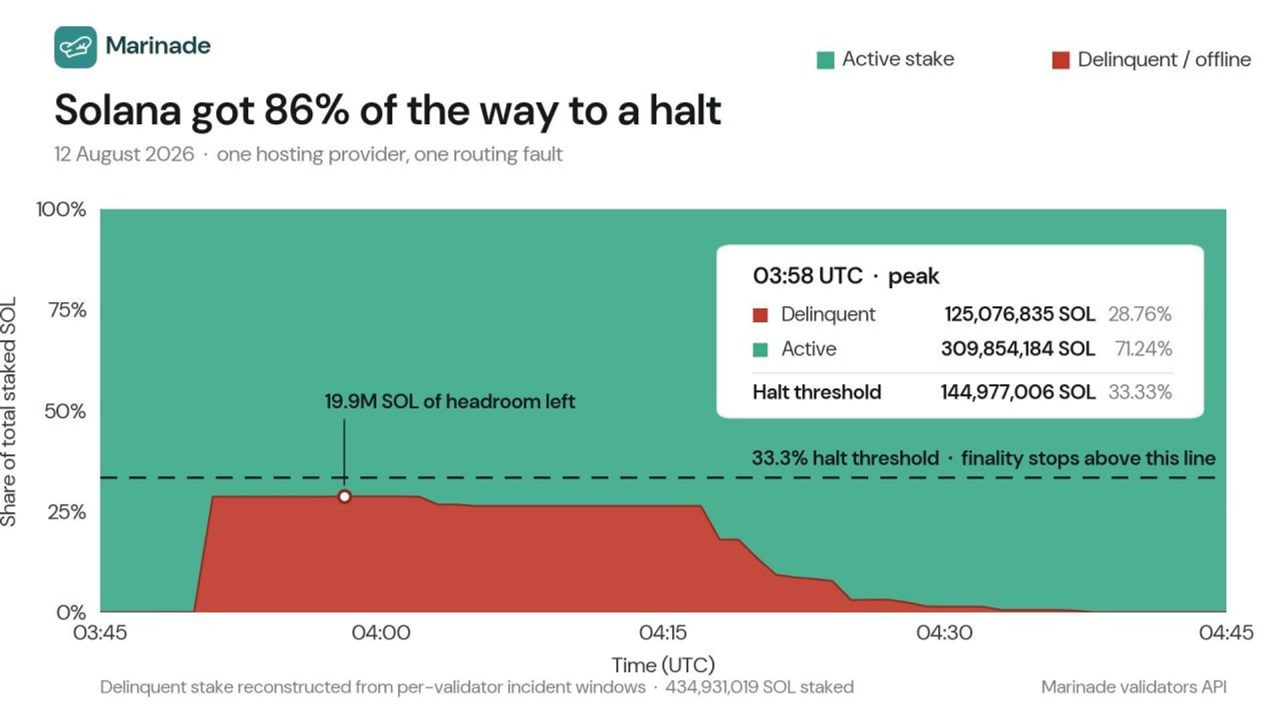
Solana came within 20 million tokens of a full transaction freeze on Wednesday, exposing a dangerous concentration of staked assets in a single data center operator that threatens the network's $4.3 billion DeFi ecosystem.
A routing failure at a major data center provider nearly brought the Solana blockchain to a complete standstill on Wednesday morning. The glitch briefly knocked nearly 29% of the network’s staked tokens offline, leaving it dangerously close to a threshold that would have halted all transaction finalization.
Solana’s architecture dictates that if more than one-third of staked tokens go dark, the blockchain stops processing transactions entirely. Staking platform Marinade Finance noted the network was within roughly 20 million tokens of that critical limit. The blockchain currently hosts $4.3 billion in assets locked across its decentralized finance protocols, all of which would have been rendered inaccessible if the threshold was breached.
The root cause was a bad internet route originating at Teraswitch’s Miami facility before cascading to data centers in London, Amsterdam, Frankfurt, Singapore, and Tokyo. The incident highlighted a severe centralization vulnerability: a single network operator, identified as AS2032, controlled more than a quarter of all staked tokens. This concentration exceeded Solana’s own prescribed safety limits, meaning a single point of failure almost paralyzed the network. Furthermore, backup systems at major validators like Helius failed to activate, leaving them offline for 33 minutes.
Teraswitch resolved the routing issue in about 10 minutes, with traffic fully restored by 4:16 a.m. UTC. Roughly 90 validators lost a combined 333 SOL in rewards, a minor sum that will be covered by validator bonds.
For institutional investors and DeFi participants, the near-miss is a sharp reminder of the physical infrastructure risks underpinning blockchain networks. While Solana markets itself as a faster, cheaper alternative to Ethereum, its history of outages continues to challenge its reliability. The reliance on a single connectivity provider to secure a quarter of a multi-billion-dollar network represents a fundamental structural risk that software upgrades alone cannot fix.