EU population to peak in 2029, squeezing labour markets and regional growth
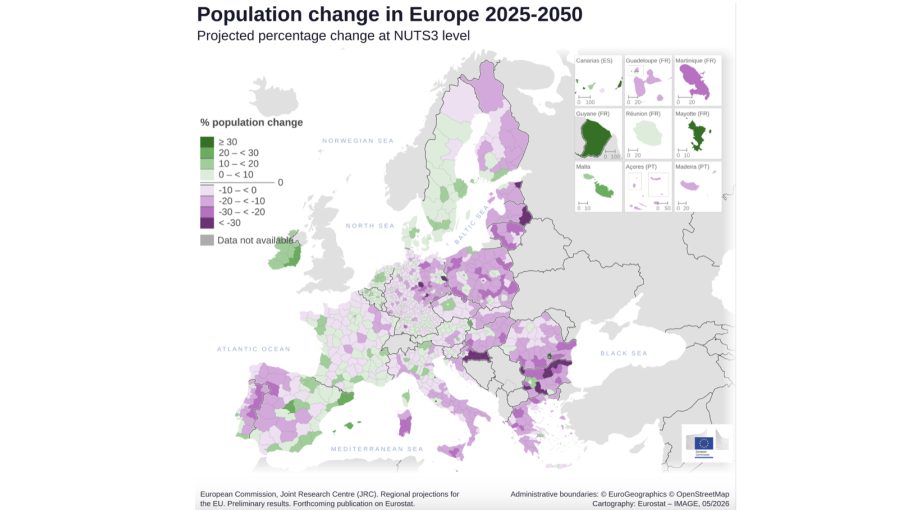
The European Union's population will begin a long-term decline in 2029, threatening to shrink the workforce, strain public budgets and concentrate economic activity in major urban hubs.
The European Union’s population will peak at 453.3 million in 2029 before entering a prolonged decline, falling to 445 million by 2050 and 398.8 million by 2100, according to a European Commission report published on July 14. By the end of the century, the bloc’s population will have contracted by 11.7%, returning to levels last seen in the 1970s. “Europe’s population is currently at its peak,” the Commission said.
The demographic shift carries direct implications for corporate labour pools and sovereign debt. Deaths have outpaced births every year since 2012, with recent population growth driven entirely by migration. As the working-age population contracts, employers will face tighter talent markets, while governments shoulder rising pension and healthcare burdens. By 2050, roughly one in three residents will be 65 or older, up from one in five today.
However, the Commission noted that structural shifts in age create distinct investment opportunities. “The expanding longevity economy opens new markets for products, services and innovations tailored to older citizens, potentially spurring growth and job creation in healthcare, technology and financial services,” the report said. The number of people requiring long-term care is projected to rise from 36 million today to 48 million by 2070.
Regional fracture risks
The decline will not be evenly distributed, creating diverging investment environments across the bloc. Almost three-quarters of EU regions, 837 out of 1,165, are projected to lose population between 2025 and 2050. These areas, home to 258 million people, include eastern Germany, eastern Poland, the Baltics, Bulgaria, Romania, and southern Italy.
Growth will remain concentrated in capital regions, major urban centres, Ireland, southern Sweden, and coastal parts of France and Spain. The Commission warned that this geographic sorting risks a self-reinforcing cycle. “The result is a ‘self reinforcing cycle’ where demographic decline leads to inadequate service provision, which in turn results in further outmigration and demographic decline,” the report said.
The exodus of younger workers from eastern and southern Europe to wealthier northern and western nations exacerbates the regional split. “The departure of young talent from regions and countries facing demographic challenges undermines their economic capacity,” the Commission noted.
To sustain economic output, the bloc will need to pull millions of inactive citizens into the labour market. Currently, 20% of working-age people are outside the labour market and 8 million young people are not in education, employment or training. “Boosting productivity and unlocking untapped talent will be key to addressing the impact of a shrinking workforce,” the Commission said. European Commissioner Dubravka Suica added: “Demographic change is happening now and we have an opportunity to address it head-on.”