Ghana Population 2026, 34.4 Million and Ethnic Groups
Ghana counted 30.8 million people in 2021. Who they are: Akan, Mole-Dagbani and Ewe, a Christian south and Muslim north, and 222,800 in the United States. The post Ghana Population 2026, 34.4 Million and Ethnic Groups appeared first on The Rio Times .
The Ghana population stood at 30.8 million at the 2021 census and is projected at about 34.4 million in 2026. It is young, increasingly urban and made up of nine broad ethnic families that mostly live side by side without open conflict. For US readers, Ghana matters as a stable English-speaking partner and as the home country of one of America’s larger African diasporas.
The most recent full count is the 2021 Population and Housing Census, run by the Ghana Statistical Service (GSS). It recorded 30,832,019 people. Every figure for later years is a projection built on that count.
The GSS official projection for 2026 is 34,378,768 people. It expects 37.2 million by 2030 and 48.2 million by 2045. The World Bank, which draws on United Nations estimates, puts the 2025 population slightly higher, at 35.1 million.
Growth is slowing but remains steady. The World Bank estimates the annual rate at 1.8 percent in 2025, down from 1.9 percent a year earlier. At that pace Ghana adds more than 600,000 people a year.
The 2021 census found 35.3 percent of Ghanaians under the age of 15. Only 4.3 percent were 65 or older. People of working age, from 15 to 64, made up 60.4 percent.
World Bank data put the fertility rate at 3.3 births per woman in 2024 and life expectancy at birth at 65.7 years. Both point to a population that keeps growing for decades, even as families get smaller.
In July 2026 the GSS reported that about 2 million people aged 15 to 35 were not in education, employment or training. That was 19.5 percent of young Ghanaians in the third quarter of 2025, Citi Newsroom reported. Jobs for school leavers are a central test for any government in Accra.
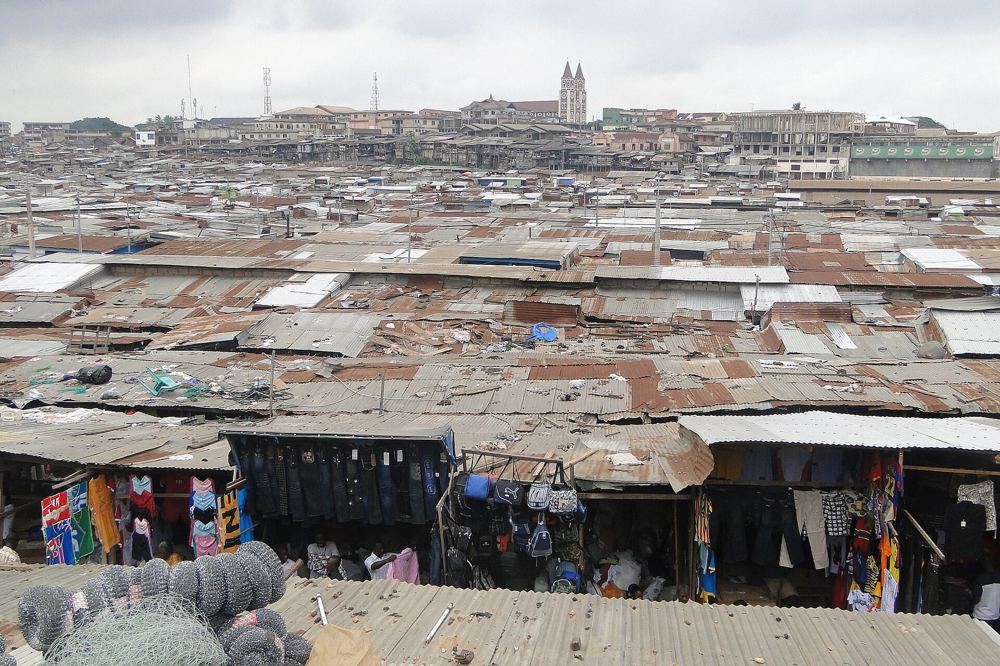
Most Ghanaians already live in towns and cities. The 2021 census counted 17.5 million urban residents, 56.7 percent of the total. The GSS projects an urban share of 59.1 percent for 2026 and about 65 percent by 2045.
Ghana is divided into 16 regions. Greater Accra, around the capital, was the most populous in 2021 with 5,455,692 people. Ashanti, centred on the city of Kumasi, was a whisker behind at 5,440,463.
GSS projections for 2026 put Greater Accra at 6.3 million and Ashanti at 5.8 million. Together the two regions hold about 35 percent of all Ghanaians. The five northern regions, from Savannah to Upper West, had 5.8 million people in 2021, under a fifth of the total.
The census asks Ghanaian nationals for their ethnic group, then sorts the answers into nine broad families and an “other” category. The base is 30.5 million people. Each family contains many peoples with their own languages, chiefs and festivals.
Accra is the great mixing ground. Akan make up 41.1 percent of Greater Accra residents, Ga-Dangme 24.6 percent and Ewe 20.2 percent. Internal migration, intermarriage and city life have made modern Ghana steadily more integrated, as Modern Ghana noted in September 2026.
English is the official language. It is used in government, the courts, formal education and much of the media. Akan languages are the most widely spoken Ghanaian languages.
The Bureau of Ghana Languages, a state agency, focuses its publishing and standardisation work on 11 languages. They are Akuapem Twi, Asante Twi, Fante, Ewe, Dagbani, Dangme, Dagaare, Ga, Nzema, Kasem and Gonja.
These are the government-supported languages used in schools. Many more are spoken by smaller communities. For a visitor or investor, English is enough to deal with officials, courts and contracts.
The 2021 census recorded 71.3 percent Christians and 19.9 percent Muslims. Traditional religion was followed by 3.2 percent, and 4.5 percent said they had no religion.
Within Christianity, Pentecostal and Charismatic churches form the largest bloc, at 31.6 percent of the population. Protestants, such as Anglicans, Methodists and Presbyterians, follow at 17.4 percent, then Catholics at 10.0 percent.
Geography shapes faith. Muslims are majorities in the Northern (66.5 percent), Savannah (64.1 percent) and North East (61.2 percent) regions. Upper West is split almost evenly, at 46.0 percent Christian and 45.2 percent Muslim.
In Greater Accra, 84.4 percent of residents are Christian. Traditional religion is strongest in Upper East, at 17.5 percent of residents.
Ghana is also a destination. The 2021 census counted 294,341 residents with a foreign nationality, under 1 percent of the population. Most of them, 204,663, came from other members of ECOWAS, the West African economic bloc.
Nigerians were the largest group at 76,961, followed by Togolese at 60,349 and Burkinabé at 46,953. Only 2,787 residents held a nationality from the Americas.
The US Census Bureau’s American Community Survey estimated 222,781 Ghana-born people in the United States in 2024. The margin of error is about 13,000. That is roughly one in five of the 1.15 million US residents born in West Africa.
In the same survey, 246,089 US residents reported Ghanaian ancestry, a count that includes US-born children of immigrants. Migration is also a diplomatic file: in 2025 Ghana agreed to receive West African nationals deported from the United States. In September 2025, 11 such deportees challenged their detention before the Accra High Court, the Ghana News Agency reported.
The 1992 constitution was written to keep ethnicity out of party politics. Article 55(4) says every party must have a national character. Membership may not rest on ethnic, religious, regional or other sectional divisions.
Article 35 commits the state to prohibit discrimination on grounds of ethnic origin and to foster loyalty to Ghana over ethnic loyalties. Chiefs keep real weight: under Article 106, no bill affecting chieftaincy may enter Parliament before referral to the National House of Chiefs.
Voting still has a regional shape. In December 2024 Mahama won 56.42 percent of the presidential vote against 41.75 percent for Mahamudu Bawumia, according to the Electoral Commission.
Mahama represents the National Democratic Congress (NDC), the centre-left party founded by former leader Jerry Rawlings. Bawumia, vice-president from 2017 to 2025, leads the New Patriotic Party (NPP), the centre-right, pro-business opposition. He won its January 2026 primary to stand again in 2028.
Citi Newsroom’s region-by-region breakdown shows the pattern. Volta, the Ewe heartland, again voted overwhelmingly for Mahama’s NDC. Ashanti, the Akan heartland, again delivered overwhelming support for the NPP.
The sharpest local conflict is in Bawku, in the Upper East Region, where Kusasi and Mamprusi communities dispute the town’s chieftaincy. On 26 August 2026 Mahama unveiled a five-member committee to oversee a Bawku Revitalisation Fund, the Ghana News Agency reported.
The exact current population. Every figure after 2021 is a projection, and the GSS and World Bank numbers differ by several hundred thousand people. Only the next census will settle it.
How ethnic and religious shares have moved since 2021. Migration to cities and the growth of Pentecostal churches may have shifted them, but no newer national count exists.
The full size of the diaspora. There is no complete official count of Ghanaians abroad, and US figures are survey estimates with margins of error.
Whether peace in Bawku will hold. The revitalisation fund is new, and long-running chieftaincy disputes of this kind can flare again.
The Ghana Statistical Service projects 34,378,768 people for 2026, based on the 2021 census count of 30,832,019. The World Bank estimated 35.1 million for 2025.
The Akan, at 45.7 percent of Ghanaian nationals in the 2021 census. They include the Asante, Fante, Akuapem, Akyem and Bono. The Mole-Dagbani, at 18.5 percent, and the Ewe, at 12.8 percent, come next.
English is the official language, and Akan languages are the most widely spoken. The Bureau of Ghana Languages supports 11 Ghanaian languages, including Asante Twi, Fante, Ewe, Dagbani and Ga.
Mostly Christian. The 2021 census recorded 71.3 percent Christians and 19.9 percent Muslims. Muslims are majorities in the Northern, Savannah and North East regions.
The US Census Bureau estimated 222,781 Ghana-born residents in 2024, with a margin of error of about 13,000. In the same survey, 246,089 people reported Ghanaian ancestry.
Greater Accra, with 5,455,692 people in 2021, narrowly ahead of Ashanti at 5,440,463. The statistics office projects 6.3 million and 5.8 million for 2026.
Sources: Ghana Statistical Service, 2021 Population and Housing Census and population projections, StatsBank (https://statsbank.statsghana.gov.gh/pxweb/en/PHC%202021%20StatsBank/); World Bank, World Development Indicators (https://data.worldbank.org/country/ghana); US Census Bureau, American Community Survey 2024, tables B05006 and B04006 (https://www.census.gov/programs-surveys/acs); Electoral Commission of Ghana, 2024 presidential results (https://ec.gov.gh/2024-presidential-election-results/); Constitution of the Republic of Ghana, 1992 (https://www.constituteproject.org/constitution/Ghana_1996); Office of the President (https://presidency.gov.gh/); Ghana News Agency (https://gna.org.gh/2026/08/president-mahama-unveils-bawku-revitalisation-fund-committee/ and https://gna.org.gh/2025/09/11-deportees-from-us-of-west-african-origin-challenge-their-detention-in-ghana/); Citi Newsroom (https://www.citinewsroom.com/2026/07/nearly-2m-young-ghanaians-out-of-school-work-and-training-gss/ and https://www.citinewsroom.com/2024/12/election-2024-a-breakdown-of-how-the-16-regions-voted/); Modern Ghana, “Many Peoples, One Nation”, 24 September 2026 (https://www.modernghana.com/news/1530553/many-peoples-one-nation-ghanas-rich-ethnic.html). All accessed 11 October 2026.