Itaipú Dam Explained: Who Owns It, Who Pays, and Why Brazil and Paraguay Still Argue
Itaipú Dam explained: how the Brazil-Paraguay giant works, who pays for its power, what Annex C is and why the tariff deal expiring in 2026 matters. The post Itaipú Dam Explained: Who Owns It, Who Pays, and Why Brazil and Paraguay Still Argue appeared first on The Rio Times .
Itaipú has produced more electricity than any other power plant in history, and it is Paraguay’s main bargaining chip with Brazil. Two governments, not a market, set its price, so every renegotiation tests relations between South America’s giant and a much smaller neighbour.
Paraguay is a landlocked country of about 6.4 million people, and Brazil is its much larger neighbour to the east. This guide explains how their shared dam works, who pays for its power, what Annex C means and what happens after 2026.
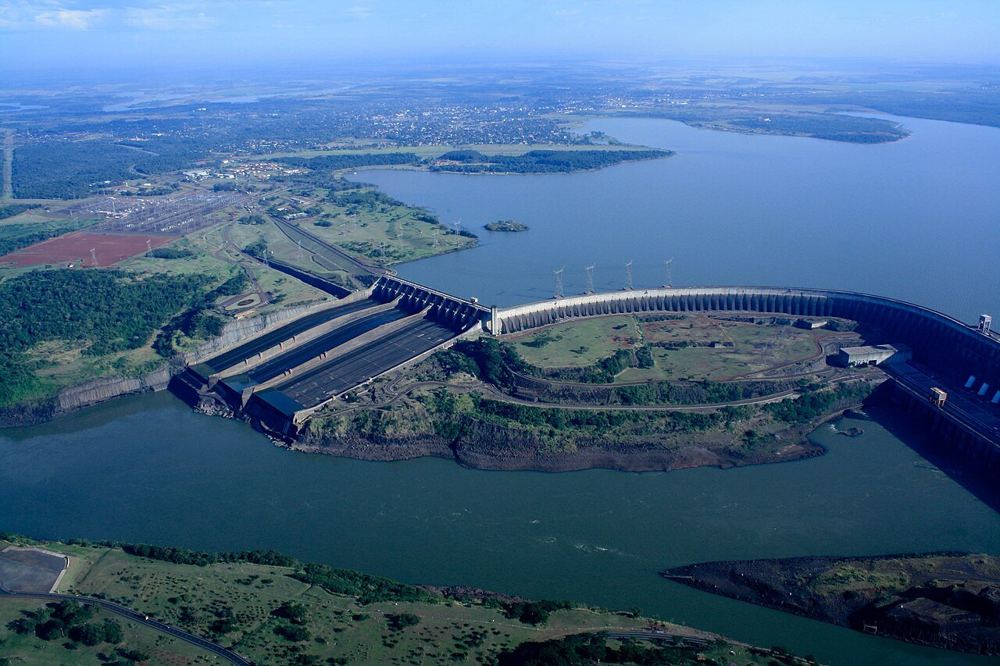
Itaipú is a hydroelectric dam on the Paraná River, which forms the border between Brazil and Paraguay. It stands between the Brazilian city of Foz do Iguaçu and the Paraguayan town of Hernandarias.
The plant has 20 generating units of 700 megawatts each, giving it an installed capacity of 14,000 megawatts. Ten units run at 50 hertz for Paraguay’s grid and ten at 60 hertz for Brazil’s, which uses a different standard.
Its best year was 2016, when it produced 103,100 gigawatt-hours, and it generated about 83,800 gigawatt-hours in 2023. Itaipú Binacional says the plant has produced more than 3 million gigawatt-hours since 1984, more than any other in history.
The dam itself is 7.9 kilometres long and up to 196 metres high. Its reservoir stretches about 170 kilometres along the river and covers 1,350 square kilometres.
Itaipú Binacional, the company that runs the dam, belongs equally to both states, and each country owns half of the electricity produced. Every senior post has a counterpart from the other country, and the 12-member supervisory board splits seats six and six.
Paraguay buys its share through ANDE, the state electricity utility. In August 2026 ANDE’s head, engineer Miguel Báez Reyes, joined Itaipú’s board for the Paraguayan side, Última Hora reported.
Brazil and Paraguay signed the Itaipú Treaty on 26 April 1973, when both countries were ruled by military dictatorships. Itaipú Binacional says the treaty also settled a border dispute over the Paraná that had lasted more than a century.
Construction ran from 1975 to 1982 and employed up to 40,000 Brazilian and Paraguayan workers at its peak. The first unit began generating in 1984, 18 units were running by 1992, and the last two were added in 2007.
The project also had a heavy human cost, especially for indigenous people. Brasil de Fato, a left-leaning Brazilian outlet, reported that over 42,000 people were removed, including Avá Guarani indigenous communities.
The reservoir also drowned Sete Quedas, a chain of giant waterfalls at Guaíra on the Brazilian side. “The Itaipu company was built with Avá Guarani blood”, community leader Vilma Rios told Brasil de Fato in 2025.
Indigenous land claims linked to the flooding remain open in Brazil. In February 2025 Brasil de Fato reported an Itaipú offer to buy 3,000 more hectares, against a claimed area of 24,000.
Itaipú paid off its construction debt on 28 February 2023. With the loans gone, the main reason for a high tariff disappeared, and the fight over what to charge began.
Itaipú does not sell power on an open market. Instead, utilities pay a tariff set by both governments, in US dollars per kilowatt of contracted capacity per month.
The rules sit in Annex C of the treaty, which sets the plant’s financial bases, energy prices and how costs are shared. Brazilian news site Poder360 noted that the 1973 treaty foresaw an Annex C review after 50 years, from 2023 onward.
The most contested rule concerns energy that one country does not use. Under Annex C, a partner not using its full half must sell the surplus to the other at a set price.
In practice that has meant Paraguay selling much of its share to Brazil for decades. Paraguayan news site El Prisma reported that Paraguay used 38.8% of Itaipú’s output in 2024, with demand rising 8% a year.
The tariff is in dollars, and on 29 September 2026 US$1 bought about 5,850 guaraníes, Paraguay’s central bank reported. In Brazil, US$1 bought about 5.22 reais that day, according to the central bank.
In August 2022 the two governments cut the tariff by 8.2%, from US$22.60 to US$20.75 per kilowatt-month. It was the first reduction in 13 years , and Brazil had pushed for an even lower figure.
In May 2024 the two governments agreed a new tariff of US$19.28 per kilowatt-month, fixed for 2024, 2025 and 2026. Infobae noted that the rate had been US$16.71 per kilowatt-month in 2023.
Paraguay’s Foreign Ministry said the deal would bring the country about US$1.25 billion a year. That total included about US$280 million in royalties, US$650 million for social investment and US$265 million in compensation for ceded energy.
President Santiago Peña called the agreement “a triumph for Paraguay and for Brazil”. Foreign Minister Rubén Ramírez Lezcano described it as a “qualitative and quantitative leap” for Paraguay’s development.
The deal also allowed Paraguay to sell power from its own smaller Acaray plant on Brazil’s free electricity market. El Prisma reported that sales of Paraguay’s Itaipú energy to Brazilian buyers were set to begin on 1 January 2027.
Brazilian consumers carry most of the cost, because Brazil takes most of the energy. Canal Solar, a Brazilian energy-industry outlet, reported that Brazilian consumers bear roughly 80% of the plant’s total costs.
To soften the bill, Itaipú’s Brazilian side committed about US$285 million in 2026, Canal Solar reported. That keeps the effective rate for regulated customers in the south, southeast and centre-west at US$17.66 per kilowatt-month.
The 2024 agreement states that from 2027 the tariff should reflect only the plant’s strict operating costs, without discretionary spending. That sounds technical, but it could cut Paraguay’s income sharply.
Energy journalist Silvana Bogarín told El Prisma that Brazil wants the tariff to fall to around US$9 after 2026. Brazil’s line, as El Prisma summarised it, is that the tariff should cover only operating costs from January 2027.
Paraguay wants the opposite outcome, plus the right to sell its surplus to any buyer at market prices. In January 2026 Peña rejected tariff cuts after 2026, citing “historical debts” owed to Paraguay, Canal Solar reported.
Infobae quoted Peña in March 2026 saying, “I am the principal negotiator”, and promising never to take a sell-out stance. For Peña, Itaipú money pays for infrastructure, health, education and the social spending his government highlights.
Some Paraguayan critics say the government has still conceded too much. Engineer Ricardo Canese, a veteran critic of the treaty, called the 2024 deal “another surrender policy” by the government.
Other open items include upgrading the turbines, compensation for the lost waterfalls and navigation locks on the river, Bogarín told El Prisma. None of these points has been settled in public as of September 2026.
Talks broke down in 2025 after the Brazilian news portal UOL reported that ABIN, Brazil’s intelligence agency, had hacked Paraguayan officials. According to Cenário Energia, the operation was approved in June 2022 under President Jair Bolsonaro and continued into Lula’s term.
Lula’s government said it ordered the operation stopped once it learned of it in March 2023. Paraguay suspended the Annex C talks on 1 April 2025 and recalled its ambassador from Brasília for consultations.
A target date of 30 May 2025 for a new Annex C passed with talks frozen, Última Hora reported. Brazil’s Mines and Energy Minister Alexandre Silveira warned that the missed deadline could put the agreed US$19.28 tariff at risk.
The crisis ended on 17 November 2025, when Brazil’s foreign minister Mauro Vieira handed Asunción a report on the spying. InfoMoney reported that Paraguay declared the matter closed and agreed to restart negotiations in December 2025.
On 19 March 2026 the foreign ministers met, and Ramírez said talks were “advancing substantially” towards a near-term deal. Days later Peña and Lula met in Campo Grande, Brazil, and pledged to finish the review “rapidly”, Infobae reported.
In June 2026 Peña again said the talks “are advancing”, according to Última Hora. As of late September 2026, no new Annex C or post-2026 tariff has been announced.
For Paraguay, Itaipú is the basis of an investment pitch built on cheap, clean and plentiful electricity. Our guide to Paraguay’s economy for investors explains how energy, low taxes and farm exports fit together.
Energy-hungry projects such as data centres depend on how much of its share Paraguay can keep and at what price. In May 2026 Paraguay and Taiwan signed a memorandum on a jointly owned AI computing hub powered by Paraguayan hydropower.