Makinde tackles Tinubu over new Army divisions funding in 2026 budget
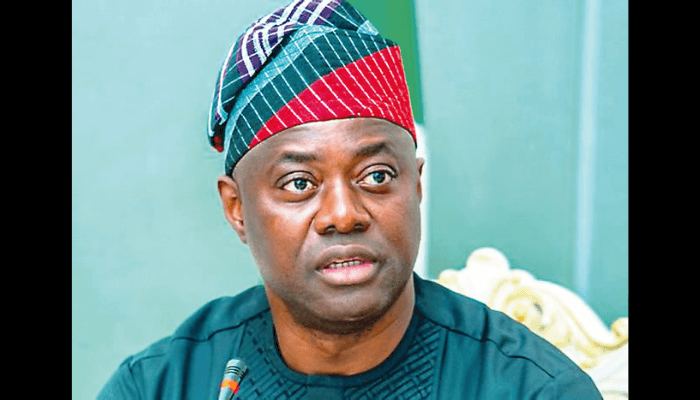
Seyi Makinde, the presidential candidate of the Allied Peoples Movement, has challenged the Federal Government to produce the 2026 budgetary read more Makinde tackles Tinubu over new Army divisions funding in 2026 budget
Seyi Makinde, the presidential candidate of the Allied Peoples Movement, has challenged the Federal Government to produce the 2026 budgetary provision for the expansion of the Nigerian Army from eight to 12 divisions, questioning the planning and funding of the move amid worsening insecurity in the North-Central.
Makinde, who spoke on Monday at the APM North-Central Town Hall Meeting in Lafia, Nasarawa State, said he searched the 2026 budget for the provision relating to the expansion of the Army divisions but could not find it.
He therefore challenged the Federal Government to show Nigerians where the expenditure was captured in the budget.
“Midway into 2026, just about June or July this year, yes, insecurity is a big issue, especially here in the North-Central Zone of Nigeria. They (APC-led Federal Government) expanded army divisions to 12.
“I was looking at the budget for 2026. I was looking for the item in that budget relating to the expansion of those army divisions. I did not see it,” Makinde said.
Read also: APM accuses Tinubu of abdicating presidency to cabal, backs Makinde
The Federal Government had in July announced the expansion of the Nigerian Army from eight to 12 divisions, with new divisions approved for Makurdi, Ilorin, Jalingo and Benin City.
The Presidency said the expansion was intended to decentralise operational decision-making, strengthen border security and improve the military’s response to emerging threats.
But Makinde questioned whether the expansion was sufficiently backed by a financial and operational plan.
“If they have it in the budget that they prepared for 2026, let them bring it out. So, you cannot just wake up and say, well, without any plan, I am setting up or expanding army divisions to tackle insecurity,” he said.
`The APM candidate’s criticism comes against the backdrop of the Federal Government’s stated security spending priorities.
President Bola Tinubu’s 2026 budget speech allocated N5.41tn to defence and security and identified modernisation of the Armed Forces, intelligence-driven policing, border security and technology-enabled surveillance among the government’s priorities.
The Presidency has also said the Army expansion would be implemented in phases, with the establishment of the 5, 9 and 10 Divisions and reorganisation of existing formations scheduled for completion by September 2026, while the new 83 Division and further reorganisation were scheduled for completion by December.
Makinde, however, argued that expanding military formations without clearly identified funding and planning would not adequately address insecurity.
He contrasted the Federal Government’s approach with the budget preparation process in Oyo State, saying his administration had already begun preparations for the 2027 budget through consultations across the state.
“If you go to Oyo State today, as I’m talking to you, we have started the process of preparing the 2027 budget.
“What we normally do is go around the geopolitical zones in the state to listen to them, to know what they would like us to include in the budget.
“This is what we have been doing for the past seven years,” he said.
Makinde also questioned whether increased revenue accruing to state governments had translated into relief for Nigerians, particularly in the face of hunger.
“Yes, they claim we have more money, that is, the state governments. The state governments were collecting more money from the Federation Account. I am not arguing with that.
The Oyo governor said his administration had reduced the state’s dependence on federal allocation after assuming office in 2019, but claimed the dependence had subsequently risen again.
Makinde added, “Then, by 2023, when they came on board with their voodoo economy, the resultant effect is that today Oyo State is back to almost 80 per cent dependence on federal allocation. That is their voodoo economy.”
The APM candidate also used the town hall to outline his proposed “Reset Nigeria” agenda, saying his administration would introduce a new security architecture if elected president in 2027.
“The reset agenda can be completed in four years. After all, we had someone who was head of state in this country for 10 months, and he was able to end military rule and usher in the democracy that we now enjoy in Nigeria,” Makinde said.
“So, we can reset this country, reset and give Nigeria a new security architecture, reset and give Nigeria a new path for education, reset our economy utilising data, science and logic, and reset our socio-political environment in four years. That is our agenda.”
He further promised that an APM administration would run a transitional government of national unity.
“So, as your President from May 29, 2027, we will run a transitional government of national unity that will culminate in new players and a new agenda for Nigeria’s sustainable development,” he said.
Read also: Rising oil prices threaten Africa’s disinflation gains
Lawal Daura, APM vice-presidential candidate, said the party was seeking to offer Nigerians a different approach to governance, particularly on insecurity and poverty.
“We don’t need to say that, for quite some time, people have been given the opportunity to rule this nation without really having an idea of how to fix it. I need to borrow a common phrase: it is always motion without movement. Ours is going to be motion with movement for the betterment of Nigerians and Nigeria,” Daura said.
Yusuf Dantalle, APM national chairman, also identified insecurity as one of the major challenges facing the North-Central, while criticising the state of infrastructure in the region.
“North Central is very strategic and instrumental to the unity and progress of this country. We are the bridge region between the South and the North, and we have a lot to do to fix Nigeria,” Dantalle said.
He added, “Successive and current administrations of Nigeria might be doing their best, but their best is not enough. It is not translating into development. For that reason, we can’t continue to do the same thing and expect different results. If we must get different results, we have to do something different.”



