ECB's Makhlouf on Inflation, Economy, Rates
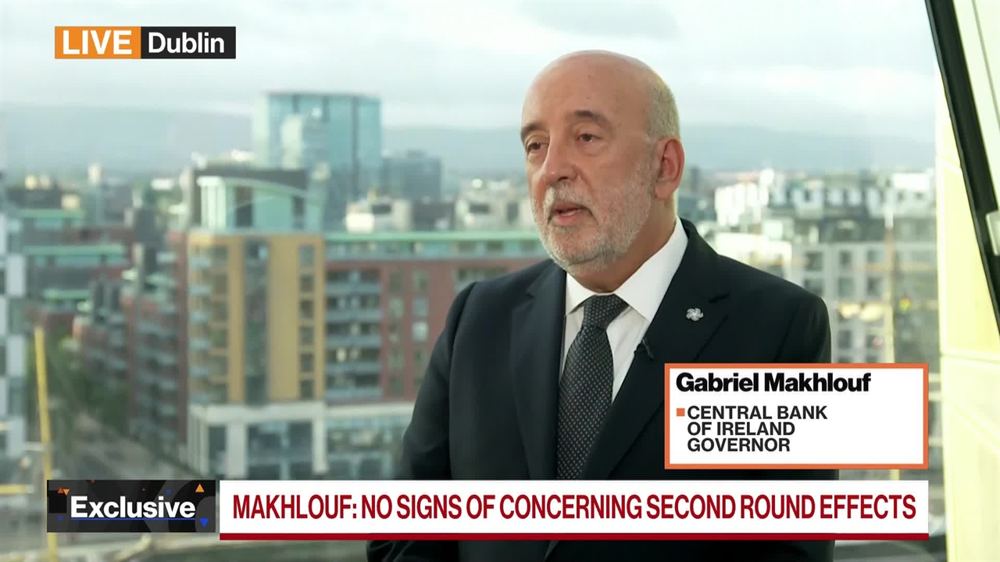
ECB Governing Council member Gabriel Makhlouf discusses the outlook for inflation, the economy and interest rates. "At a time of uncertainty, every meeting is a live meeting for the European Central Bank," the Irish central-bank chief told Bloomberg Television when asked whether there is a chance of an interest-rate hike in October if circumstances require it.
So, I just want to speak to you now about where we are on the sort of energy shock situation. We're well above $100 a barrel on oil. We're talking about gas prices in Europe that are the highest that they've been since, you know, 2022 thereabouts. Um, how are you viewing the inflation picture developing now and critically, do you still see it segregated to the first round effects?
Well, at the moment, we're certainly uh not seeing signs of uh concerning second round effects, but it's pretty clear that um the uh shock, uh the energy shock that started with the war in Iran, um isn't going away very quickly. Um and we must't forget there's also a war in Ukraine, which the Russians started uh four years ago, that is ongoing, and is also causing a shock to to energy. So, I mean, at the moment, the outlook is uncertain. I mean, what we discussed at the ECB at our last meeting was essentially the risks to inflation remain on the upside.
And does that mean that the the probabilities of a rate hike even in the shorter term are relatively high? Before that ECB decision, there was basically the October meeting was discounted. We're now at 50/50. Do you think that October is a live meeting for the European Central Bank?
I think at a time of uncertainty, every meeting is a live meeting for the European Central Bank. I mean, for a while now, our policy has been uh to approach uh the whole the whole issue of monetary policy at a meeting by meeting basis, um looking at the data, looking at the evidence. So uh we're not on a predetermined rate path, uh which means that you can't rule out anything that might happen in future meetings. Uh nor can you rule them in.
Mm. But looking at the sort of market pricing over the next 12 months, they're anticipating, you know, some, you know, upwards of three to four hikes. That's an additional percentage point on the sort of benchmark deposit rate here in Europe. That is a substantial material increase. Do you think that that is a possibility? Is that the market pricing that correctly with current ECB thinking?
Well, I think I mean, I'm always keen to let markets do what they want to do uh and not to interfere with markets. I mean, the one thing that uh I I mean in my view, uh that's indicating is markets understand uh that we're committed to delivering our 2% inflation target. And at the moment, uh the numbers aren't as strong as we want them to be. Um but otherwise, uh I'm not uh in the business of saying whether the markets are right or wrong.
Well, thinking about the benchmark rate now at two and a half percent that has been suggested by a number of people at the ECB that that is really the upper limit of the neutral rate for the European Central Bank. The last decisions, the two in this hiking cycle have been achieved unanimously at the European Central Bank. Do you believe that another rate takes us into restrictive territory and do you think that that means that there's going to be a more active debate within the governing council?
Well, I think there's always an active debate actually within the governing Council on on the evidence and what we're seeing. Um even when we are unanimous, there's an active debate and active discussion. I mean, in my view, where we are now remains within uh the neutral uh band. Um but I don't uh in uh again, uh whether we're in neutral restrictive territory, our focus is on are we uh delivering policy that's actually going to achieve our 2% inflation target.
Uh to be honest, I mean I think it depends on uh I mean there's theory of neutral rates. Uh but then there's also the judgments that we have to exercise in uh making our monetary policy decisions. So I'm not uh really going to go into uh is there a fine is there a defining moment when we're restrictive or not?
And thinking about that stagflationary conversation that obviously began with the beginning of this energy shock, wanted to sit for a moment on the stag side of that conversation. How concerned are you about growth, um and sort of, you know, it's an aggressive hiking cycle so far. Do you consider, I mean, where do you take that into the calculus?
Well, we're we're moving at an at a measured pace. And I think that's the important thing. I mean, it's quite clearly um the uh not just the European economy but the global economy could do without having the sort of war in uh in in the Gulf. But um one of the things that surprised us at our last meeting is the resilience that the economy has shown, driven uh to uh a certain extent by consumer confidence rebounding from low levels admittedly, extra defense spending, extra spending on infrastructure. So the European economy is uh performing more robustly, I should say than perhaps we may have thought a few months ago.
Yeah, and that was evident at the last meeting when you discussed, you know, the growth forecast being raised and of course the inflation forecast also being raised. So sort of dissipating a bit of that stagflationary story. But it seems to me that a lot of that resilience is dependent on a narrative, one thing that's holding up the sort of global economy. There's one very positive story. There are a ton of negative stories. That is the AI build out, technology um and everything around that and also the unlocking the productivity games around that. A lot has been priced into that, probably not all 100% correct. How concerned are you about potentially an unwind of A, what has been a huge move of capital, but B, also one of the only sort of positive macro narratives we've got right now?
I mean, there's there's more than just AI, I should say. I mean, as I just said, I mean, I think what we're seeing on infrastructure, investment, what we're seeing on defense. I mean, these are playing big roles. But certainly AI, um my own view is that we have to pay very close attention to what's happening there, that uh we are uh at risk of uh stretched valuations, um uh rebounding. Um but uh overall, it remains, I think, a positive story. So, uh but it it requires vigilance.
So you you you you've highlighted some of the risks within the pricing there on that side. I want to talk about some of the risks in the bond market where we have yields across the world, certainly across Europe, the highest we've seen since the financial crisis. What is the bond market telling you?
Well, the bond market is telling me that there's a complex macro picture out there and when people look at the sort of longer term, um they have concerns. I mean, our focus at the ECB actually is on our medium-term inflation target and bond, long-term bond yields don't necessarily uh directly uh impact uh the uh the medium term.
But is there a risk of hiking into that environment? How do you appraise that risk?
Well, I think we need we'd need to continue doing what we're doing, which is looking at um how uh you know, what the inflation outlook is showing, what's happening to the underlying dynamics of uh inflation and the strength of monetary policy transmission and being focused on our 2% medium-term target.
Okay. Well, Governor McGloth, thank you so much for your time this morning, speaking there on the sidelines and beginning that Euro group and Ecofin summit here in Dublin over the next couple of days.