RBL Bank: is investor frenzy over FCNR (B) deposits justified?
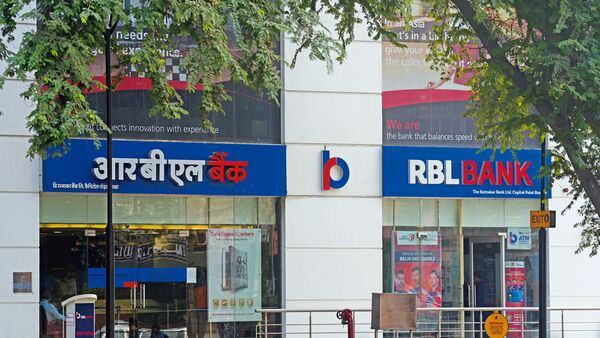
RBL Bank’s stock surge reflects investor excitement over its FCNR(B) inflows, which have expanded deposits and boosted lending capacity. Yet the benefits may take time to materialize, and questions remain about whether this windfall can substitute for building a domestic deposit base.
RBL Bank stock hit a new 52-week high on Wednesday, and has gained nearly 9% in September so far to ₹ 412.50. The rally comes after RBL raised ₹ 32,472 crore in FCNR(B) deposits under the scheme, which ended on 31 August, wherein the Reserve Bank of India (RBI) covers the hedging costs.
No doubt, RBL stands to gain materially from the funds raised in two ways. One, the deposits have substantially expanded the bank's total deposit base by 26%, from ₹ 1.25 trillion at the end of the June quarter (Q1FY27). In comparison, rival IDFC First Bank also raised ₹ 33,975 crore under FCNR(B), increasing its total deposit base at a comparatively lesser rate of 11%. Notably, RBL has shared the break-up of unleveraged and leveraged deposits (money mobilized by giving loans against deposits), a data point that others have not disclosed.
Two, 75% of RBL’s deposit base consists of term deposits at an average cost of 7.07%. Given that RBL offered interest rates between 6.25-6.35% for deposits lasting three to five years, FCNR (B) deposits are likely to lower the overall cost of term deposits for the bank.
RBL has already used ₹ 10,309 crore as collateral for lending against FCNR(B) deposits. So, the net inflow on account of FCNR (B) available for either repaying existing term-deposits or for fresh lending is ₹ 22,163 crore. FCNR(B) deposits are exempt from the Cash Reserve Ratio (CRR) and Statutory Liquidity Ratio (SLR) requirements. So, the entire FCNR(B) deposits can be used for lending, with the average yield on advances at about 11.2% based on Q1FY27. The lending could fetch a net interest spread of about 5%. Consequently, the net interest income (NII) could get a boost of ₹ 1,100 crore per annum, which is about 15% of the likely NII of FY27 based on the annualized NII of Q1FY27. However, a caveat here. The full positive impact is unlikely to reflect in FY27. In fact, NII in FY27 could be adversely affected because interest on FCNR(B) must be accounted for immediately, whereas deploying those funds for lending could take some time.
While RBL’s FCNR(B) fund raise solves the liability growth issue for some time, it does not take away the need to build a sustainable domestic deposit franchise. Funds raised from deposits or other sources serve as raw material for lenders and increase their lending capacity, but the cost of raising funds must be attractive.
RBL might have to expand its branch network to grow deposits, as its current network of 628 branches is about half of similar-sized banks such as IDFC First and Yes Bank . The counterargument is that besides online banking, RBL has a large number of about 1,339 business correspondent branches that could lead to deposit mobilization without incurring the cost of setting up full-fledged branches.
Deposit growth will be critical to driving earnings growth, and earnings are used to arrive at valuation under the dividend-discounting model (similar to discounted cash flow). For now, RBL trades at 21x FY28 earnings estimates of ICICI Securities, a significant premium over IDFC First Bank’s 12x and Yes Bank’s 14x. So, the earnings boost from FCNR(B) might have been adequately priced into RBL’s valuation.