Buying Property in Argentina as a Foreigner Legal Rules
Buying property in Argentina as a foreigner is free in cities. Rural land still sits under Law 26.737, which survived repeal and reform. The post Buying Property in Argentina as a Foreigner Legal Rules appeared first on The Rio Times .
, The stakes. Foreigners can freely buy urban property in Argentina, but rural land carries nationality-based caps and security-zone checks under Law 26.737., The process. An escribano handles title review, the boleto de compraventa preliminary contract, the escritura pública, and registration at the property registry., The money. Physical US dollars still anchor most closings, while Milei-era liberalisation has widened formal payment channels without ending the dollar habit., The costs. Stamp tax, notary fees, and registry fees dominate closing costs, with total burden varying by province and first-home status in CABA., The yields. Palermo and Belgrano sit above USD 3,000 per square metre on the August 2026 index, Recoleta a little below, and Puerto Madero runs between roughly USD 5,800 and USD 6,300 on second-quarter used-apartment data.
Argentina’s property market remains one of the few Latin American urban real estate sectors where a foreigner can enter without nationality-based restrictions. Yet the legal simplicity of buying a Buenos Aires apartment conceals a dollar-driven closing culture, a notary-centred process, and a separate rural land regime that still trips up unwary buyers.
Foreigners may acquire urban property in Argentina freely, including apartments and houses in Buenos Aires and other cities. No nationality-based prohibition applies to city real estate.
The main legal exception concerns rural land. Law 26.737, the Rural Land Ownership Law, imposes quantitative limits on foreign ownership of rural land nationally and by jurisdiction. Its status is the point most often reported wrongly. Milei’s DNU 70/2023 purported to repeal it outright in December 2023, but that repeal was suspended by a court injunction, and the government’s own portal states that the law’s force was restored by a precautionary measure that remains in effect. A further attempt in 2026 to raise the foreign ceiling from 15 to 25 percent was withdrawn from the property bill on 5 August 2026 for lack of Senate votes, and the bill passed the next day without it. The 15 percent national cap therefore still applies.
The rural-land regime is a restriction with caps and territorial limits, not a total ban. It also affects certain border and security-area transactions through authorisation or special-review rules.
Buyers must therefore distinguish clearly between urban purchases, which remain generally permitted, and rural parcels, where eligibility may depend on nationality quotas and location. Before buying any land outside urban zones, a buyer should confirm whether the plot falls within a restricted border or strategic area requiring special approvals or certificates.
The escribano, a public notary, sits at the centre of every Argentine real estate closing. This professional reviews title, verifies liens and encumbrances, and coordinates the final registration.
The buyer first signs a boleto de compraventa, the preliminary contract. It records the price, payment terms, and planned closing date but does not itself transfer ownership.
The final step is the escritura pública, the notarial deed that transfers title. Ownership becomes effective only when this deed is executed and registered.
Title verification normally includes a search through the Registro de la Propiedad Inmueble. The registry confirms ownership, liens, and other recorded rights.
Foreign buyers who lack a local tax identifier usually need a CDI. This practical tax number allows them to participate in a registrable property transaction without holding a CUIT or CUIL.
The CDI is the standard tax identifier for foreigners who do not have a CUIT or CUIL. Argentine registrable real-estate transactions require tax identification for the parties.
Current guides describe the CDI as obtained through the tax authority using a passport and related identification documents. The number is a bureaucratic prerequisite, not an ownership restriction.
A foreign buyer should start the CDI process early. The application sits inside a wider compliance system that has become more permissive for formalised payments since 2024.
Having a CDI also helps the buyer open the payment channels needed for a documented transaction. It links the foreigner to a tax identity recognised by the registry and notary.
Argentina’s property market has historically relied on physical US dollars for settlement, especially in private deals. Dollars have long functioned as a stable reference currency in a high-inflation economy.
This dollar habit remains strong, but verified developments under the Milei period include currency-liberalisation and regularization measures. These measures aimed to broaden formal payment channels and improve access to declared funds.
The changes have not eliminated the market’s dollar orientation. They have made the ecosystem more permissive for formalised payments than during the heavily restricted years before 2024.
What can be stated conservatively is that registered, documented funds and compliance checks remain relevant. Sellers still often expect dollar-denominated value, but formal payment routes are now wider.
A foreign buyer should be prepared for a market where pricing is quoted in dollars even when formal channels are used. The currency liberalisation changes the documentation path more than the currency preference.
Typical closing costs include stamp tax, notary fees, and registry fees. The combined burden varies by province, property type, and whether the buyer qualifies for a stamp-tax exemption.
Available market guidance gives a typical total transaction-cost range rather than a single exact percentage. No universal figure applies across Argentina.
Under rules in force from 1 January 2026, the City of Buenos Aires grants a full exemption from stamp duty on the purchase of a single-family primary residence valued up to ARS 226.1 million (about US$150,000), with a reduced 2.7 percent rate above that in the same band and no stamp tax on the associated mortgage. Tax is then due only on the excess above that threshold.
Buyers should ask the escribano for a closing-cost estimate early in the process. This protects against surprises in a system where attribution of costs can be negotiated.
The notary’s role means that notary fees are a material component of the total. Registry fees cover the formal inscription of the escritura pública in the property registry.
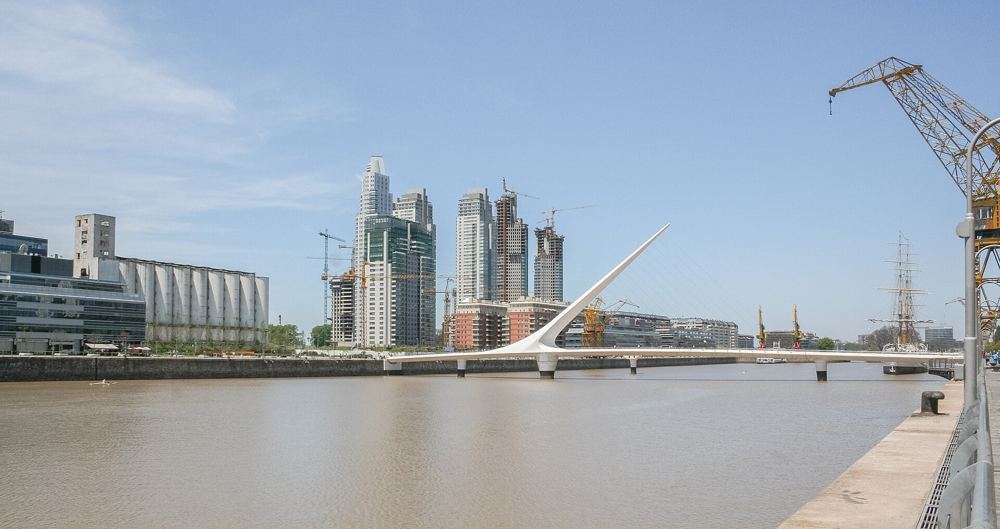
Puerto Madero sits at the top of the Buenos Aires price hierarchy. Market listings in 2026 placed its average around USD 5,400 per square metre.
Palermo, Recoleta, and Belgrano form the next premium tier. The most recent indices are higher than the figures still circulating in older guides. The UdeSA and Mercado Libre index for August 2026 put Palermo at about USD 3,421 per square metre, Belgrano at about USD 3,319 and Recoleta between roughly USD 2,525 and USD 2,820. A second-quarter 2026 reading reported through Argenprop gave used two-bedroom apartments at about USD 3,118 in Palermo, USD 2,958 in Belgrano and between USD 5,805 and USD 6,296 in Puerto Madero.
Other market writeups broadly confirm the tiering. Palermo and Belgrano both trade above USD 3,000 per square metre, Recoleta in the high USD 2,000s, and Puerto Madero far above all three.
Emerging or lower-priced areas generally trade below the classic premium corridors. Building quality, lot age, amenity level, and micro-location drive price more than neighbourhood name alone.
For foreigners, Palermo and Recoleta offer liquid expat-heavy markets, while Belgrano appeals to longer-term residents. Puerto Madero is a luxury waterfront market with newer construction.
The post-2023 rental market changed materially after deregulation. Guides describe a shift away from the rigid, heavily controlled rental framework that had constrained supply and pricing.
Furnished or short-term and semi-flexible units in Palermo, Recoleta, and Belgrano command materially different rents than standard direct rentals. The market remains segmented rather than uniform.
Gross yield calculations are often distorted if expensas, vacancy, and furnishing or management costs are ignored. Yield reality is highly location- and format-dependent.
A foreign buyer should model net yield after building fees and management costs. The headline rent is not the investor’s cash return.
Deregulation has improved supply visibility, but it has not created a uniform yield. Short-term expat-focused formats tend to generate stronger gross figures with higher operating costs.
In CABA, the recurring municipal levy is commonly billed as Impuesto Inmobiliario or ABL. The acronym ABL remains in everyday use even after administrative renaming.



