CBN Draft Rules Force Nigerian Standalone Banks Into Holding Company Structures
The Central Bank of Nigeria’s proposed reforms will compel major standalone lenders to restructure into holding companies, triggering significant capital raises and reshaping corporate governance across the country’s financial sector.
The Central Bank of Nigeria is moving to eliminate the structural divide in the country’s banking sector by mandating that standalone lenders adopt financial holding company frameworks. Proposed guidelines require closely linked entities to be housed under a single non-operating parent company, bringing institutions like Zenith Bank, United Bank for Africa, and Fidelity Bank into the holding company fold.
Restructuring and Capital Demands
For over a decade, Nigeria’s financial landscape has been split between traditional banks and diversified holding groups such as Access Holdings and GTCO. The new exposure draft removes exemptions for institutions owning non-bank businesses or foreign subsidiaries, signaling a regulatory push toward a unified governance model.
A critical shift involves the ownership of overseas operations. Foreign subsidiaries would transfer from the Nigerian operating bank to the holding company or a dedicated intermediate entity. This structural change weakens the operational rationale for maintaining international banking licenses at the subsidiary level.
Consequently, banks with substantial African operations may downgrade to national licenses, which carry lower minimum capital thresholds. However, this restructuring introduces stringent new capital buffers at the group level. Holding companies will be required to maintain capital equivalent to 1.2 times the combined paid-up capital of their subsidiaries.
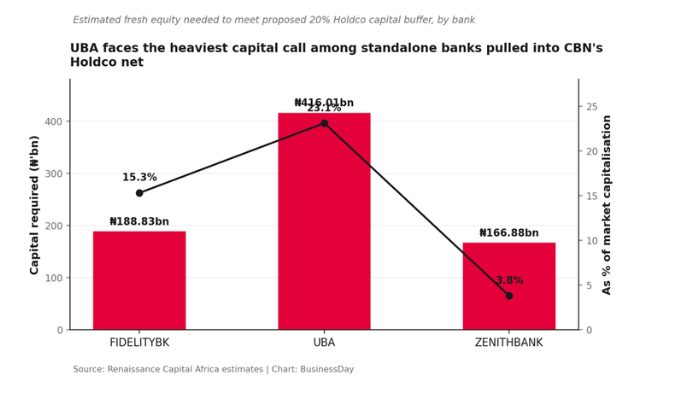
Standalone institutions will face a two-step transition, beginning with share swap arrangements to create non-operating parent companies. Renaissance Capital estimates that meeting the subsequent capital framework will require approximately N416 billion in additional equity for UBA, N189 billion for Fidelity Bank, and N167 billion for Zenith Bank.
Analysts note that Zenith Bank could clear this hurdle comfortably. As Renaissance Capital observed, its estimated N166.88 billion raise equates to "just 3.8 percent of market capitalisation, whereas UBA faces the heaviest lift given its larger absolute requirement."
Existing Holding Companies Face Buffers
Existing holding companies are not exempt from the regulatory tightening. While they avoid initial corporate restructuring, they must still meet a proposed 20 percent holding company capital buffer. Access Holdings faces the largest projected requirement at N669 billion, followed by FCMB Group at N267 billion and First HoldCo at N243 billion.
The proposal leaves a critical ambiguity regarding capital efficiency. Renaissance Capital highlights that it remains unclear whether excess capital released from operating subsidiaries can be redeployed across the group or returned to shareholders. The resolution of this question will determine whether the new framework enhances shareholder value or traps capital within non-operating entities.