Madagascar Economy Reels as Vanilla Collapses and Ambatovy Halts Again
Madagascar economy faces a vanilla price collapse and a halting nickel recovery in 2026. Investors weigh mining expansion against power and cyclone risks. The post Madagascar Economy Reels as Vanilla Collapses and Ambatovy Halts Again appeared first on The Rio Times .
, The stakes. Madagascar’s 2026 growth path is distorted by a historic vanilla price crash and a stop-start nickel operation., The date. By September 2026 the farmgate vanilla floor is reinstated at a fraction of its former level., The miner. The Ambatovy operation, then Sumitomo-controlled, produced only 28,000 tonnes of nickel in the year to March 2025., The power gap. Chronic capacity shortages are worsened by cyclone damage to dams and grids., The politics. President Michael Randrianirina’s transitional government faces voter scrutiny ahead of the July 2027 election.
Madagascar’s 2026 story is one of weakened foundations. The two pillars that once anchored export growth have cracked, while the state’s ability to restore energy and infrastructure is tested by nature.
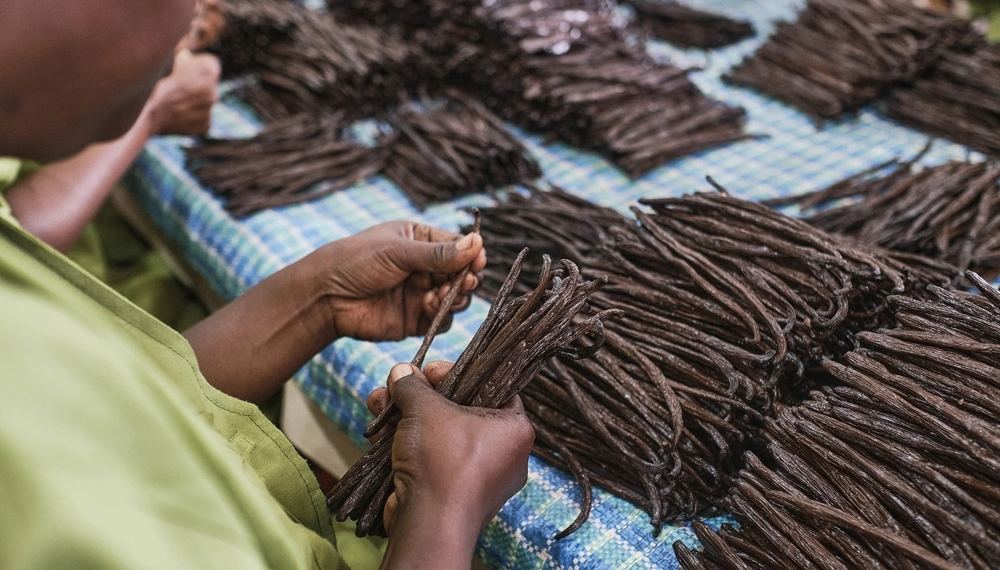
For years Madagascar set a minimum export price near USD 250 per kilogram for cured vanilla. That reference price effectively set the global market floor.
In May 2023 the government liberalised export prices and removed the USD 250 floor. Export revenue then slumped 64 percent by mid-2024 despite shipments nearly doubling.
The domestic farmgate floor for green vanilla was once 75,000 Ariary per kilogram, roughly USD 18. By 2024 and 2025 there was no floor at all.
In late June 2026 the state reinstated a much lower farmgate floor. Long pods over 13 centimetres were set at 10,000 Ariary per kilogram and shorter pods at 5,000.
Biovanilla describes a third price cycle from 2023 onward as structural overproduction. The average export price in that cycle is around USD 40 per kilogram.
Flowering observed in late 2025 points to abundant production for 2026 and 2027. Biovanilla estimates the future crop at about 4,500 tonnes.
Aust and Hachmann projects a large Madagascar crop of 3,000 to 3,500 metric tonnes in 2026. Prices are at inflation-adjusted historic lows.
Reference prices circulating in the trade, never formalised by decree, are USD 15 per kilogram for cuts, USD 25 for long vanilla, and USD 50 for gourmet black vanilla.
Some distressed lots traded as low as USD 10 to 16 per kilogram. The 2018 peak near USD 600 per kilogram is now a distant memory.
Ambatovy is the country’s largest nickel and cobalt mine, near Toamasina. It uses a high-pressure acid leach process to produce battery-grade nickel.
The operation is controlled by AMRI, a vehicle of Essenwood Partners and Zungu Investments that took over Sumitomo’s entire stake in May 2026, alongside Korea’s KOMIR. Designed capacity is about 60,000 tonnes of nickel per year.
Sumitomo produced 31,000 tonnes of nickel in the year to March 2024. Malfunctions at the processing plant kept output below the 40,000-tonne target.
By the year to March 2025 output fell to 28,000 tonnes. A slurry pipeline was damaged on 25 September 2024, forcing a suspension of operations.
Cyclone Gezani forced another halt at Ambatovy in February 2026, and production only restarted on 11 June 2026 after a four-month shutdown. The stop came as the operation was trying to stabilise after the 2024 pipeline incident.
Suspensions at Ambatovy carry national significance. Nickel and cobalt revenues support foreign exchange and formal employment.
Each restart faces physical damage and supply-chain delays. The performance gap widens whenever weather events strike the east coast.
Chronic power shortages compound the problem. Damaged dams and grid infrastructure limit reliable electricity for industrial users.
The result is an operation that cannot reach even half of its designed capacity. That shortfall matters for budget projections and investor confidence.
Ilmenite and graphite mining are expanding in Madagascar. These minerals are linked to global demand for titanium feedstock and battery anodes.
The sector is attracting new operators, but controversy persists over land use and environmental compliance. Local communities have raised concerns about displacement and water access.
Graphite projects target export markets for electric vehicle supply chains. Ilmenite operations feed pigment and titanium metal producers.
Mining expansion offers diversification away from vanilla and nickel. It also exposes weak regulatory enforcement in remote areas.
Foreign investors weigh ore quality and logistics against governance risk. Power shortages raise operating costs for processing plants.
Tourism is recovering unevenly after years of border disruption. Arrivals are rising but remain below the volumes seen before the pandemic.
High-end eco-lodges report stronger bookings from European and South African visitors. Budget and mid-range operators lag behind.
Air connectivity remains a constraint. Limited direct flights and high ticket prices deter long-haul travellers.
Cyclone damage to roads and coastal infrastructure has slowed access to key areas. Some lodges closed for repairs during the 2026 season.
The tourism sector sees opportunity in Madagascar’s unique biodiversity. Yet instability in power and transport undermines the visitor experience.
Madagascar suffers from chronic electricity shortages in urban and rural areas. The national utility relies on ageing hydro and thermal plants.
Cyclone damage to dams and transmission lines has worsened outages in 2026. Businesses report rising diesel generator costs.
Industrial users such as Ambatovy compete with households for limited capacity. Load shedding remains common in Antananarivo.
Power deficits raise the cost of doing business. They also delay the expansion of processing industries beyond raw mineral exports.
Reforms to the energy sector are slow. Investors note that stable power is a precondition for manufacturing and tourism growth.
President Michael Randrianirina faces a difficult narrative ahead of the July 2027 vote. The June 2026 partial floor reversal was his government’s decision; the earlier liberalisation was Andry Rajoelina’s, before he was ousted in October 2025.



