India's NSE Bans Market Orders in Final Minutes of Pre-Open Session
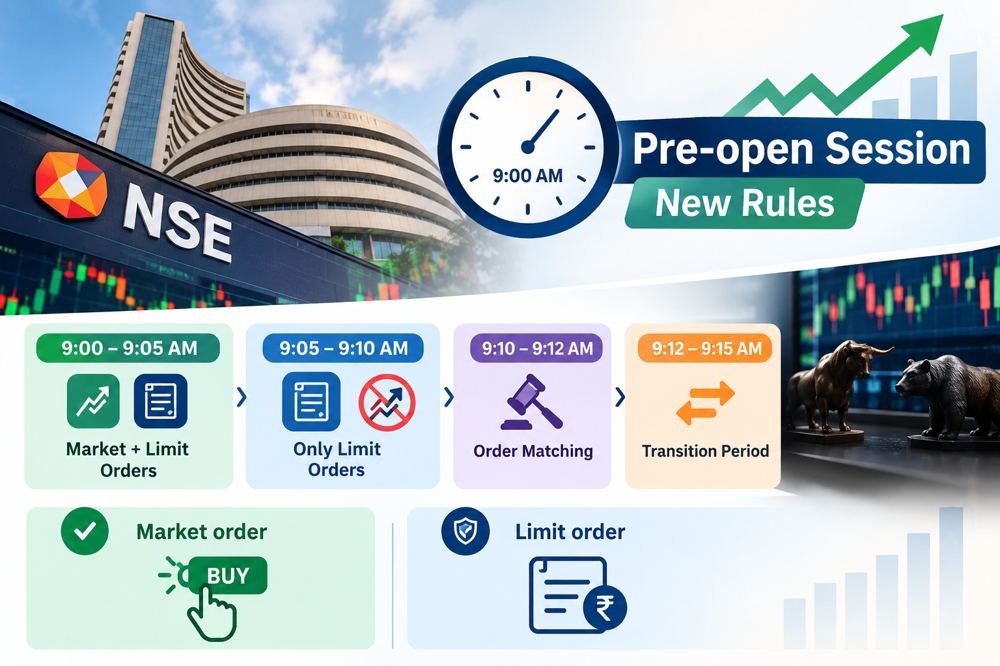
The National Stock Exchange of India has restricted market orders during the final five minutes of its pre-open session to curb early volatility and align with closing auction protocols.
The National Stock Exchange of India (NSE) has implemented new rules for its pre-open session, banning market orders between 9:05 am and 9:10 am. During this five-minute window, the exchange will now accept only limit orders, automatically rejecting any market orders placed by participants.
The revised framework divides the pre-open period into two distinct phases. From 9:00 am to 9:05 am, investors retain the ability to enter, modify, or cancel both market and limit orders. The subsequent phase restricts activity to limit orders only, featuring a random closure mechanism during the final two minutes.
This structural shift directly impacts traders who historically wait until the end of the pre-open window to execute trades. By forcing participants to specify a maximum buying price or minimum selling price, the exchange aims to eliminate the execution uncertainty inherent in market orders.
Late market orders have occasionally triggered sudden price distortions, particularly on days when stocks open with significant gaps or heightened volatility. The mandatory use of limit orders in the final minutes provides a buffer against these erratic price movements, granting traders greater control over their execution prices.
The NSE has also clarified the matching hierarchy for the revised session. Market orders paired with other market orders will receive the highest priority based on time.
Any leftover market orders will then be matched with limit orders using a price-time priority system. Finally, remaining limit orders will be matched against one another under the same price-time framework.
According to the exchange, this revision brings the opening mechanism into closer alignment with the Closing Auction Session structure. The move is designed to create a more uniform and predictable auction framework across both ends of the trading day.