West Africa Cocoa Crop Set to Shrink as El Nino and Disease Bite
Black pod, swollen shoot and a strengthening El Niño are converging on the two countries that grow more than half the world’s cocoa. The post West Africa Cocoa Crop Set to Shrink as El Nino and Disease Bite appeared first on The Rio Times .
, What happened: Ivory Coast held its guaranteed cocoa price at 1,200 CFA francs a kilo for the 2026/27 crop., How big it is: Pod counters and exporters surveyed by Reuters expect Ivory Coast’s main crop to fall more than 10%., The catch: Ghana’s output may sink by more than a third, per a newer Bloomberg report., Who it hits: Ivory Coast and Ghana together supply more than half of world cocoa., What comes next: Watch port arrivals in Ivory Coast through October and November for the first hard data., The number that matters: El Niño’s peak is forecast between November 2026 and January 2027.
The West Africa cocoa harvest that starts this month in Ivory Coast and Ghana looks set to come in far smaller. Early surveys put Ivory Coast down more than 10% and Ghana down at least 13%.
Pod counters and exporters surveyed by Reuters in July put Ivory Coast’s 2026/27 main crop at 1.35 to 1.45 million tonnes. That compares with about 1.6 million tonnes in the current season, a fall of more than 10%.
Oxford Economics separately expects the full 2026/27 harvest to come in around 20% down. The two numbers are not the same measure: the first is the main crop alone, the second the whole year.
For Ghana, Bloomberg reported on 3 September that output may sink by more than a third, according to a licensed buyer. That supersedes an earlier internal projection of about 650,000 tonnes, down at least 13%.
Reports of the same internal projection have put the fall at 13% and at at least 16%, depending on the base used. The Ghana Cocoa Board has not confirmed the numbers publicly.
Together the two countries supply more than half the world’s cocoa. A double-digit fall in both at once is a world problem, not a regional one.
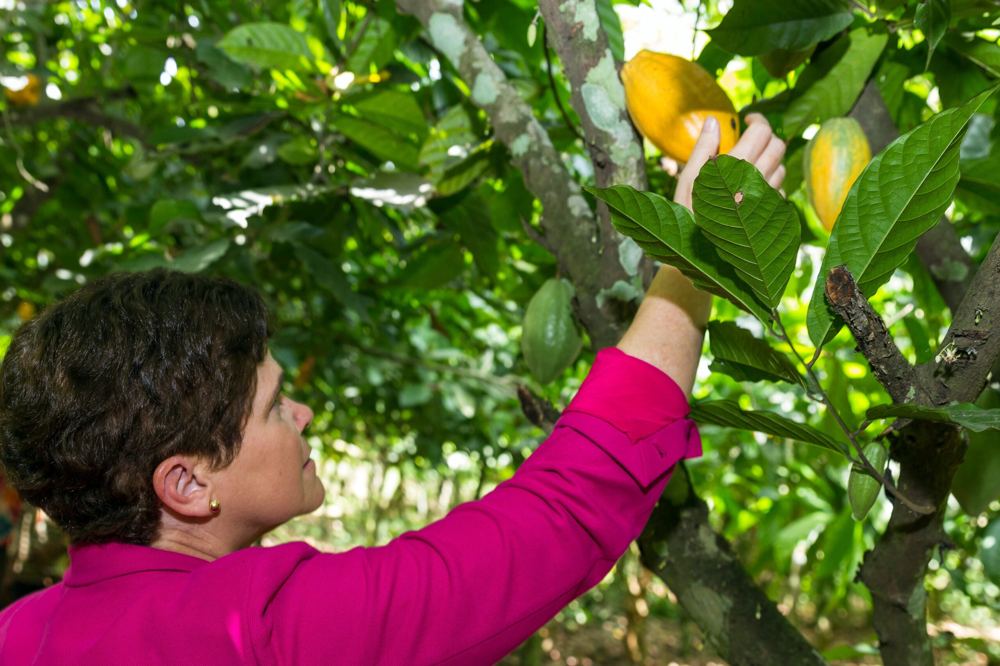
Black pod is a fungus that rots the pod on the tree. It thrives in exactly the wet, sunless weather growers have had.
Swollen shoot is a virus spread by mealybugs. The only reliable treatment is cutting out the infected trees.
The third problem is age. Large parts of the West African cocoa belt were planted decades ago.
Yields decline as trees pass their productive peak. Weather then compounds all three.
Heavy rain with limited sunshine slows pod development. It also makes it harder to apply fungicide at the right moment.
The Japan Meteorological Agency confirmed El Niño conditions on 10 June 2026. It was the first national forecaster to make the call, eight days after the World Meteorological Organization said conditions were developing.
By July the Niño-3.4 sea surface temperature anomaly averaged about 2.0C above normal, on WMO figures. Individual weeks in late July ran between 2.2C and 2.6C.
Forecasters expect the peak between November 2026 and January 2027. In West Africa, El Niño tends to strengthen the Harmattan, the dry season wind that blows off the Sahara.
The Harmattan dries out the topsoil and makes pods drop. That comes after a wet, cloudy period that encouraged fungus.
The sequence is what makes it awkward. A wet, cloudy period that encourages fungus, followed by a dry one that starves the pods, is close to a worst case.
Ivory Coast held the guaranteed farm price at 1,200 CFA francs a kilogram for the 2026/27 main crop. The agriculture minister announced the decision on 1 September 2026.
That is roughly US$2.05 a kilogram at 585 CFA to the dollar on 5 September 2026. Coffee was set at 1,300 CFA francs.
The farmgate price is the guaranteed sum a farmer is paid at the farm. About 1.1 million cocoa farmers live on it, according to the Conseil du Café-Cacao.
Ghana faces the same trade-off between supporting growers and protecting the marketing board’s finances. A smaller crop makes that arithmetic worse.
The same running costs are spread across fewer tonnes. Holding the price steady, as Ivory Coast did, protects farmers but squeezes the board’s margins.
Chocolate makers have already swallowed several years of higher costs. Buying beans forward only delays the reckoning.
Growing cocoa elsewhere is under way, but slow. Ecuador and Brazil have planted more, and Nigeria has attracted new investment.
None of it replaces West African volume quickly. Trees take years, and that is the whole difficulty with a supply response in cocoa.
Traders treat grinding data as the earliest reliable signal. It shows how many beans factories are actually crushing into cocoa butter and powder.
That data arrives before farm numbers are added up. Port arrivals in Abidjan and San Pedro come next.
They arrive week by week through the main crop, the larger of the two annual harvests. Traders watch the cumulative line against the same point in previous seasons.
Quality is the quieter problem. Disease-affected beans fetch discounts, so a stated tonnage can overstate the usable crop.
Cocoa is a top export earner for both countries. A short crop hits the money they earn from abroad, not just farm incomes.
Ghana has some cushion from gold, its other big export earner. Ivory Coast is less diversified in soft commodities and more exposed to the single crop.
Ivorian growth has run near 6% in recent years, on International Monetary Fund estimates. That absorbs some of the shock.
Watch the main-crop arrivals data at the Ivorian ports through October and November. That is the first hard read on the surveys.
Watch the farmgate announcements too. Any widening of the gap to the world price would tell you how bad the boards think it is.
Ivory Coast’s main crop is expected to fall more than 10%, to 1.35 to 1.45 million tonnes. Ghana’s output may sink by more than a third, according to a newer Bloomberg report.