Zimbabwe inflation drops below three percent as stock market leads Africa
Zimbabwe has reduced annual inflation to below three percent and seen its stock market outperform the continent, testing whether strict monetary discipline and mineral exports can sustain a broader economic recovery.
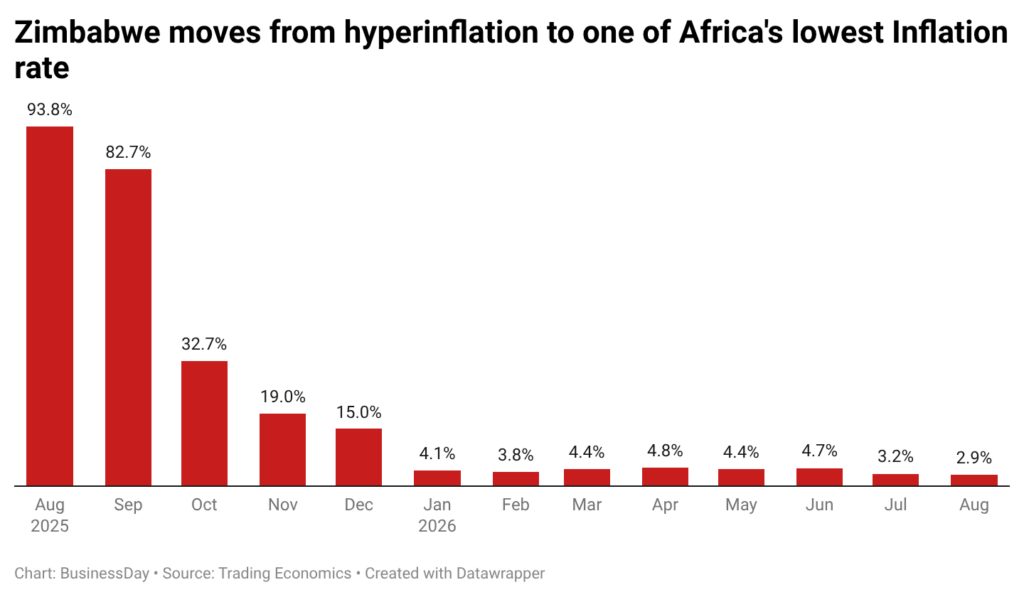
Zimbabwe has driven annual inflation below three percent, marking a sharp reversal from the 736 percent average recorded in 2024. The local equity market has simultaneously emerged as the top-performing bourse on the continent, signaling a major shift in investor sentiment.
The equity rally highlights a changing perception of the southern African nation among global capital allocators. Local equities returned 68.5 percent in US dollar terms through July 31, 2026, outpacing peers in Nigeria, Ghana, and Tanzania.
Overseas capital is flowing back into the market, with foreign investor participation climbing to 26.5 percent in the second quarter from 15.4 percent previously. Trading value by international clients surged 153.9 percent to ZiG743.6 million, indicating renewed appetite for local assets.
David Cowan, Citigroup’s chief Africa economist, noted the rapid shift in market dynamics. “Where perceptions and reality may now be increasingly out of kilter is the speed with which an economic turnaround has started to play out in Zimbabwe since 2025,” Cowan wrote in a client note.
This stabilization follows the April 2024 introduction of the Zimbabwe Gold currency, or ZiG, and a strict end to printing money to fund government deficits. The central bank projects that ZiG inflation will average roughly five percent this year, with monthly increases staying below one percent.
Central bank reserves have expanded significantly to back the new monetary system. Governor John Mushayavanhu stated that the institution held approximately 3,400 kilogrammes of gold by 2025, more than doubling the 1,500 kilogrammes stored the previous year.
Borrowing costs remain elevated despite a recent easing, with the central bank cutting its benchmark rate by 500 basis points to 30 percent in June. The economy also remains heavily dollarized, though the premium between official and parallel exchange rates has narrowed to below 20 percent.
Expanding mineral exports are providing crucial foreign exchange to support the currency. Lithium shipments generated roughly $782 million in the first half of 2026, more than tripling the $237 million recorded during the same period a year earlier.
Major Chinese-backed operators including Zhejiang Huayou Cobalt, Sinomine Resource Group, Chengxin Lithium, and Yahua are active in the sector. The government is now accelerating plans to ban raw mineral and lithium concentrate exports to force domestic processing and capture more value.
Despite the macroeconomic improvements, corporate fundamentals remain mixed. RioZim, a prominent listed mining firm, posted a ZiG739.1 million loss equivalent to $27.75 million in 2025 following a drop in gold output and suspended its dividend.
Structural challenges persist, including unsustainable public debt, electricity shortages, and ongoing creditor negotiations that began in 2022. Market participants are watching to see if the current fiscal discipline can withstand future external shocks or weaker commodity prices.