South Korea reclaims top global stock market spot as Nigerian rally pauses
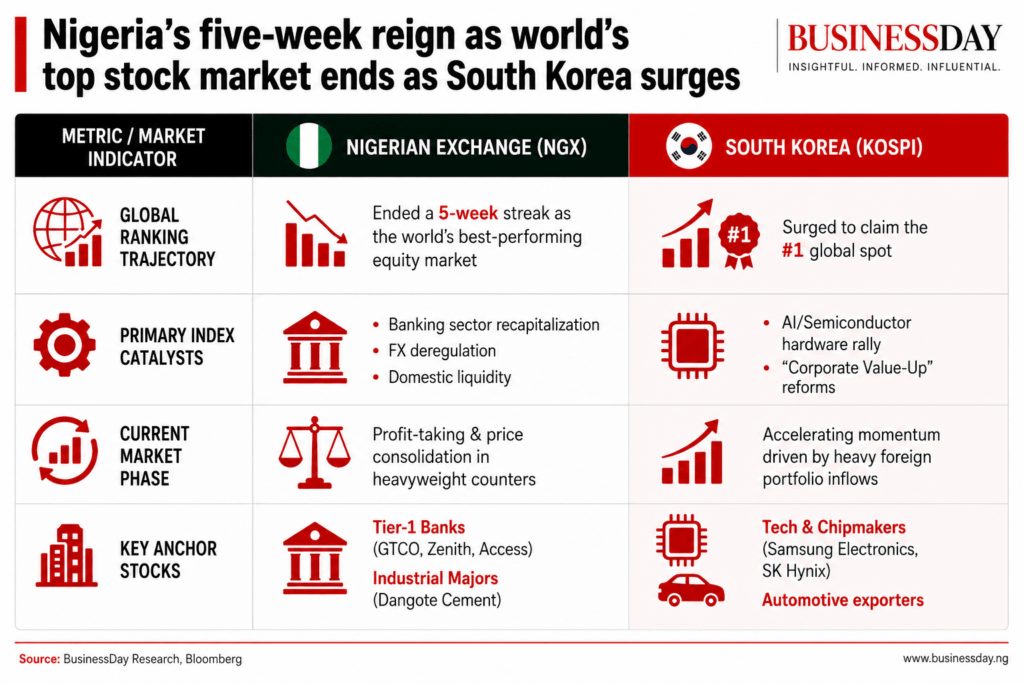
South Korea’s Kospi has retaken the title of the world’s best-performing stock market from Nigeria, highlighting the divergent drivers of emerging market rallies and the rapid reversal of global capital flows.
South Korea’s Kospi has reclaimed the top spot in global equity returns, ending a five-week reign by the Nigerian Exchange. As of August 14, the South Korean benchmark led global exchange rankings with a 68.52 percent year-to-date dollar return, pushing Ghana’s Composite Index to second and the Nigerian Exchange All-Share Index to third at 65.23 percent.
This shift underscores the velocity of global market leadership changes, driven by a sharp technical recovery in Asian technology stocks. The Kospi entered a bull market after surging 23 percent from its July 30 trough, erasing a brutal 40 percent plunge caused by heavy selling in semiconductor giants Samsung Electronics and SK Hynix.
Renewed optimism around artificial intelligence demand for memory chips fueled the turnaround, with Samsung and SK Hynix closing more than five percent and seven percent higher respectively. Macquarie Capital analysts declared the volatility over, citing an unprecedented memory crunch and AI inference demand that remains constrained by slow supply responses.
Conversely, Nigeria’s equity surge rests on structural macroeconomic reforms rather than a technology boom. The Nigerian Exchange rally has been anchored by foreign-exchange policy shifts, banking recapitalization, and a stabilized naira, which prevented currency depreciation from eroding dollar-denominated investor returns.
The naira has emerged as the second-best performing African currency against the dollar this year, gaining nearly 6 percent. Trading at an average official rate of 1,357.7 to the dollar on August 14, the currency has provided crucial relief to importers and preserved the dollar value of local equity gains.
Despite these structural improvements, the Nigerian market recently experienced a modest pullback as investors took profits. Between August 10 and 14, the All-Share Index declined 2.78 percent to 242,619.2 points, reducing market capitalization to 156.6 trillion naira and moderating the local year-to-date return to 55.9 percent.
CSL Research attributed the dip to profit-taking rather than deteriorating fundamentals, though they warned that elevated valuations and new retail OMO bill availability could sustain near-term volatility. Even with this correction, the exchange’s market capitalization had hit a record 158.1 trillion naira earlier in August, reflecting massive growth since 2023.
Nigerian Exchange Group chief executive Temi Popoola noted the bourse was the second-best global performer in the first half of 2026, trailing only the Kospi. He attributed the 57 percent first-half return to the Investments and Securities Act 2025 and robust corporate earnings, highlighting that combined profits at major firms like Dangote Cement and MTN Nigeria have grown 6.2 times since 2023.