High taxes and FX risks push intra-African airfares above long-haul European rates.
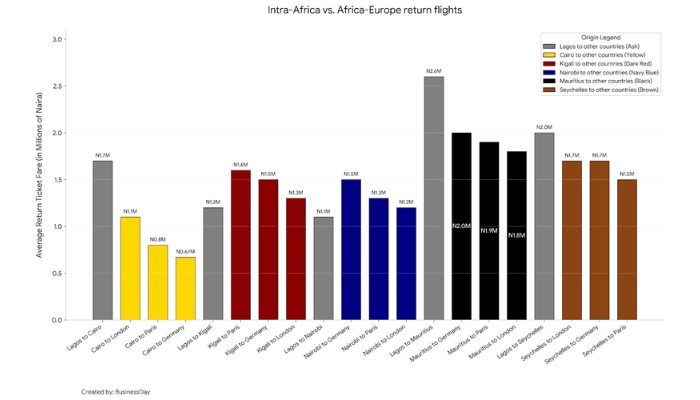
Exorbitant government levies, foreign exchange risk premiums, and limited carrier competition are driving intra-African ticket prices above long-haul European routes, stifling regional tourism and trade integration.
Intra-African short-haul flights are consistently priced higher than long-haul journeys to Europe, driven by a complex web of government taxes, airport levies, and regulatory fees. This pricing anomaly is undermining regional tourism and trade, even as tighter visa conditions in the US and Europe redirect Nigerian travelers toward continental destinations.
Taxes and charges consume between 35 percent and over 70 percent of an airline ticket in Nigeria and much of Africa. With more than 54 distinct levies applied across the sector, roughly a third of every African plane ticket goes directly to government and airport authorities rather than the airline.
African international departures average $68 in direct taxes per passenger, roughly double the global average. In Nigeria, Gabon, and Sierra Leone, passengers pay between $180 and $297 purely in taxes and regulatory fees per ticket. Nigerian travelers face a $180 tax burden on departure, more than triple the $55 fee in Kenya.
The financial distortion is stark on specific routes, such as the five-hour return flight from Lagos to Nairobi costing N1.1 million. By comparison, the nine-and-a-half-hour journey from Nairobi to London costs just N1.2 million. Calculated per kilometer, a Nigerian flying to Nairobi pays $0.18, which is 60 percent more than the $0.11 a Kenyan pays to fly to London.
For investors and airlines, these structural disparities highlight severe market inefficiencies and currency risks. Carriers operating in Nigeria embed a $100 currency hedge into international tickets to protect against naira volatility and delayed fund repatriation. Furthermore, while Nairobi’s Jomo Kenyatta International Airport hosts over 60 competing carriers, the Lagos-Nairobi corridor is serviced by only two or three, allowing airlines to extract higher yields.
Industry experts point to domestic fiscal policy rather than operational costs as the primary driver of these price gaps. Samuel Caulcrick, former rector of the Nigerian College of Aviation Technology, stated that the structural disparity is driven by the naira environment and the tax regime.
Olumide Ohunayo, director of research at Zenith Travels, noted that African airspace charges are legendary and highlighted regional regulatory failures. He pointed out that the Economic Community of West African States set a January 2026 deadline to reduce charges by 25 percent, but Nigeria has yet to implement the mandate.
Additional cost pressures stem from higher insurance covers for aircraft leases, which are frequently structured as wet leases rather than dry leases. Until regional aviation policies address these fragmented agreements and cost drivers, the economic promise of a seamless, visa-free Africa will remain constrained by prohibitive airfares.