Financial Stocks Rally 8% as Rate Divergence Drives Rotation From Tech
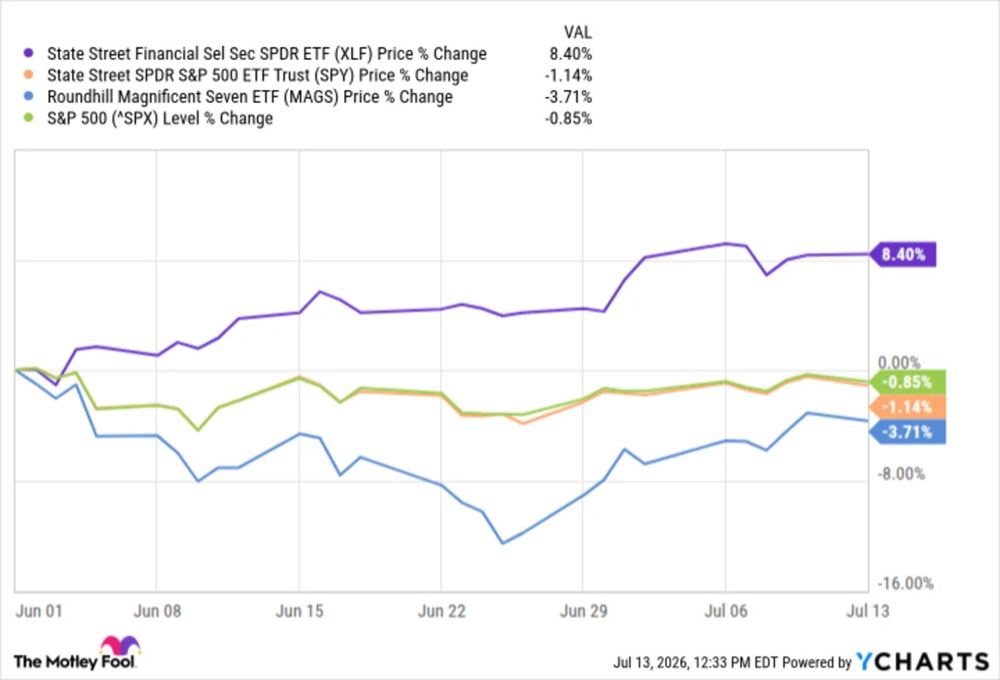
A surge in financial stocks, driven by unexpectedly wide loan margins as market rates lag behind the Fed Funds Rate, is drawing capital away from flagship technology and artificial intelligence names.
Financial stocks are outperforming the broader market as investors pivot away from AI-focused technology. Since early June, the State Street Financial Select Sector SPDR ETF (XLF) has gained more than 8%, while the S&P 500 has remained largely flat.
This movement comes directly at the expense of the market's former leaders. The Roundhill Magnificent Seven ETF (MAGS) has dropped nearly 4% over the same period, weighed down by Alphabet and Microsoft, signaling a clear rotation out of aggressive growth names and into traditional lenders like Bank of America, American Express, and JPMorgan Chase.
The primary catalyst for this shift is an evolving interest rate environment. The Fed Funds Rate currently sits just over 3.5%, down from a 2024 peak above 5%. However, because this level remains elevated compared to the better part of the past 17 years, and is now projected to linger "higher for longer" than expected just a few months ago, the macroeconomic backdrop has fundamentally shifted.
Crucially for bank profitability, market-based interest rates on mortgages, auto loans, and credit cards have not declined at the same pace as the Fed Funds Rate. This divergence has effectively widened the spread between what lenders pay for capital and what they charge borrowers, making the banking business markedly more profitable.
This dynamic is already materializing in corporate earnings. Bank of America posted a 9% year-over-year increase in first-quarter net interest income. For market professionals, this indicates that banking sector profitability is currently operating at a multi-year high and is positioned to remain elevated for the foreseeable future.
Meanwhile, the appetite for artificial intelligence equities is cooling. While the underlying technology rollout continues, early expectations for immediate and practical commercial applications have proven overly optimistic, prompting investors to reallocate capital toward sectors with more tangible current earnings.