Nigeria palm oil giants face margin squeeze as tariff cuts spur imports
Nigeria's top palm oil producers, Presco and Okomu, are reporting their first profit declines in years after a government tariff cut triggered a surge in cheaper imports, threatening the viability of the sector's multi-billion dollar capital investments.
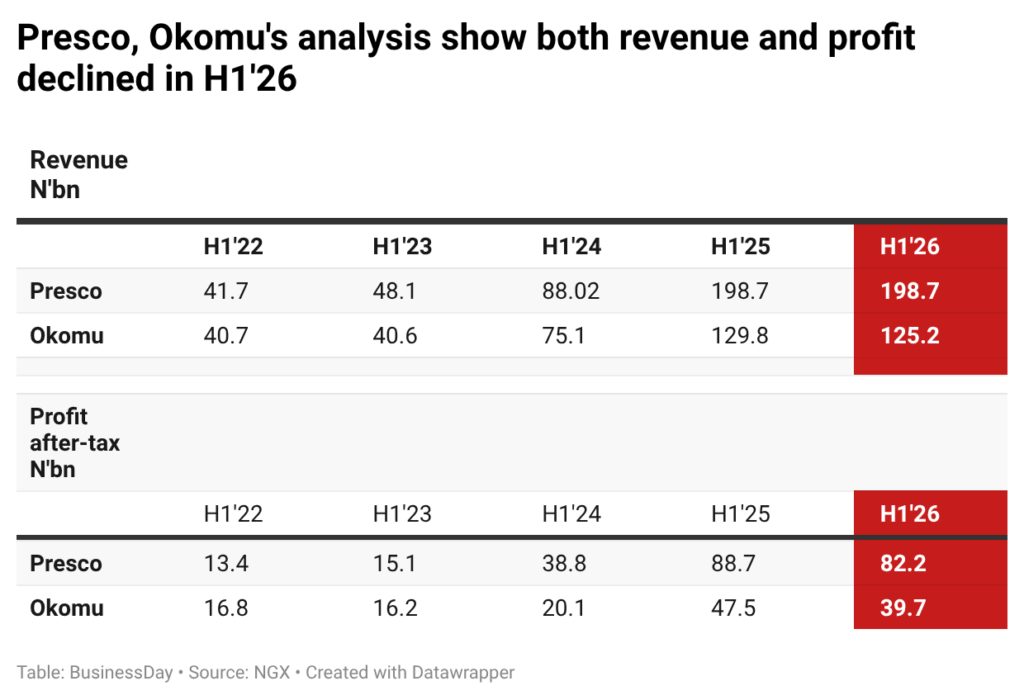
Presco Plc and Okomu Oil Palm Plc posted declining first-half profits as a sudden influx of cheaper imports eroded domestic prices. Combined profit after tax for the two Nigerian plantation giants fell to N121.9 billion in the first six months of 2026, ending a four-year boom that saw earnings nearly quadruple.
Okomu took the heavier hit, with profit after tax dropping 16.4 percent to N39.7 billion on a 3.5 percent revenue decline. Presco managed to keep revenue flat at N198.7 billion but saw earnings slip 7.3 percent to N82.2 billion. The divergence underscores how rising operational costs collided with a weakened pricing environment.
The margin compression stems directly from a shift in government trade policy. In April, the Federal Government slashed import duties on crude palm oil to 28.75 percent from 35 percent to help curb inflation. The move backfired for local producers: Nigeria spent N23 billion on crude palm oil imports in the first quarter of 2026, a 30.26 percent year-on-year increase.
Those imports, alongside an influx of smuggled vegetable oils, crashed local commodity prices. Fresh fruit bunch prices plummeted by roughly 43 percent to N1.6 million per tonne, stripping plantation operators of their pricing power just as they faced higher input costs.
Policy risk threatens long-term capital
The earnings dip signals a deeper threat to Nigeria’s backward integration strategy. Since 2011, tariff protections have justified over a decade of heavy capital expenditure, lifting national oil palm fruit production by 45 percent to 11.6 million metric tons by 2024. Industry leaders warn that unpredictable policy is now jeopardizing those gains.
“The industry is at an existential moment,” said Emmanuel Ibru, chairman of the Plantation Owners Forum of Nigeria, noting that billions of dollars in investments are at risk. Fatai Afolabi, managing director of Foremost Development Services Limited, pointed to the impact on future growth: “When investors cannot predict policy direction, confidence erodes. That slows expansion and new planting.”
The strain extends beyond the plantations to the broader manufacturing base. Processors are running below capacity as imported oil undercuts their margins. “If you are not self-reliant, you remain exposed to external shocks,” said Mohammed Tahir, chairman of the vegetable oil subsector of the Manufacturers Association of Nigeria.
Presco pushes ahead with expansion
Despite the headwinds, Presco is pressing forward with a $100 million investment to establish new operations in Ogun State. Group chief executive Adewale Arikawe announced the expansion after meeting with Governor Dapo Abiodun, aiming to extend the company's footprint beyond its traditional bases in Edo and Delta.
The move highlights a sector struggling to reach its potential. Nigeria once supplied 43 percent of the world’s palm oil but now accounts for less than five percent, hindered by fragmented smallholder farming and policy reversals. For investors, the immediate question is whether the current tariff regime is a temporary measure or a permanent shift that resets the sector's valuations.