AI Hardware Demand Lifts Marvell Forecast to $2.7B, Outpacing UiPath
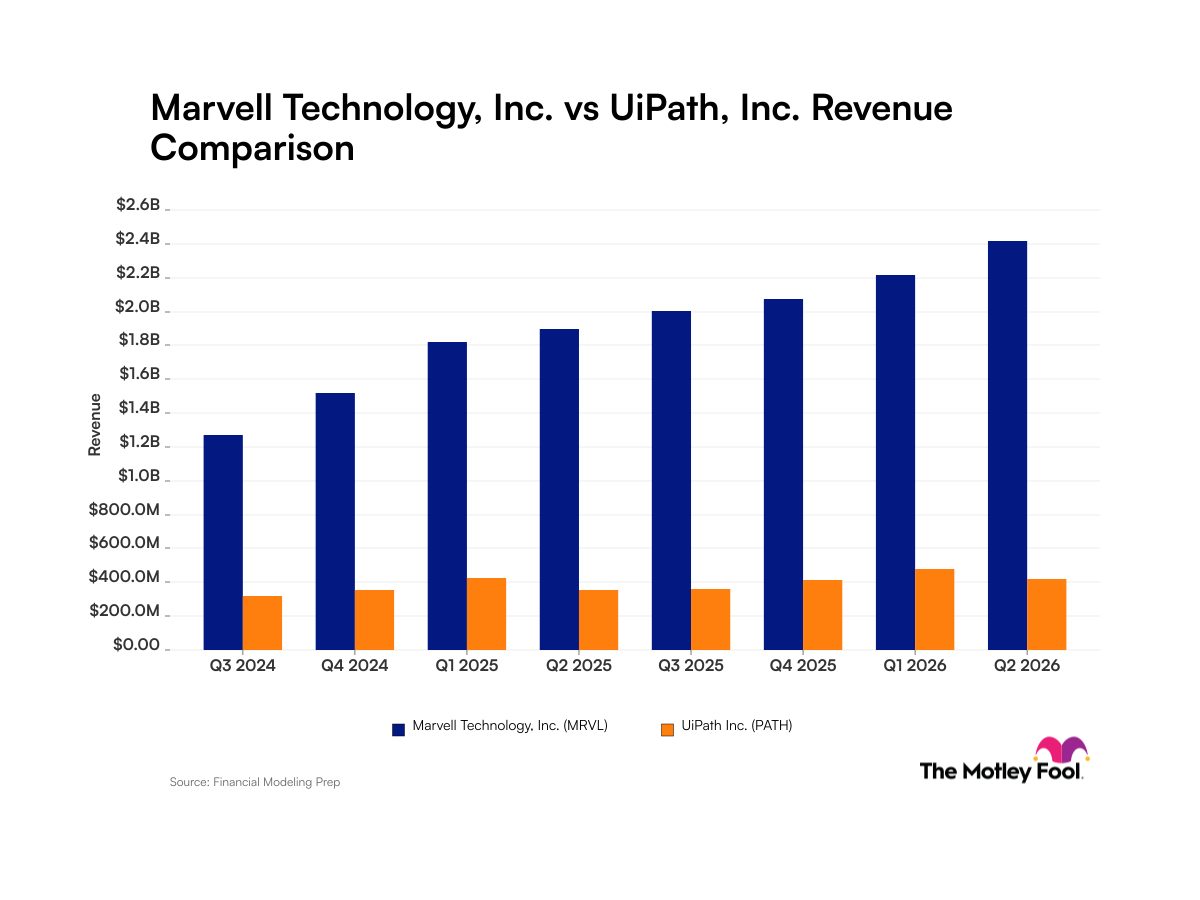
Marvell Technology's $2.7 billion quarterly revenue forecast highlights a divergence in the artificial intelligence supply chain, where semiconductor demand is scaling faster than enterprise automation software adoption.
Marvell Technology has guided for approximately $2.7 billion in revenue next quarter, underscoring accelerating demand for data infrastructure semiconductors. The projection follows the chipmaker's addition to the S&P 500 index on June 22. By comparison, UiPath expects revenue between $395 million and $400 million in its upcoming quarter, up from $361.7 million in the prior year.
The contrast highlights diverging trajectories within the artificial intelligence supply chain. For investors, top-line revenue serves as a primary gauge of market penetration before operating expenses and taxes are deducted. Under this metric, Marvell is capturing a larger absolute share of enterprise spending as clients build out foundational data capabilities.
UiPath reported $418.4 million in revenue for the quarter ended April 30, representing a 17% year-over-year increase. While Marvell did not disclose its exact current-quarter sales figure, it posted a 52% gross margin for the period ended May 2. UiPath recorded a substantially higher 81% gross margin, reflecting the typical leverage inherent in software ecosystems compared to capital-intensive semiconductor manufacturing.
Both firms are leveraging the broader artificial intelligence expansion to grow their overall business volumes. Marvell's growth is driven by what the company characterized as "unprecedented customer demand" for its system-on-a-chip architectures. UiPath is targeting a different segment of the AI market, focusing on commercial and government organizations adopting its robotic process automation tools.
On May 5, UiPath launched new artificial intelligence features for its Automation Suite to secure these customers. However, the revenue gap between the two indicates that enterprise spending on physical AI infrastructure is currently scaling faster than software-based workflow automation. Market participants will monitor whether UiPath's high-margin software model can eventually close the absolute revenue gap as AI deployment matures.