European leveraged loans tipped to beat US in H2 2026
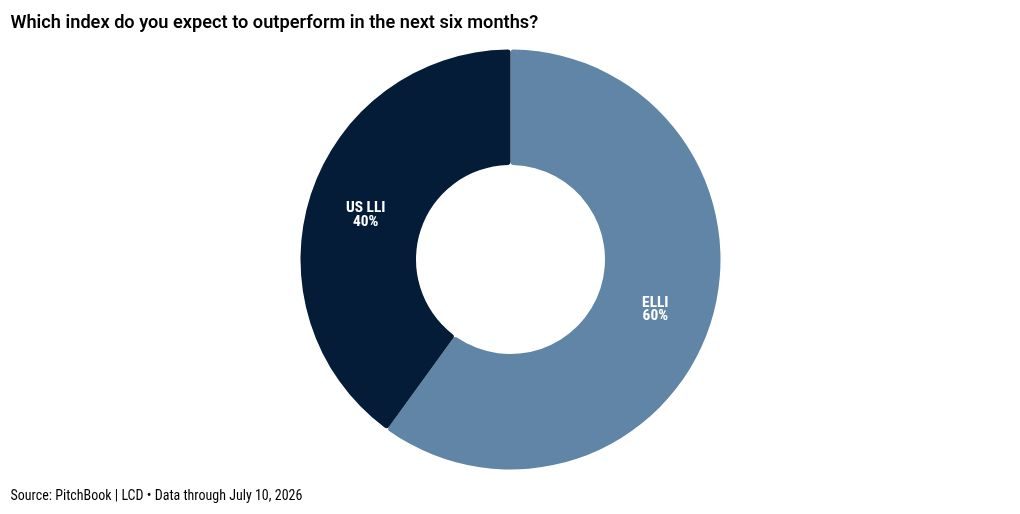
Investors expect European leveraged loans to outperform both US peers and high-yield bonds in the second half of the year, as a floating-rate advantage and decoupling from US tech volatility support a market facing persistent supply shortages.
European leveraged loan investors are positioning for regional outperformance in the second half of 2026, betting that floating-rate premiums and stable credit fundamentals will outweigh broader macroeconomic anxieties. A semi-annual survey by LCD found that 80% of respondents expect loans to beat high-yield bonds, while 60% forecast the European market will outpace the US.
This shift in sentiment marks a reversal from late 2025, when investors broadly expected the US to win out. The US benchmark did lead in the first quarter, but a subsequent sell-off in software and artificial intelligence stocks dragged US loan returns down to 1.32% year-to-date by the end of June. The Morningstar European Leveraged Loan Index (ELLI) returned 1.82% over the same period, escaping the worst of the tech-driven volatility.
The strong preference for loans over high-yield bonds hinges on central bank policy. With the future path of interest rate cuts remaining uncertain, investors are unwilling to abandon the floating-rate coupon advantage that loans provide. This dynamic is expected to keep capital anchored in the loan market even as macro risks simmer.
Pricing is forecast to remain static. Eighty percent of survey participants expect European credit spreads to stay unchanged over the next six months, while the remaining 20% anticipate only moderate widening. Nobody predicted tightening or severe widening. This stasis extends to private equity deal structures, where the majority of respondents foresee no movement in leverage multiples, equity contributions, or average purchase price multiples.
Deal flow offers a slight bright spot, with 60% of respondents anticipating a rise in M&A-related broadly syndicated loan issuance in the second half. However, this expected uptick is not seen as sufficient to resolve the technical supply shortage that has helped underpin European credit pricing.
Under the surface, risks remain concentrated at the bottom of the capital structure. Triple-C rated loans are expected to underperform better-rated cohorts, even though a sharp recent rise in the ELLI distress ratio is expected to stabilize rather than deteriorate further. For market professionals, the survey underscores a strategy of defensive positioning: capturing carry in a stable spread environment while avoiding the lowest-quality credits most vulnerable to a macro shock.