Nigeria's 93% informal economy blunts reform impact
Nigeria's ambitious macroeconomic reforms are largely failing to reach the 93% of the workforce operating outside the formal economy, limiting their effectiveness for investors and policymakers.
Nigeria’s most aggressive economic reforms in decades are failing to deliver broad-based improvements because policymakers are targeting an economy that only employs 7% of the workforce. Over the past three years, the government has removed fuel subsidies, liberalised the exchange rate and pushed interest rates to their highest levels in decades. Yet these policies are struggling to generate expected growth because they largely bypass the 93% of Nigerian workers operating in the informal economy.
According to the National Bureau of Statistics’ Labour Force Survey and a 2025 report by the Nigerian Economic Summit Group titled From Hustle to Decent Work, roughly 93% of employed Nigerians work informally. This structural reality means minimum wage increases, tax overhauls and central bank rate adjustments simply do not apply to the vast majority of businesses.
For the Central Bank of Nigeria, this gap severely weakens monetary policy transmission. Millions of micro, small and medium enterprises, numbering about 40 million, rely on personal savings, cooperatives and informal lenders rather than commercial banks. Consequently, hiking rates does not constrain the informal credit that fuels much of the real economy.
Meanwhile, the costs of reform transmit instantly through informal networks. In the transport sector, which lacks long-term contracts or financial buffers, fuel subsidy removal immediately pushes up passenger fares. These costs cascade directly into food prices and production overheads, explaining why inflation remains stubborn even as formal policy tightens.
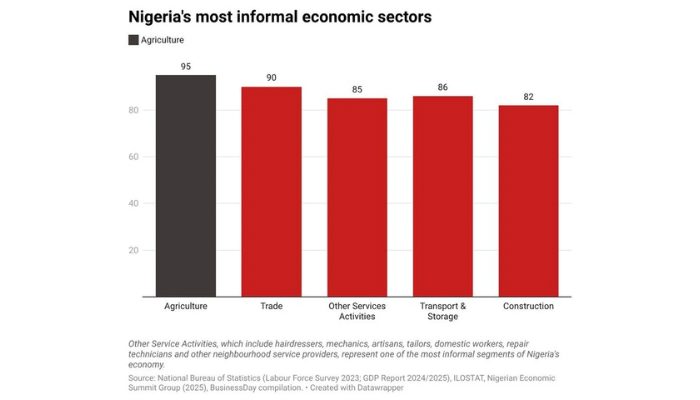
The productive core of Nigeria is similarly disconnected from formal institutions. Agriculture makes up 27.8% of GDP following a 2024 rebasing, but over 95% of its workforce is informal. Without secure land titles, farmers cannot access bank credit to invest in mechanisation, sustaining food inflation. Wholesale and retail trade, contributing over 15% of GDP, faces a parallel trap of local levies and an inability to secure affordable finance.
For market participants, the solution may lie in technology rather than regulation. A recent report by Moniepoint, produced with SMEDAN and the Federal Ministry of Industry, Trade and Investment, highlights that digital payments are quietly building transaction histories for unregistered businesses. This allows them to access financial services without facing the immediate administrative burdens of formal registration.
The underlying issue remains institutional. As Muda Yusuf, chief executive of the Centre for the Promotion of Private Enterprise, argues: "many businesses remain informal because the costs of formalisation outweigh its benefits." Until Nigeria builds institutions that offer tangible value to these millions of unregistered enterprises, macroeconomic reforms will continue to deliver weaker outcomes than their designers expect.