Morocco Education and Healthcare Explained
A plain guide to how Morocco's schools, universities, hospitals and AMO health insurance work, what they cost households, and what is still unknown. The post Morocco Education and Healthcare Explained appeared first on The Rio Times .
Morocco is putting more children in school and more people on health insurance, yet many families still pay a large share of medical bills themselves. This explainer sets out how its schools, universities, hospitals and insurance fit together.
For a US reader the country matters as a destination for retirees and investors, and the home country of relatives of Moroccan Americans. We rely on official statistics and international datasets, and we say plainly where the picture stops.
Morocco has widened school places and health insurance quickly, but learning results and out-of-pocket costs show how much work remains, and several reforms are still being rolled out.
Over two decades the state has pushed towards universal schooling and health insurance. A royal social-protection roadmap, set in law as framework law 09-21 of 2021 on social protection, sets the course and drives the insurance expansion described below.
Literacy has improved, as the census presentation of the HCP (Haut-Commissariat au Plan, Morocco’s statistics office) shows. It puts illiteracy among people aged 10 and over at 24.8% in 2024, the share of that age group who cannot read and write.
Among literate people in that age group, the HCP census presentation of 2024 shows that 99.2% read and write Arabic, 57.7% French and 20.5% English. Those shares explain why language shapes both classrooms and daily life.
On health spending, the World Bank’s 2023 indicators show Morocco at 6.06% of GDP, against 4.35% in Algeria, 7.99% in Tunisia and 4.88% in Egypt. The United States spent 16.69% of GDP on health in the same World Bank series for 2023.
Doctors are scarcer, with the World Bank listing 0.74 physicians per 1,000 people in Morocco in 2021 against 3.68 in the United States in 2022. The same World Bank series shows 1.66 in Algeria (2022), 1.32 in Tunisia (2021) and 0.67 in Egypt (2020)., AMO. Assurance Maladie Obligatoire, Morocco’s compulsory health insurance., CNSS. The Caisse Nationale de Sécurité Sociale, the private-sector social security fund., AMO Tadamon. The AMO branch for people whose premiums the state pays., HCP. The Haut-Commissariat au Plan, the national statistics office., GST. A Groupement Sanitaire Territorial, a regional group running public hospitals and health centres., Bac. The baccalauréat, the national exam that ends upper secondary school.
Primary school, grades 1 to 6 for ages 6 to 12, is compulsory, and preschool for ages 4 to 6 is being generalised. The IEA (International Association for the Evaluation of Educational Achievement, a research body) says so in its 2024 encyclopedia for TIMSS 2023, the Trends in International Mathematics and Science Study.
Pupils then attend three years of collège, meaning lower secondary school, and three years of lycée, meaning upper secondary school, as the IEA encyclopedia describes. Lycée ends with the baccalauréat, known as the bac, the national school-leaving exam.
Arabic and Amazigh, the Berber language, are the two official languages under article 5 of the 2011 constitution. The framework law 51-17 of 2019 sets Arabic and Amazigh as languages of instruction and allows teaching of scientific subjects in foreign languages.
In TIMSS 2023 (IEA, December 2024), Morocco scored 378 in grade 8 mathematics against the TIMSS scale centrepoint of 500. In grade 4 mathematics it scored 393 against the same centrepoint.
The World Bank said in a feature of 21 May 2026 that about 60% of 10-year-olds in Morocco could not read a simple text in 2023. That finding is the backdrop to the Schools of Pioneers programme.
The Schools of Pioneers (Écoles Pionnières) started in 2023/24 as a pilot in 626 primary schools with about 320,000 pupils, the World Bank feature of 21 May 2026 reports. It now covers 4,626 public primary schools, about 54% of the total, with more than 2 million pupils, about 75,000 teachers and 960 inspectors.
A preliminary evaluation, reported in the same World Bank feature, found that pioneer pupils outperformed 82% of peers in comparable schools after one year. A secondary pilot, Collèges Pionniers, began in 2024/25 and covers 786 schools and about 678,000 pupils.
Higher Education Minister Abdellatif Miraoui said in October 2024 that Moroccan universities had about 1.3 million students that year. We give no public-private split because we could not confirm one at a ministry source.
Al-Qarawiyyin University in Fez traces its founding to 859 by Fatima al-Fihri. Guinness World Records lists it as the world’s oldest existing, continually operating educational institution.
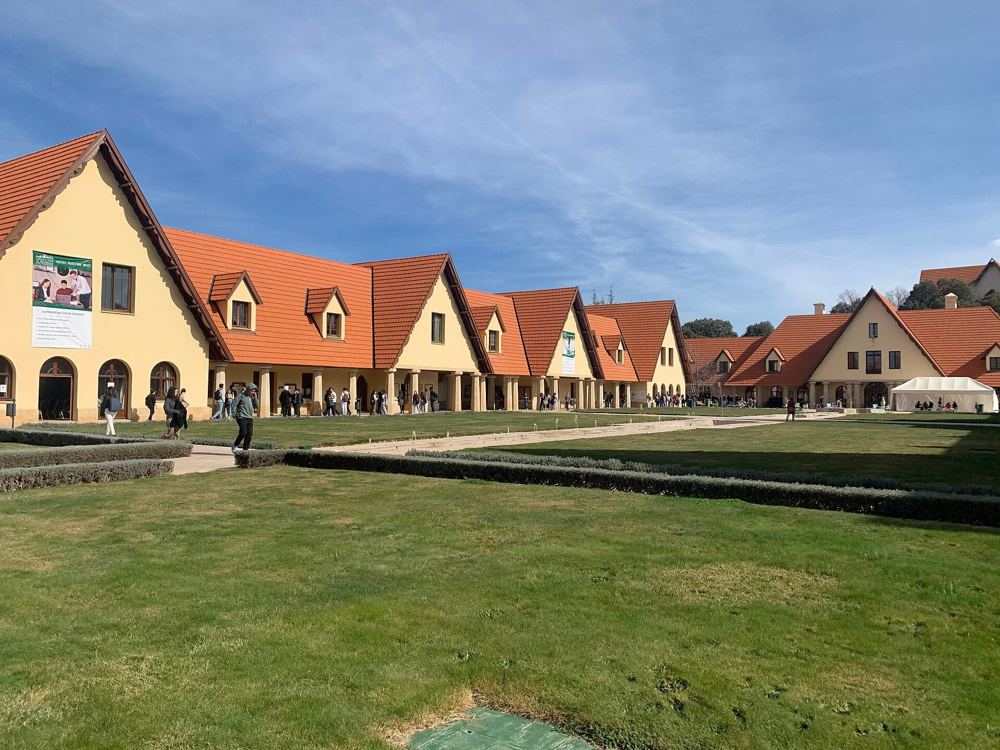
Al Akhawayn University in Ifrane teaches in English, in contrast to most public universities. Fees for foreign students are not confirmed at an official source.
Medical and pharmacy students boycotted classes from late 2023 into November 2024 over a plan to shorten medical training. The boycott ended by agreement with the government in November 2024.
Training places for general doctors rose from 2,650 in 2019 to 6,414 in 2025, according to the government portal maroc.ma on 8 October 2025. Nursing places rose from 2,735 in 2019 to 9,500 in 2024, the same portal says.
Readers who want detail on the shared France-Morocco campus at Fez can read our page on the project . We give no figures for it here.
The US Commerce Department commercial guide of 31 July 2025 counts 164 public hospitals and over 400 private clinics, the latter with more than 15,500 beds. It says public hospitals provide 83% of care.
The IMF (International Monetary Fund) selected issues paper of 2026 puts Morocco at 7.3 hospital beds per 10,000 people in 2020, against a desirable level of 20. That gap frames the building programme now under way.
Government figures on maroc.ma of 8 October 2025 list 22 projects from 2022 to 2025 adding 2,433 beds. Another 24 projects due in 2025 and 2026 add 2,273 beds, which together come to 4,706 beds on the two government lists.
Life expectancy at birth in Morocco was 75.49 years in 2024, according to the World Bank. The figure is a national average and says nothing about the quality of any one hospital.
AMO was created by law 65-00. RAMED, the former scheme for low-income Moroccans, ran alongside it until AMO Tadamon replaced it.
AMO Tadamon covers about 11 million people whose premiums the state pays (government portal maroc.ma, 21 October 2025). The self-employed regime, AMO-TNS (for non-salaried workers), covers about 4 million.
Total AMO beneficiaries passed 32 million in 2025, about 88% of the population and up from 42% before the scheme was extended. These are the Finance Ministry’s own figures from its 2026 budget presentation note, so they show registered cover rather than actual use of care.
The CNSS, the private-sector social security fund, runs AMO for private-sector employees. CNOPS, the civil servants’ insurer, handles the public-sector scheme.
Why it matters: when public care is thin, private spending pushes costs onto households. The World Bank puts Morocco’s out-of-pocket share of current health spending at 37.25% in 2023, against 10.93% in the United States.
The neighbours differ: in the same World Bank series for 2023 the share is 45.00% in Algeria, 37.94% in Tunisia and 57.20% in Egypt. Morocco’s share is the lowest of the four countries, below Algeria and Egypt and just under Tunisia.
AMO Tadamon beneficiaries have their premiums paid by the state, so poorer households are insured without contributing, according to maroc.ma on 21 October 2025. Doctor and public-hospital fees for non-residents are not confirmed, as we explain below.
Foreign employees with a Moroccan work contract are generally affiliated through their employer, according to consultancies, though we could not confirm this on an official page. Our guide to expat health cover gives the detail.
Framework law 06-22 on the health system, promulgated on 9 December 2022, replaced law 34-09. It created the Groupements Sanitaires Territoriaux (GSTs), regional health groups that run public hospitals and health centres, under law 08-22.