COP31 ends without a major climate deal amid divisions over fossil fuels
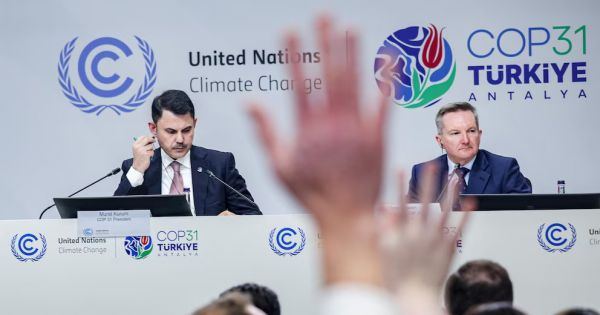
The UN COP31 climate summit in the Turkish city of Antalya ended on Sunday without a major political agreement, after deep divisions between countries over fossil fuels and finance for the poorest. It is the first time since the 2009 Copenhagen summit that the main declaration of one of these conferences has collapsed in this way.
The UN COP31 climate summit in the Turkish city of Antalya ended on Sunday without a major political agreement, after deep divisions between countries over fossil fuels and finance for the poorest. It is the first time since the 2009 Copenhagen summit that the main declaration of one of these conferences has collapsed in this way.
Negotiations, due to end on Friday, ran into Sunday, making COP31 the longest UN climate conference in history, according to the BBC. The final draft, presented in the early hours, did not mention “fossil fuels”, the main cause of global warming, and referred only indirectly to the commitment made at COP28 in 2023 to “transition away” from them in energy systems. An earlier draft mentioned them six times, which was unacceptable to oil-producing countries.
The European Union, Pacific island states and others rejected the text. “It is unconscionable that we would have a climate pact that makes no mention of fossil fuels,” said the EU's representative, Irish minister Darragh O'Brien. Panama and the Marshall Islands also criticised its lack of ambition. At the other end, Saudi Arabia's delegate, Mohammad Ayoub, said Arab countries had negotiated “in good faith” and noted that they account for only a small share of historical emissions, while Russia warned that moving away from fossil fuels too quickly would cause “fuel poverty”.
Developing countries also objected to the absence of concrete figures to deliver on the commitment, agreed last year at COP30 in Brazil, to triple finance for adaptation to climate change. “Rich nations and polluting governments cannot keep arriving empty-handed,” said Mohamed Adow of the African think tank Power Shift Africa.
UN Secretary-General António Guterres, at his last climate summit before stepping down, said he was “deeply disappointed” and accused “powerful fossil fuel interests” of following “a page from Big Tobacco's playbook”. Australian Prime Minister Anthony Albanese, whose government led the negotiations, blamed the failure on “difficult geopolitical times”. Australian minister Chris Bowen, president of the negotiations, spoke of “unbridgeable red lines”.
There was some progress, including on a “just transition mechanism” to support workers and communities affected by the energy shift, and more than 80 countries backed Turkey's proposed target for electricity to meet 35% of global energy use by 2035. UN climate chief Simon Stiell said he would seek advice on reforming a consensus-based process that “fell short” on Sunday. The next summit, COP32, will be held in Ethiopia in November 2027.
With current policies, the planet is heading for warming of about 2.8C by 2100, according to the UN, well above the 1.5C limit set in Paris in 2015, which will be exceeded in the next few years.