What the Alberta Referendum Result Means for Canada
The Alberta referendum result was a decisive unity signal, yet it leaves pipeline, regulatory and trade risks for US investors fully intact. The post What the Alberta Referendum Result Means for Canada appeared first on The Rio Times .
The Alberta referendum result was a decisive political setback for separatists, with roughly three in four voters choosing to remain in Canada. For US investors and refiners, the vote preserves the existing operating framework for oil sands, pipelines and cross-border trade without resolving the policy disputes that still shape energy risk.
Alberta is Canada’s main oil-producing province and a critical supplier of heavy crude to US Midwest and Gulf Coast refineries. This analysis explains what the non-binding vote does and does not change, drawing on the USA & Canada Intelligence Brief of 20 October 2026.
The ballot did not offer a simple choice between Canada and independence. It asked whether Alberta should remain a province of Canada or whether the Government of Alberta should begin the legal process required under the Canadian Constitution to hold a binding provincial referendum on separation.
That wording matters because a vote for the second option would not have made Alberta independent. It would only have instructed the provincial government to start a constitutional and legal process that could eventually lead to a separate vote on independence.
The referendum contained nine additional questions: questions 1-9 were non-binding yes-or-no questions, while question 10 was a non-binding choice question with two options, for ten questions in total. These covered immigration authority, eligibility for certain provincially funded services, health and education charges for some non-permanent residents, voter identification and constitutional reform.
Elections Alberta, the independent office of the Legislative Assembly, administers provincial votes.
The official announcement is scheduled for 29 October 2026, the tenth day after Election Day. Until then, the certified result remains pending.
Legally, almost nothing changes immediately. Because the referendum was non-binding, it did not alter Alberta’s status as a Canadian province, authorise independence negotiations, or transfer federal powers over borders, citizenship, currency, defence or foreign affairs.
It also did not change ownership or regulation of oil and gas resources, or cancel or approve any pipeline. The vote’s legal effect was political rather than executory: it provided or withheld a democratic mandate for the provincial government to pursue the next stage.
Even a hypothetical future yes to beginning the process would not have permitted unilateral secession.
A future separation would also require negotiations over assets, debt, borders, Indigenous rights, citizenship, pensions, trade, federal lands, energy infrastructure and the constitutional position of municipalities and Indigenous nations.
Alberta Premier Danielle Smith said the early result showed widespread support for remaining in Canada and described the outcome as support for a stronger Alberta within a united Canada. The result narrows her room for an immediate separatist strategy.
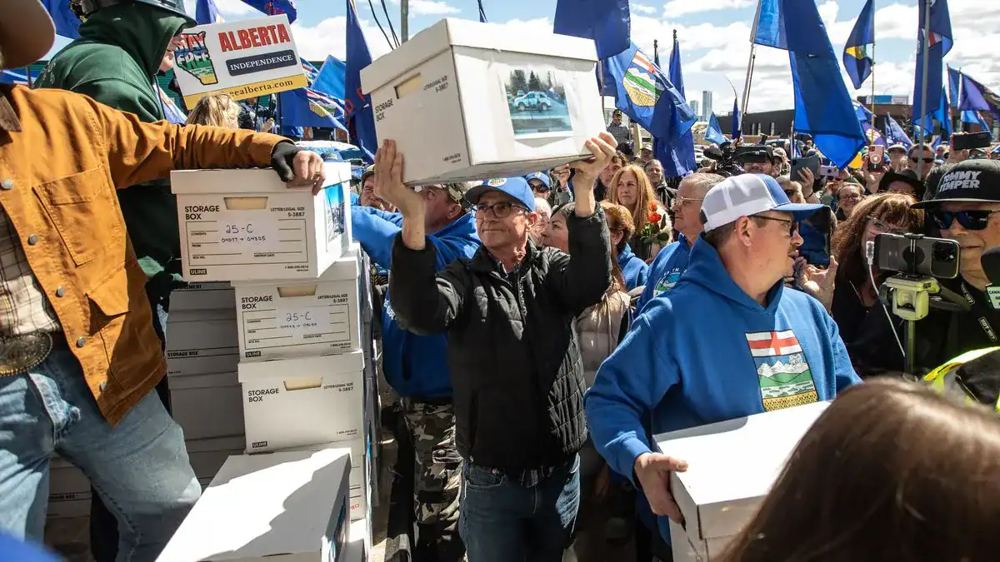
The separatist movement’s organisers, including the Alberta Prosperity Project and lead petition organiser Mitch Sylvestre, have indicated they intend to continue campaigning despite defeat. Their likely next steps include building a permanent membership and fundraising organisation, pressuring the provincial government on federal energy and equalisation policies, contesting future provincial elections, and seeking another referendum initiative if political conditions change.
Elections Alberta administered the vote and will certify the result. The referendum was established through Alberta Order in Council 160/2026.
The result is broadly stabilising for Alberta’s energy industry because it reduces near-term constitutional uncertainty. Alberta remains inside the Canadian regulatory, tax, financial and trade framework through which its oil sands, conventional oil, natural gas and petrochemical industries operate.
The Alberta referendum has no power to restore a US federal permit or compel Washington to approve construction.
It also does not directly change existing pipeline flows. Alberta crude reaches the United States through several routes, including Enbridge’s Mainline system into the US Midwest and eastern Canada, Enbridge’s Line 3 Replacement system into the US Midwest, Trans Mountain’s system to the British Columbia coast, and rail and other transport links used when pipeline capacity is constrained.
For US refiners, Alberta remains a major source of heavy crude suited to complex refineries in the Midwest and Gulf Coast. A stable constitutional position supports commercial continuity, but pipeline volumes will continue to depend on production, maintenance, tolls, refinery demand, transportation constraints and US trade policy.
The referendum result is likely to be interpreted by markets as modestly positive for Canadian political stability, but it is not a standalone currency catalyst. The Canadian dollar is driven more heavily by US, Canada interest-rate differentials, Federal Reserve and Bank of Canada policy, crude oil and broader commodity prices, US economic growth, Canada’s trade balance and global risk appetite.
A failed push toward a separation process removes one tail risk: the possibility of prolonged constitutional uncertainty around Alberta’s fiscal and energy position. That could help sentiment toward Canadian assets at the margin, but it does not guarantee a stronger Canadian dollar.
For US investors, the practical implications are limited but relevant. Alberta projects retain the benefit of operating inside Canada’s existing legal and financial system, and the immediate risk of a province-level constitutional shock is lower.
Oil-sands exposure remains tied to heavy-oil differentials, pipeline tolls, carbon costs and US refinery demand. Canadian-dollar returns can diverge from the performance of the underlying Canadian energy asset, and cross-border investors still face tax, withholding, sanctions, trade and regulatory considerations that the referendum does not change.
The result supports continuity in Canada, US commercial relations. Alberta cannot independently rewrite Canada’s tariff commitments, customs arrangements, sanctions policy or energy-trade obligations, which remain federal responsibilities.
That continuity matters because Canadian crude is deeply integrated into US refinery supply chains. Any future separation campaign would have created questions over customs, pipeline jurisdiction, currency, treaty rights and market access.
For Latin America, the vote is a secondary but instructive signal. It shows that resource-rich provinces in federal systems can test constitutional boundaries without immediately disrupting commodity flows or investor frameworks.
The result does not remove trade uncertainty. The United States and Canada still face recurring disputes over energy policy, tariffs, softwood lumber, critical minerals, dairy, procurement and the implementation of the USMCA review process, none of which should be attributed to the Alberta vote.
The most likely scenario is that the result stabilises the constitutional question for the near term. Premier Smith can pursue greater provincial autonomy without claiming a mandate for separation, and Ottawa can argue that Alberta’s grievances should be addressed within Canada.
A second scenario is that separatist organisers use the roughly one-quarter support as a base for a longer campaign. They could pressure the provincial government on federal energy, equalisation and environmental policies, contest future provincial elections, and seek another referendum initiative if political conditions change.
A third scenario is that federal, provincial disputes over emissions policy, project approvals and carbon policy continue to create investment friction even without a constitutional crisis. That would keep pipeline and regulatory risk active for energy investors.
What would tip the situation toward instability is a sharp deterioration in federal, provincial relations or a renewed separatist push with stronger organisation. What would stabilise it further is a concrete federal response on energy infrastructure, internal trade or fiscal arrangements that addresses the grievances behind the movement.
For a US investor or executive with exposure to Canadian energy, the Alberta referendum result removes one near-term tail risk without changing the fundamentals. You still face the same pipeline, regulatory, commodity-price and carbon-policy risks you faced before the vote.
The practical takeaway is to separate constitutional risk from ordinary policy risk. Constitutional risk is lower after the vote, but pipeline and regulatory risk remain active, commodity-price risk is unchanged, US market-access risk depends on trade and infrastructure policy, and carbon-policy risk is unresolved.
If you hold Canadian-dollar assets, remember that the currency can move on interest-rate differentials and oil prices even when the constitutional picture is calm. The vote is not a reason to reprice Canadian energy assets on its own.
Several facts should remain explicitly qualified until Elections Alberta releases the certified result on 29 October 2026. The final vote totals and turnout are not yet official, and the margin in each electoral division has not been certified.
It is also not known whether support for remaining in Canada was geographically concentrated or broadly distributed, or what the final results of the nine other referendum questions will show. Those details will shape how the political response unfolds.
The strategic response is also unresolved. It is not yet clear whether Premier Smith will treat the result as a mandate for autonomy negotiations with Ottawa, whether separatist organisers will seek another referendum mechanism, or whether the result changes the next Alberta provincial election’s party strategy.
Finally, it is not known whether Ottawa will respond with new energy, fiscal or constitutional proposals, or whether markets will assign any measurable reduction to Alberta political-risk premiums. The central conclusion is that Alberta voted against taking the next formal step toward a separation referendum, a meaningful political unity signal but not a constitutional settlement.
The first dated event is 29 October 2026, when Elections Alberta announces the official result. That will replace the broadcaster projection with certified vote totals and turnout.
Watch Premier Smith’s first substantive response after the official announcement. Her framing will signal whether the province pursues autonomy negotiations with Ottawa or lets the constitutional question fade.
Watch whether separatist organisers announce a new organisational structure or a timeline for another referendum initiative. Their ability to convert roughly one-quarter support into a durable political force is the key test of the movement’s future.