Venezuela History Explained, From Origins to 2026
A dated guide to Venezuela history: colonial rule, independence, oil, democracy, Chávez, Maduro, mass emigration and the road to 2026. The post Venezuela History Explained, From Origins to 2026 appeared first on The Rio Times .
A plain-English timeline of Venezuela, from its first peoples to the events of 2026. It shows how oil, strongmen and a long fight over who may rule explain the country now in the news.
Venezuela history runs from Indigenous chiefdoms to the 1811 declaration of independence, then through a century of strongmen and an oil boom. It reaches, for now, the US seizure of Nicolás Maduro in January 2026, which put Venezuelan oil and elections on Washington’s agenda.
Every date below comes from a primary or official record, and every disputed claim is labelled as a claim. The sections follow the calendar, and the closing sections show what the past means for investors, travellers and families.
Before the Spanish arrived, the land that is now Venezuela held many small peoples rather than one empire. The Library of Congress country study says some were nomadic hunters and gatherers, while others built towns and farmed with irrigation and terraces.
In the Andes the Timoto-Cuica lived in a series of chiefdoms, built roads and traded with the plains and the Maracaibo basin. No Aztec or Inca-style power ruled the whole territory, which made conquest slower and less rewarding for Spain.
That lack of a single centre shaped what followed. The Spanish found no capital to seize, and the conquest took far longer than those of Mexico and Peru.
Christopher Columbus sighted the Paria Peninsula in 1498. The Library of Congress study says that on 1 August that year he became the first European to step onto the South American mainland.
A year later Alonso de Ojeda and Amerigo Vespucci reached Lake Maracaibo. Houses on stilts reminded Vespucci of Venice, and the name Venezuela, or Little Venice, followed.
Pearls drew the first colonists, but the oyster beds were exhausted by the 1520s, and slave raids on the coast took their place. The study says those raids fed labour demand in Panama and the Caribbean and fuelled more than a century of low-intensity warfare.
In 1528 the indebted Spanish crown handed western Venezuela to the German banking house of Welser, which ran it until 1556. Diego de Losada founded Santiago de León de Caracas in 1567, after more than a decade of fierce fighting with the local population.
For two and a half centuries Venezuela was a backwater, split into provinces governed from Santo Domingo and later Bogotá. Only in 1777 did the crown create a Captaincy General of Venezuela seated in Caracas, the first recognition of Venezuela as a political entity.
From the 1620s cocoa was the main export, and its plantations created demand for enslaved Africans. By the late eighteenth century, the study says, mixed-race pardos were more than half of the people and enslaved Africans about 20 percent.
In 1728 the crown gave a Basque firm, the Caracas Company, exclusive trading rights to stamp out smuggling. Growers resented its low prices, and a revolt led by Juan Francisco de León in 1749 was crushed by troops from Spain.
Napoleon’s invasion of Spain in 1808 cut the link between Caracas and the crown. On 19 April 1810 the Caracas town council ousted the Spanish governor and set up a junta in the name of the captive King Ferdinand VII.
A congress declared independence on 5 July 1811. A constitution that December began the First Republic.
Venezuelans call it La Patria Boba, the Silly Republic. Its Caracas elite ignored the poor and the mixed-race majority, many of whom stayed loyal to the crown.
A major earthquake in March 1812 struck pro-independence towns and spared royalist ones, and on 25 July 1812 the republican commander Francisco de Miranda surrendered. Miranda died in a Spanish prison in 1816.
Simón Bolívar, born in Caracas in 1783 to an aristocratic creole family, took up the fight and proclaimed “war to the death” in 1813. His Second Republic fell in 1814 to the royalist chief José Tomás Boves, whose plainsmen saw the creole elite, not Spain, as the enemy.
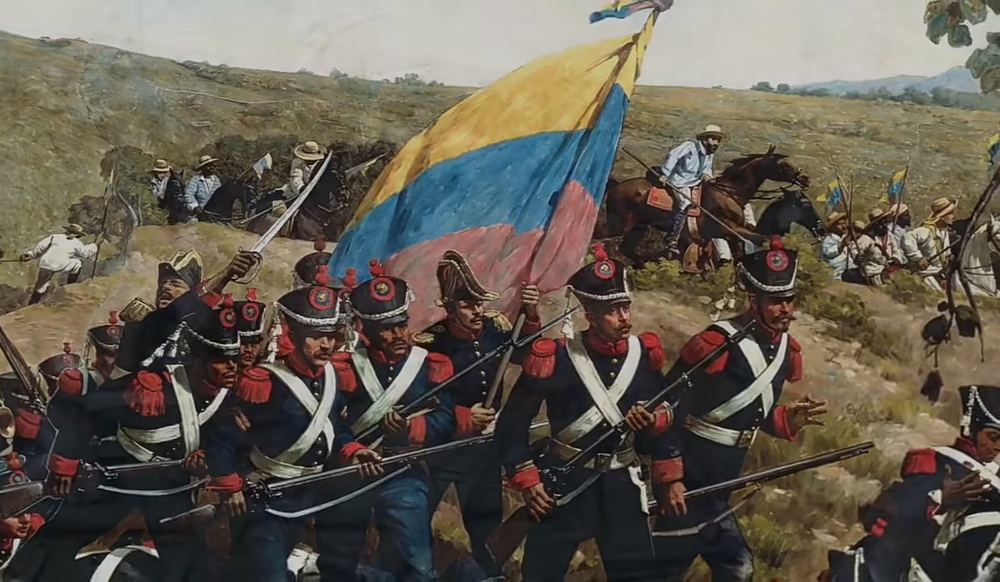
Bolívar then allied with the plainsman José Antonio Páez, and the 1819 Congress of Angostura named him president. His victories at Boyacá in 1819 and Carabobo in June 1821 freed New Granada and Caracas.
Venezuela became part of Gran Colombia, governed from Bogotá, which many Venezuelans resented. Páez led the break around 1830, and Bolívar died that December, saying he had “plowed the sea”.
Two decades of war had killed between a quarter and a third of the people, estimated at about 800,000 in 1830. The United States recognised Venezuela on 28 February 1835 and opened diplomatic relations on 30 June 1835, the State Department historian records.
After 1830 power went to regional strongmen called caudillos, who competed to control the Caracas bureaucracy. Páez ruled with the creole elite for sixteen relatively peaceful years, helped by high coffee prices.
When coffee prices fell in the 1840s the elite split into Conservatives and Liberals, and the Monagas brothers ousted Páez in 1848. The study calls the abolition of slavery in 1854 their only noteworthy act.
The Federal War of 1858 to 1863 pitted local caudillos against each other, and the Liberals won. Antonio Guzmán Blanco then ran a dictatorship from 1870 to 1888 that brought peace, schools and railways, and a large personal fortune.
In 1899 Cipriano Castro marched on Caracas from the Andean state of Táchira and took the presidency. His rule provoked blockades and bombardments by British, German and Italian warships over foreign claims.
In 1908 his aide Juan Vicente Gómez seized power and held it until his death in December 1935. The “Tyrant of the Andes” relied on a loyal army and a secret police, and thousands of opponents were jailed.
Under Gómez foreign companies began pumping oil, which let him pay off the whole foreign debt. Most Venezuelans gained little, because oil created few jobs and imports pushed up food prices.
In 1928 students at the Central University rose against Gómez and were jailed or exiled. Several of that “generation of 1928”, including Rómulo Betancourt and Raúl Leoni, later led the country.
Gómez’s death in 1935 closed the century of caudillos. Two successive presidents from Táchira eased his controls.
A 1943 law raised the state’s oil income. On 18 October 1945 Democratic Action and junior officers overthrew President Medina Angarita.
A 1946 decree gave every citizen over eighteen the vote, women included, and the novelist Rómulo Gallegos took office as president in February 1948. The army removed him in November 1948, and Marcos Pérez Jiménez ran a harsh dictatorship until 1958.
After the dictator Pérez Jiménez fled on 23 January 1958, the main parties agreed to share power under the Pact of Punto Fijo. The Library of Congress study says Betancourt’s inauguration in 1959 began a period of civilian democratic rule of unprecedented length.
In 1960 Venezuela, with Kuwait, Saudi Arabia, Iraq and Iran, founded OPEC, an idea of oil minister Juan Pablo Pérez Alfonso. In March 1964 the presidential sash passed for the first time from one elected president to another.
The 1973 oil shock roughly quadrupled crude prices in two months. President Carlos Andrés Pérez spent the windfall freely.
Congress approved nationalisation in August 1975, with about US$1 billion paid to fourteen foreign firms. The state company Petróleos de Venezuela (PDVSA) took over.
Oil income then levelled off, and by 1983 outside analysts put the foreign debt at about US$32 billion. In February 1983 the government imposed exchange controls, and the study says disillusion with the political system began to grow.
On 27 February 1989 riots over higher transport fares began in Guarenas and spread across Caracas. The Inter-American Court of Human Rights recorded 276 dead by official count, a figure later questioned when mass graves appeared.
In February 1992 Lieutenant Colonel Hugo Chávez led a failed coup against President Carlos Andrés Pérez and spent two years in prison before a pardon. He founded the Bolivarian Revolutionary Movement and was first elected president in 1998.
In 1999 Venezuela adopted a new constitution under Chávez. The charter created a single-chamber legislature, set a six-year presidential term and renamed the country the Bolivarian Republic of Venezuela.
On 11 April 2002 mass protests and military pressure removed Chávez for a brief period, after at least 18 people died. The military restored him, and from December 2002 to February 2003 an opposition strike cut oil exports and the government fired thousands of PDVSA staff.



