Boron One boosts Serbia project economics in updated study
Canadian explorer has outlined a higher projected return, annual revenue and after-tax net present value.
Canadian explorer Boron One Holdings (TSXV: BONE) has outlined a higher projected return, annual revenue and after-tax net present value (NPV) for its Piskanja boron project in Serbia.
An updated preliminary economic assessment (PEA) released Wednesday forecasts an after-tax internal rate of return of 89%, compared with 79% in the 2022 study. At a 10% discount rate, the NPV rises about 6% to $558.8 million from $524.9 million, while average annual gross revenue increases to $140.4 million from $126 million.
Initial capital costs remain unchanged at $79.9 million, with payback projected within a year of starting commercial production. However, the proposed mine life falls to 13 years from 16, while average annual earnings before interest, taxes, depreciation and amortization drop to $87.7 million from $91.3 million.
The economic assessment excludes inferred resources. The study remains preliminary, and the resources don’t have demonstrated economic viability.
“Given these and other factors, future activities are justified to continue to advance project development,” Boron One said in Wednesday’s statement. A future work program will be discussed to define the necessary steps toward a feasibility study and the eventual construction of an underground mine, it added.
Boron is considered a critical mineral in the United States, the United Kingdom and the European Union, but not in Canada. Its compounds are used in fertilizers, specialty glass, ceramics, fibreglass insulation, as well as electrolyte additives in some electric-vehicle batteries.
Turkey and the U.S. are the world’s largest boron producers, according to the U.S. Geological Survey . Turkey holds an estimated 950 million tonnes of reserves, expressed as boron trioxide content, by far the largest of any reporting country. Other significant producers include Bolivia, Chile, China and Peru.
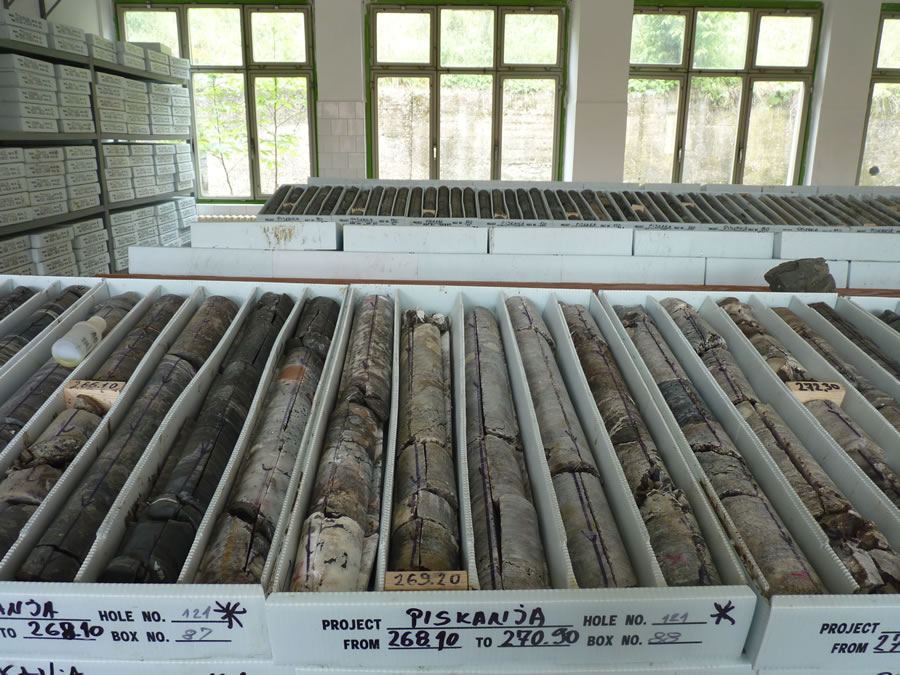
Measured and indicated resources at Piskanja total 7.1 million tonnes grading 32.4% boron trioxide for 2.3 million contained tonnes of the compound, according to an estimate dated Oct. 12. The project is in southern Serbia, about 160 km south of Belgrade by road. A 2022 estimate outlined measured and indicated resources of 6.9 million tonnes grading 34.4% boron trioxide for 2.36 million contained tonnes.
Borate mineralization at Piskanja is hosted in sedimentary rocks. The deposit includes colemanite, ulexite and howlite, minerals used in products and industrial applications that rely on boron. Boron One has been advancing technical studies and pursuing the approvals needed to develop the project.
A binding offtake agreement signed in May covers at least 25,000 tonnes of boron products annually for three years from the start of operational production, with an option to increase purchases to 50,000 tonnes. The unnamed buyer’s commitment is subject to required permits and a successful plant qualification trial.
The new study assumes prices of $650 per tonne for sales-grade colemanite and ulexite concentrates and $1,000 per tonne for technical-grade boric acid. Capital and operating cost estimates have an accuracy range of plus or minus 35%, the company said.
All-in sustaining costs are estimated at $231.44 per tonne of product, Boron One says. Sustaining capital over the mine life is forecast at $38.1 million.
The new PEA incorporates additional metallurgical and processing tests, a three-dimensional resource model distinguishing different borate types, revised mine designs, geotechnical testing, updated market studies and environmental work.
Boron One’s revised plan also changes the mix of products expected to be sold. Average annual commercial production is projected at 157,600 tonnes of colemanite and 83,800 tonnes of ulexite, two borate minerals, alongside 25,000 tonnes of boric acid. The 2022 study had forecast annual production of about 258,300 tonnes of sales-grade colemanite and 25,000 tonnes of boric acid.
Shares of Boron One last closed at C3¢ in Toronto, giving the company a market value of about C$9 million ($6.3 million). The stock has traded between C2.5¢ and C9.5¢ in the past year.
Canadian mines boost quarterly production as the expanded North American miner targets a stronger finish to 2026.