Why the federal government must stop collateralising Nigeria’s natural resources for loans
Introduction: Nigeria’s Borrowing and Securitisation History. On paper, resource-backed loans (RBLs) sound pragmatic. Nigeria needs an estimated $35 billion annually
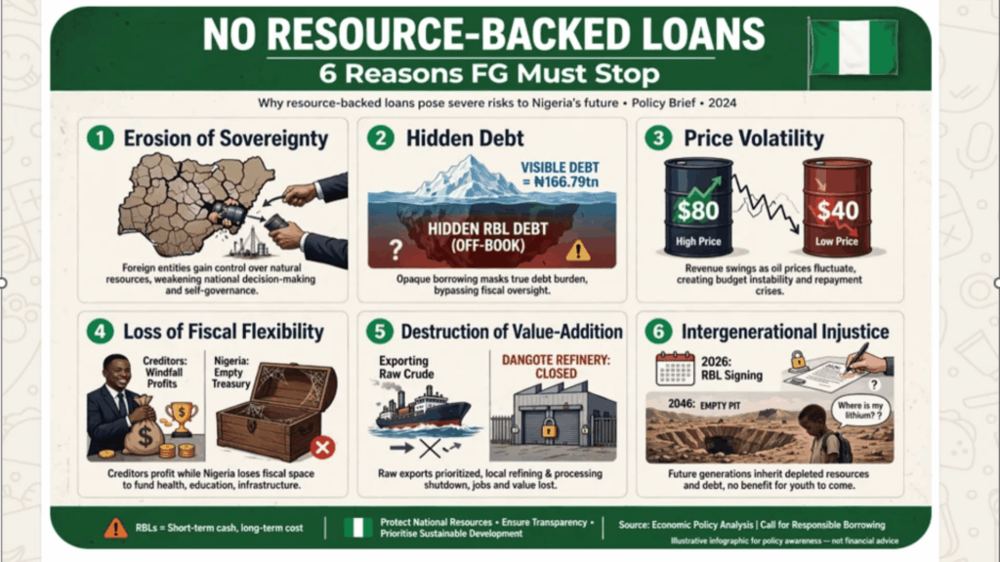
On paper, resource-backed loans (RBLs) sound pragmatic. Nigeria needs an estimated $35 billion annually for infrastructure, yet the country continues to face a significant gap between what it earns and what it spends. The 2026 budget, for instance, projects revenue of N14.2 trillion against expenditure of N39.8 trillion. The obvious response is borrowing. The problem begins with what Nigeria chooses to put on the table as security. With approximately 37 billion barrels of crude oil reserves, 209 trillion cubic feet of gas and significant deposits of minerals such as lithium, Nigeria possesses resources that should form the foundation of long-term economic prosperity. Increasingly, however, these resources are being used to secure financing today at the expense of future fiscal flexibility. This practice of pledging future crude oil, gas, and mining royalties to secure upfront cash is one of the most dangerous fiscal policies of the last decade. Nigeria’s $3.3 billion Afrexim Bank facility in 2023, associated with Project Gazelle and backed by future oil revenues, illustrates the direction in which the country is moving. NNPC has also entered into arrangements involving future crude production to service financing obligations. This is where the conversation needs to change. Natural resources are not simply another government asset that can be pledged whenever the government needs cash. They belong to the Nigerian people and represent a finite economic inheritance. Using them as collateral may provide immediate liquidity, but it can create obligations that constrain governments for years after the money has been spent. For a country already carrying public debt of N166.79 trillion as of June 30, 2026, Nigeria should be asking a more fundamental question: how much of tomorrow’s wealth are we willing to spend today? What Are Resource-Backed Loans? A resource-backed loan is a financing arrangement in which repayment is directly connected to the future production, export or revenue generated by a natural resource. The difference between such an arrangement and conventional sovereign borrowing is significant. With a conventional Eurobond, for example, Nigeria commits its general revenues to servicing the debt. With a resource-backed arrangement, a specific stream of future resource income may be committed to a lender. In practical terms, the arrangement can amount to: “Give us the money today, and we will repay you from a predetermined quantity or value of crude oil, gas or mineral revenue in the future.” Unlike a conventional Eurobond, where Nigeria promises to pay from general revenue, an RBL stipulates: “If we don’t pay, take 50,000 barrels of crude daily for the next 10 years.” Nigeria’s three main variants are crude-for-loan deals, royalty and tax-backed borrowing, and mineral-backed infrastructure deals (Natural Resources Governance Institute 2023). These arrangements can take different forms, including crude-for-loan transactions, royalty or tax-backed borrowing and mineral-backed infrastructure financing. The concern is not that every resource-backed transaction is automatically wrong. The concern is what happens when a government that is already fiscally constrained begins using its most valuable finite assets to solve recurring financing problems. DANGERS OF RESOURCE-BACKED LOANS. 1. Erosion of Sovereignty and Neocolonial Extraction. Section 44(3) of the 1999 Constitution of the Federal Republic of Nigeria vests control of mineral resources in the Federal Government on behalf of the Nigerian people. Pledging it as collateral without explicit National Assembly approval of the exact resource volume violates the spirit of that trust (Federal Republic of Nigeria, 1999). Under a typical crude-backed loan, a creditor has a right to crude at source. Nigerian courts have no jurisdiction. Arbitration is in London. In Angola’s case, lenders lifted oil directly at the port, bypassing the treasury completely (International Monetary Fund, 2024). Nigeria’s natural resources are held in trust for the Nigerian people. Section 44(3) of the 1999 Constitution vests control of mineral resources in the Federal Government. That responsibility should make the government more cautious, not less, when pledging future resource revenues. Once a significant portion of future production has been committed to a lender, the government has less freedom to determine how that resource should be used. The resource may no longer be available to respond to changing national priorities, economic shocks or future industrial policies. The structure of some resource-backed arrangements can make the problem even more serious where lenders have direct rights over the revenue or physical commodity, and disputes are subject to international arbitration. The experience of other resource-dependent countries demonstrates the danger. Angola, for example, has used oil-backed financing structures in which oil revenues were committed directly to debt servicing. Nigeria should not wait until similar arrangements materially restrict its fiscal independence before recognising the risk. 2. Hidden Debt and Lack of Transparency. Nigeria’s reported public debt does not necessarily tell the whole story of the country’s future financial obligations. This is particularly important when resource-backed transactions are contracted through entities such as NNPC Limited rather than appearing directly as conventional sovereign borrowing. If an obligation ultimately depends on future oil production or revenue that would otherwise have accrued to the Nigerian state, it has a fiscal consequence whether or not it appears neatly under the headline figure for sovereign debt. That distinction matters. The National Assembly, investors and the Nigerian public need to know not only how much government has borrowed, but also how much future government revenue has already been committed. A country can therefore appear to have room to borrow while significant portions of future resource income are already spoken for. That is a transparency problem. It is also a budgeting problem. If future oil production is already committed to debt servicing, it should not be treated as though the entire production volume remains freely available to finance government expenditure. 3. Commodity Price Volatility Risk. Commodity Price Volatility Can Turn a Manageable Loan into a Fiscal Burden. Natural resources are inherently exposed to price volatility. Suppose Nigeria borrows $1 billion against oil when crude is valued at $80 per barrel. At that price, the equivalent of approximately 12.5 million barrels would cover the principal, ignoring interest and other financing costs. If oil falls to $40 per barrel, the amount of crude required to generate the same dollar value doubles. The debt does not become smaller because the price has fallen. The resource required to repay it becomes larger. This is not a theoretical risk. Chad experienced the consequences of oil-backed borrowing when oil prices collapsed after it had taken substantial financing backed by future oil production. Debt servicing subsequently placed enormous pressure on its oil revenues. Nigeria, which has repeatedly experienced oil-price shocks, should understand this risk better than most. 4. Loss of Fiscal Flexibility. The purpose of crude oil is to provide fiscal flexibility during shocks. If oil is pre-sold, that flexibility is gone. One of the most valuable characteristics of oil revenue is flexibility. When oil prices rise, the government can use additional revenues to invest, save, reduce deficits or respond to unexpected pressures. When oil prices fall, government revenue falls as well. The ability to redirect available income becomes even more important. But if a substantial portion of future oil production has already been committed to creditors, then that flexibility automatically disappears. Nigeria may experience an oil-price increase and still find that a significant portion of the additional value generated by higher prices is already committed elsewhere. The country carries the production risk while creditors gain greater certainty over repayment. That is not necessarily an attractive trade for a government that already has limited fiscal space. 5. Destruction of Value-Addition Policy. It Can Undermine Nigeria’s Value-Addition Agenda. Nigeria has increasingly recognised that exporting raw resources is not enough. The country wants to refine more of its crude domestically, develop petrochemicals, process critical minerals and build industries around resources such as lithium. These ambitions require access to the very resources being used to secure financing. If future crude production is committed to external creditors, the government may have less flexibility to redirect that crude toward domestic refining or industrial development. The same principle applies to minerals. Nigeria should not borrow against the future of its mineral economy while simultaneously telling investors that it wants to build domestic processing and manufacturing industries around those minerals. A resource should ideally create an economic chain: extraction, processing, manufacturing, employment, exports and tax revenue. Collateralising the resource too early can interrupt that chain. 6. Intergenerational Injustice. It Creates an Intergenerational Burden. Perhaps the most important argument is also the simplest. Oil, gas and mineral deposits are finite. Once extracted and consumed, they cannot simply be replaced. When a government borrows against future resource production, it is effectively bringing part of tomorrow’s wealth into today’s budget. There are circumstances where borrowing against future income can be justified. But doing so repeatedly to finance recurring expenditure creates a dangerous pattern. A child born today in a mineral-producing community should eventually inherit an economy that has benefited from the resources beneath the ground. That child should not inherit only the debt accumulated from selling those resources in advance. This is why natural-resource financing must be considered not merely as a question of borrowing, but as a question of intergenerational responsibility. Section 16 of the Constitution mandates the state to protect resources for future generations. Resource-backed borrowing violates this. What Nigeria Should Do Instead: Recommended steps to stop this menace. Nigeria needs a clearer framework for resource-backed financing. • Firstly, amend the Fiscal Responsibility Act: the Fiscal Responsibility Act should be strengthened to place strict limits on the collateralization of unextracted natural resources and future resource revenues. Any exceptional transaction should require full disclosure and rigorous legislative scrutiny. Prohibit collateralization of unextracted natural resources and future royalties as security for any public borrowing. Require full disclosure of any NNPC forward sale above 10,000 bpd to the National Assembly. • Secondly, borrow against cash flows, not resources: all significant NNPC forward-sale arrangements should be disclosed to the National Assembly and the public. Nigerians should know how much future production has been committed, to whom, for what amount, at what price and for how long. Issue infrastructure bonds backed by user fees, e.g., tolls from the Lagos-Ibadan Expressway, not crude. • Thirdly, increase revenue, not collateral: Nigeria should increasingly borrow against productive cash flows rather than finite resources. Infrastructure that generates predictable revenue, such as toll roads, ports, utilities and other commercially viable assets, can provide a more sustainable basis for project financing. The real problem is N14.2 trillion revenue vs N39.8 trillion spending. Implement the 2012 Oronsaye Report, merge MDAs, stop N5.9 trillion fuel subsidy leakages, and tax luxury, not resources. • Fourthly, use concessional windows: Nigeria should make greater use of concessional financing. Institutions such as the World Bank and other development-finance institutions provide long-tenor financing on terms that can be substantially more favourable than commercial resource-backed borrowing. World Bank IDA loans at 0.75% for 40 years require no collateral, only reforms. That is cheaper than Afreximbank at 8% plus oil. • Finally, create a Sovereign Wealth Lock: every resource-backed transaction should be subjected to a transparent value-for-money assessment. The government should be able to demonstrate not simply that it can obtain the loan, but that the economic return from the project being financed will exceed the long-term value of the resources being committed. Require that any resource forward sale above $100 million must be approved by the National Assembly and published in the DMO debt report, including barrels encumbered. Stopping resource-backed loans does not mean stop borrowing. It means borrow better: Conclusion: A Mountain We Must Not Make Higher. The heading of my previous article called debt a mountain on a fragile economy. Resource-backed loans make that mountain taller and more unstable because they remove the very ground (the oil, gas, lithium, gold) that the fragile economy stands on. Nigeria’s natural resources should be treated as national capital, not as an emergency credit card. The country has spent decades struggling with the consequences of an economy heavily dependent on oil revenue. The answer cannot be to mortgage more of that same finite wealth whenever government finances become strained. In 2005, Nigeria completed its exit from approximately $18 billion in Paris Club debt. That process was important not only because it reduced the country’s debt burden, but because it restored a degree of fiscal sovereignty. Twenty-one years later, Nigeria must be careful not to recreate a similar vulnerability through another mechanism. Borrowing itself is not the enemy. Development requires capital, and responsible borrowing can accelerate economic growth. The danger is borrowing in a way that quietly transfers control over tomorrow’s national wealth to creditors today. Nigeria needs infrastructure. It needs capital. It needs investment. It needs growth. But it also needs to protect the resources that belong to generations yet unborn. The mountain of debt is already high. We should not mortgage the ground beneath it. Nigeria is not short of resources. It is short of revenue discipline, transparency, and courage to tax the rich instead of mortgaging the poor’s patrimony. In 2005, Nigeria exited $18 billion Paris Club debt precisely to reclaim sovereignty over its oil. Twenty-one years later, we must not re-enter debt slavery through the back door of resource collateral. The Federal Government should stop backing loans with our natural resources, not tomorrow, but today, by executive order, pending a legislative ban. If we must borrow, let us pledge our reforms, not our geology. Let us pledge our efficiency, not our children’s inheritance. The mountain is already N166.79 trillion high. Let us not give away the land beneath it. For more information, clarifications and support, Contact Prof. Prisca Ndu on +2348033086190 or [email protected] Related News India-Nigeria trade rebounds to $9bn as LCCI pitches Nigeria as gateway to AfCFTA FAAN sets December for opening of new MMIA terminal link bridge Civil war reconciliation: Federal Government targets closure after 59 years Prisca Ndu Dr. Prisca Ndu who holds four doctorate degrees in Credit Management, Banking and Finance, Leadership and Management and Artificial Intelligence, is a social impact advocate and multi-sector entrepreneur. An alumnus of the University of Ibadan, Lagos Business School, Harvard Business School, London Graduate School, Institute of Management Development, INSEAD and Robert Kennedy College, Switzerland, amongst others. She sits on the Board of several companies including INDECO, KREENO Consortium, BHLA Awards, and many more. She was listed in 2017 among the most influential people of African descent by the United Nations and is passionate about Nation Building. Share
Increasingly, however, these resources are being used to secure financing today at the expense of future fiscal flexibility. This practice of pledging future crude oil, gas, and mining royalties to secure upfront cash is one of the most dangerous fiscal policies of the last decade. Nigeria’s $3.3 billion Afrexim Bank facility in 2023, associated with Project Gazelle and backed by future oil revenues, illustrates the direction in which the country is moving. NNPC has also entered into arrangements involving future crude production to service financing obligations. This is where the conversation needs to change. Natural resources are not simply another government asset that can be pledged whenever the government needs cash. They belong to the Nigerian people and represent a finite economic inheritance. Using them as collateral may provide immediate liquidity, but it can create obligations that constrain governments for years after the money has been spent. For a country already carrying public debt of N166.79 trillion as of June 30, 2026, Nigeria should be asking a more fundamental question: how much of tomorrow’s wealth are we willing to spend today? What Are Resource-Backed Loans? A resource-backed loan is a financing arrangement in which repayment is directly connected to the future production, export or revenue generated by a natural resource. The difference between such an arrangement and conventional sovereign borrowing is significant. With a conventional Eurobond, for example, Nigeria commits its general revenues to servicing the debt. With a resource-backed arrangement, a specific stream of future resource income may be committed to a lender. In practical terms, the arrangement can amount to: “Give us the money today, and we will repay you from a predetermined quantity or value of crude oil, gas or mineral revenue in the future.” Unlike a conventional Eurobond, where Nigeria promises to pay from general revenue, an RBL stipulates: “If we don’t pay, take 50,000 barrels of crude daily for the next 10 years.” Nigeria’s three main variants are crude-for-loan deals, royalty and tax-backed borrowing, and mineral-backed infrastructure deals (Natural Resources Governance Institute 2023). These arrangements can take different forms, including crude-for-loan transactions, royalty or tax-backed borrowing and mineral-backed infrastructure financing. The concern is not that every resource-backed transaction is automatically wrong. The concern is what happens when a government that is already fiscally constrained begins using its most valuable finite assets to solve recurring financing problems. DANGERS OF RESOURCE-BACKED LOANS. 1. Erosion of Sovereignty and Neocolonial Extraction. Section 44(3) of the 1999 Constitution of the Federal Republic of Nigeria vests control of mineral resources in the Federal Government on behalf of the Nigerian people. Pledging it as collateral without explicit National Assembly approval of the exact resource volume violates the spirit of that trust (Federal Republic of Nigeria, 1999). Under a typical crude-backed loan, a creditor has a right to crude at source. Nigerian courts have no jurisdiction. Arbitration is in London. In Angola’s case, lenders lifted oil directly at the port, bypassing the treasury completely (International Monetary Fund, 2024). Nigeria’s natural resources are held in trust for the Nigerian people. Section 44(3) of the 1999 Constitution vests control of mineral resources in the Federal Government. That responsibility should make the government more cautious, not less, when pledging future resource revenues. Once a significant portion of future production has been committed to a lender, the government has less freedom to determine how that resource should be used. The resource may no longer be available to respond to changing national priorities, economic shocks or future industrial policies. The structure of some resource-backed arrangements can make the problem even more serious where lenders have direct rights over the revenue or physical commodity, and disputes are subject to international arbitration. The experience of other resource-dependent countries demonstrates the danger. Angola, for example, has used oil-backed financing structures in which oil revenues were committed directly to debt servicing. Nigeria should not wait until similar arrangements materially restrict its fiscal independence before recognising the risk. 2. Hidden Debt and Lack of Transparency. Nigeria’s reported public debt does not necessarily tell the whole story of the country’s future financial obligations. This is particularly important when resource-backed transactions are contracted through entities such as NNPC Limited rather than appearing directly as conventional sovereign borrowing. If an obligation ultimately depends on future oil production or revenue that would otherwise have accrued to the Nigerian state, it has a fiscal consequence whether or not it appears neatly under the headline figure for sovereign debt. That distinction matters. The National Assembly, investors and the Nigerian public need to know not only how much government has borrowed, but also how much future government revenue has already been committed. A country can therefore appear to have room to borrow while significant portions of future resource income are already spoken for. That is a transparency problem. It is also a budgeting problem. If future oil production is already committed to debt servicing, it should not be treated as though the entire production volume remains freely available to finance government expenditure. 3. Commodity Price Volatility Risk. Commodity Price Volatility Can Turn a Manageable Loan into a Fiscal Burden. Natural resources are inherently exposed to price volatility. Suppose Nigeria borrows $1 billion against oil when crude is valued at $80 per barrel. At that price, the equivalent of approximately 12.5 million barrels would cover the principal, ignoring interest and other financing costs. If oil falls to $40 per barrel, the amount of crude required to generate the same dollar value doubles. The debt does not become smaller because the price has fallen. The resource required to repay it becomes larger. This is not a theoretical risk. Chad experienced the consequences of oil-backed borrowing when oil prices collapsed after it had taken substantial financing backed by future oil production. Debt servicing subsequently placed enormous pressure on its oil revenues. Nigeria, which has repeatedly experienced oil-price shocks, should understand this risk better than most. 4. Loss of Fiscal Flexibility. The purpose of crude oil is to provide fiscal flexibility during shocks. If oil is pre-sold, that flexibility is gone. One of the most valuable characteristics of oil revenue is flexibility. When oil prices rise, the government can use additional revenues to invest, save, reduce deficits or respond to unexpected pressures. When oil prices fall, government revenue falls as well. The ability to redirect available income becomes even more important. But if a substantial portion of future oil production has already been committed to creditors, then that flexibility automatically disappears. Nigeria may experience an oil-price increase and still find that a significant portion of the additional value generated by higher prices is already committed elsewhere. The country carries the production risk while creditors gain greater certainty over repayment. That is not necessarily an attractive trade for a government that already has limited fiscal space. 5. Destruction of Value-Addition Policy. It Can Undermine Nigeria’s Value-Addition Agenda. Nigeria has increasingly recognised that exporting raw resources is not enough. The country wants to refine more of its crude domestically, develop petrochemicals, process critical minerals and build industries around resources such as lithium. These ambitions require access to the very resources being used to secure financing. If future crude production is committed to external creditors, the government may have less flexibility to redirect that crude toward domestic refining or industrial development. The same principle applies to minerals. Nigeria should not borrow against the future of its mineral economy while simultaneously telling investors that it wants to build domestic processing and manufacturing industries around those minerals. A resource should ideally create an economic chain: extraction, processing, manufacturing, employment, exports and tax revenue. Collateralising the resource too early can interrupt that chain. 6. Intergenerational Injustice. It Creates an Intergenerational Burden. Perhaps the most important argument is also the simplest. Oil, gas and mineral deposits are finite. Once extracted and consumed, they cannot simply be replaced. When a government borrows against future resource production, it is effectively bringing part of tomorrow’s wealth into today’s budget. There are circumstances where borrowing against future income can be justified. But doing so repeatedly to finance recurring expenditure creates a dangerous pattern. A child born today in a mineral-producing community should eventually inherit an economy that has benefited from the resources beneath the ground. That child should not inherit only the debt accumulated from selling those resources in advance. This is why natural-resource financing must be considered not merely as a question of borrowing, but as a question of intergenerational responsibility. Section 16 of the Constitution mandates the state to protect resources for future generations. Resource-backed borrowing violates this. What Nigeria Should Do Instead: Recommended steps to stop this menace. Nigeria needs a clearer framework for resource-backed financing. • Firstly, amend the Fiscal Responsibility Act: the Fiscal Responsibility Act should be strengthened to place strict limits on the collateralization of unextracted natural resources and future resource revenues. Any exceptional transaction should require full disclosure and rigorous legislative scrutiny. Prohibit collateralization of unextracted natural resources and future royalties as security for any public borrowing. Require full disclosure of any NNPC forward sale above 10,000 bpd to the National Assembly. • Secondly, borrow against cash flows, not resources: all significant NNPC forward-sale arrangements should be disclosed to the National Assembly and the public. Nigerians should know how much future production has been committed, to whom, for what amount, at what price and for how long. Issue infrastructure bonds backed by user fees, e.g., tolls from the Lagos-Ibadan Expressway, not crude. • Thirdly, increase revenue, not collateral: Nigeria should increasingly borrow against productive cash flows rather than finite resources. Infrastructure that generates predictable revenue, such as toll roads, ports, utilities and other commercially viable assets, can provide a more sustainable basis for project financing. The real problem is N14.2 trillion revenue vs N39.8 trillion spending. Implement the 2012 Oronsaye Report, merge MDAs, stop N5.9 trillion fuel subsidy leakages, and tax luxury, not resources. • Fourthly, use concessional windows: Nigeria should make greater use of concessional financing. Institutions such as the World Bank and other development-finance institutions provide long-tenor financing on terms that can be substantially more favourable than commercial resource-backed borrowing. World Bank IDA loans at 0.75% for 40 years require no collateral, only reforms. That is cheaper than Afreximbank at 8% plus oil. • Finally, create a Sovereign Wealth Lock: every resource-backed transaction should be subjected to a transparent value-for-money assessment. The government should be able to demonstrate not simply that it can obtain the loan, but that the economic return from the project being financed will exceed the long-term value of the resources being committed. Require that any resource forward sale above $100 million must be approved by the National Assembly and published in the DMO debt report, including barrels encumbered. Stopping resource-backed loans does not mean stop borrowing. It means borrow better: Conclusion: A Mountain We Must Not Make Higher. The heading of my previous article called debt a mountain on a fragile economy. Resource-backed loans make that mountain taller and more unstable because they remove the very ground (the oil, gas, lithium, gold) that the fragile economy stands on. Nigeria’s natural resources should be treated as national capital, not as an emergency credit card. The country has spent decades struggling with the consequences of an economy heavily dependent on oil revenue. The answer cannot be to mortgage more of that same finite wealth whenever government finances become strained. In 2005, Nigeria completed its exit from approximately $18 billion in Paris Club debt. That process was important not only because it reduced the country’s debt burden, but because it restored a degree of fiscal sovereignty. Twenty-one years later, Nigeria must be careful not to recreate a similar vulnerability through another mechanism. Borrowing itself is not the enemy. Development requires capital, and responsible borrowing can accelerate economic growth. The danger is borrowing in a way that quietly transfers control over tomorrow’s national wealth to creditors today. Nigeria needs infrastructure. It needs capital. It needs investment. It needs growth. But it also needs to protect the resources that belong to generations yet unborn. The mountain of debt is already high. We should not mortgage the ground beneath it. Nigeria is not short of resources. It is short of revenue discipline, transparency, and courage to tax the rich instead of mortgaging the poor’s patrimony. In 2005, Nigeria exited $18 billion Paris Club debt precisely to reclaim sovereignty over its oil. Twenty-one years later, we must not re-enter debt slavery through the back door of resource collateral. The Federal Government should stop backing loans with our natural resources, not tomorrow, but today, by executive order, pending a legislative ban. If we must borrow, let us pledge our reforms, not our geology. Let us pledge our efficiency, not our children’s inheritance. The mountain is already N166.79 trillion high. Let us not give away the land beneath it. For more information, clarifications and support, Contact Prof. Prisca Ndu on +2348033086190 or [email protected] Related News India-Nigeria trade rebounds to $9bn as LCCI pitches Nigeria as gateway to AfCFTA FAAN sets December for opening of new MMIA terminal link bridge Civil war reconciliation: Federal Government targets closure after 59 years Prisca Ndu Dr. Prisca Ndu who holds four doctorate degrees in Credit Management, Banking and Finance, Leadership and Management and Artificial Intelligence, is a social impact advocate and multi-sector entrepreneur. An alumnus of the University of Ibadan, Lagos Business School, Harvard Business School, London Graduate School, Institute of Management Development, INSEAD and Robert Kennedy College, Switzerland, amongst others. She sits on the Board of several companies including INDECO, KREENO Consortium, BHLA Awards, and many more. She was listed in 2017 among the most influential people of African descent by the United Nations and is passionate about Nation Building. Share
For a country already carrying public debt of N166.79 trillion as of June 30, 2026, Nigeria should be asking a more fundamental question: how much of tomorrow’s wealth are we willing to spend today? What Are Resource-Backed Loans? A resource-backed loan is a financing arrangement in which repayment is directly connected to the future production, export or revenue generated by a natural resource. The difference between such an arrangement and conventional sovereign borrowing is significant. With a conventional Eurobond, for example, Nigeria commits its general revenues to servicing the debt. With a resource-backed arrangement, a specific stream of future resource income may be committed to a lender. In practical terms, the arrangement can amount to: “Give us the money today, and we will repay you from a predetermined quantity or value of crude oil, gas or mineral revenue in the future.” Unlike a conventional Eurobond, where Nigeria promises to pay from general revenue, an RBL stipulates: “If we don’t pay, take 50,000 barrels of crude daily for the next 10 years.” Nigeria’s three main variants are crude-for-loan deals, royalty and tax-backed borrowing, and mineral-backed infrastructure deals (Natural Resources Governance Institute 2023). These arrangements can take different forms, including crude-for-loan transactions, royalty or tax-backed borrowing and mineral-backed infrastructure financing. The concern is not that every resource-backed transaction is automatically wrong. The concern is what happens when a government that is already fiscally constrained begins using its most valuable finite assets to solve recurring financing problems. DANGERS OF RESOURCE-BACKED LOANS. 1. Erosion of Sovereignty and Neocolonial Extraction. Section 44(3) of the 1999 Constitution of the Federal Republic of Nigeria vests control of mineral resources in the Federal Government on behalf of the Nigerian people. Pledging it as collateral without explicit National Assembly approval of the exact resource volume violates the spirit of that trust (Federal Republic of Nigeria, 1999). Under a typical crude-backed loan, a creditor has a right to crude at source. Nigerian courts have no jurisdiction. Arbitration is in London. In Angola’s case, lenders lifted oil directly at the port, bypassing the treasury completely (International Monetary Fund, 2024). Nigeria’s natural resources are held in trust for the Nigerian people. Section 44(3) of the 1999 Constitution vests control of mineral resources in the Federal Government. That responsibility should make the government more cautious, not less, when pledging future resource revenues. Once a significant portion of future production has been committed to a lender, the government has less freedom to determine how that resource should be used. The resource may no longer be available to respond to changing national priorities, economic shocks or future industrial policies. The structure of some resource-backed arrangements can make the problem even more serious where lenders have direct rights over the revenue or physical commodity, and disputes are subject to international arbitration. The experience of other resource-dependent countries demonstrates the danger. Angola, for example, has used oil-backed financing structures in which oil revenues were committed directly to debt servicing. Nigeria should not wait until similar arrangements materially restrict its fiscal independence before recognising the risk. 2. Hidden Debt and Lack of Transparency. Nigeria’s reported public debt does not necessarily tell the whole story of the country’s future financial obligations. This is particularly important when resource-backed transactions are contracted through entities such as NNPC Limited rather than appearing directly as conventional sovereign borrowing. If an obligation ultimately depends on future oil production or revenue that would otherwise have accrued to the Nigerian state, it has a fiscal consequence whether or not it appears neatly under the headline figure for sovereign debt. That distinction matters. The National Assembly, investors and the Nigerian public need to know not only how much government has borrowed, but also how much future government revenue has already been committed. A country can therefore appear to have room to borrow while significant portions of future resource income are already spoken for. That is a transparency problem. It is also a budgeting problem. If future oil production is already committed to debt servicing, it should not be treated as though the entire production volume remains freely available to finance government expenditure. 3. Commodity Price Volatility Risk. Commodity Price Volatility Can Turn a Manageable Loan into a Fiscal Burden. Natural resources are inherently exposed to price volatility. Suppose Nigeria borrows $1 billion against oil when crude is valued at $80 per barrel. At that price, the equivalent of approximately 12.5 million barrels would cover the principal, ignoring interest and other financing costs. If oil falls to $40 per barrel, the amount of crude required to generate the same dollar value doubles. The debt does not become smaller because the price has fallen. The resource required to repay it becomes larger. This is not a theoretical risk. Chad experienced the consequences of oil-backed borrowing when oil prices collapsed after it had taken substantial financing backed by future oil production. Debt servicing subsequently placed enormous pressure on its oil revenues. Nigeria, which has repeatedly experienced oil-price shocks, should understand this risk better than most. 4. Loss of Fiscal Flexibility. The purpose of crude oil is to provide fiscal flexibility during shocks. If oil is pre-sold, that flexibility is gone. One of the most valuable characteristics of oil revenue is flexibility. When oil prices rise, the government can use additional revenues to invest, save, reduce deficits or respond to unexpected pressures. When oil prices fall, government revenue falls as well. The ability to redirect available income becomes even more important. But if a substantial portion of future oil production has already been committed to creditors, then that flexibility automatically disappears. Nigeria may experience an oil-price increase and still find that a significant portion of the additional value generated by higher prices is already committed elsewhere. The country carries the production risk while creditors gain greater certainty over repayment. That is not necessarily an attractive trade for a government that already has limited fiscal space. 5. Destruction of Value-Addition Policy. It Can Undermine Nigeria’s Value-Addition Agenda. Nigeria has increasingly recognised that exporting raw resources is not enough. The country wants to refine more of its crude domestically, develop petrochemicals, process critical minerals and build industries around resources such as lithium. These ambitions require access to the very resources being used to secure financing. If future crude production is committed to external creditors, the government may have less flexibility to redirect that crude toward domestic refining or industrial development. The same principle applies to minerals. Nigeria should not borrow against the future of its mineral economy while simultaneously telling investors that it wants to build domestic processing and manufacturing industries around those minerals. A resource should ideally create an economic chain: extraction, processing, manufacturing, employment, exports and tax revenue. Collateralising the resource too early can interrupt that chain. 6. Intergenerational Injustice. It Creates an Intergenerational Burden. Perhaps the most important argument is also the simplest. Oil, gas and mineral deposits are finite. Once extracted and consumed, they cannot simply be replaced. When a government borrows against future resource production, it is effectively bringing part of tomorrow’s wealth into today’s budget. There are circumstances where borrowing against future income can be justified. But doing so repeatedly to finance recurring expenditure creates a dangerous pattern. A child born today in a mineral-producing community should eventually inherit an economy that has benefited from the resources beneath the ground. That child should not inherit only the debt accumulated from selling those resources in advance. This is why natural-resource financing must be considered not merely as a question of borrowing, but as a question of intergenerational responsibility. Section 16 of the Constitution mandates the state to protect resources for future generations. Resource-backed borrowing violates this. What Nigeria Should Do Instead: Recommended steps to stop this menace. Nigeria needs a clearer framework for resource-backed financing. • Firstly, amend the Fiscal Responsibility Act: the Fiscal Responsibility Act should be strengthened to place strict limits on the collateralization of unextracted natural resources and future resource revenues. Any exceptional transaction should require full disclosure and rigorous legislative scrutiny. Prohibit collateralization of unextracted natural resources and future royalties as security for any public borrowing. Require full disclosure of any NNPC forward sale above 10,000 bpd to the National Assembly. • Secondly, borrow against cash flows, not resources: all significant NNPC forward-sale arrangements should be disclosed to the National Assembly and the public. Nigerians should know how much future production has been committed, to whom, for what amount, at what price and for how long. Issue infrastructure bonds backed by user fees, e.g., tolls from the Lagos-Ibadan Expressway, not crude. • Thirdly, increase revenue, not collateral: Nigeria should increasingly borrow against productive cash flows rather than finite resources. Infrastructure that generates predictable revenue, such as toll roads, ports, utilities and other commercially viable assets, can provide a more sustainable basis for project financing. The real problem is N14.2 trillion revenue vs N39.8 trillion spending. Implement the 2012 Oronsaye Report, merge MDAs, stop N5.9 trillion fuel subsidy leakages, and tax luxury, not resources. • Fourthly, use concessional windows: Nigeria should make greater use of concessional financing. Institutions such as the World Bank and other development-finance institutions provide long-tenor financing on terms that can be substantially more favourable than commercial resource-backed borrowing. World Bank IDA loans at 0.75% for 40 years require no collateral, only reforms. That is cheaper than Afreximbank at 8% plus oil. • Finally, create a Sovereign Wealth Lock: every resource-backed transaction should be subjected to a transparent value-for-money assessment. The government should be able to demonstrate not simply that it can obtain the loan, but that the economic return from the project being financed will exceed the long-term value of the resources being committed. Require that any resource forward sale above $100 million must be approved by the National Assembly and published in the DMO debt report, including barrels encumbered. Stopping resource-backed loans does not mean stop borrowing. It means borrow better: Conclusion: A Mountain We Must Not Make Higher. The heading of my previous article called debt a mountain on a fragile economy. Resource-backed loans make that mountain taller and more unstable because they remove the very ground (the oil, gas, lithium, gold) that the fragile economy stands on. Nigeria’s natural resources should be treated as national capital, not as an emergency credit card. The country has spent decades struggling with the consequences of an economy heavily dependent on oil revenue. The answer cannot be to mortgage more of that same finite wealth whenever government finances become strained. In 2005, Nigeria completed its exit from approximately $18 billion in Paris Club debt. That process was important not only because it reduced the country’s debt burden, but because it restored a degree of fiscal sovereignty. Twenty-one years later, Nigeria must be careful not to recreate a similar vulnerability through another mechanism. Borrowing itself is not the enemy. Development requires capital, and responsible borrowing can accelerate economic growth. The danger is borrowing in a way that quietly transfers control over tomorrow’s national wealth to creditors today. Nigeria needs infrastructure. It needs capital. It needs investment. It needs growth. But it also needs to protect the resources that belong to generations yet unborn. The mountain of debt is already high. We should not mortgage the ground beneath it. Nigeria is not short of resources. It is short of revenue discipline, transparency, and courage to tax the rich instead of mortgaging the poor’s patrimony. In 2005, Nigeria exited $18 billion Paris Club debt precisely to reclaim sovereignty over its oil. Twenty-one years later, we must not re-enter debt slavery through the back door of resource collateral. The Federal Government should stop backing loans with our natural resources, not tomorrow, but today, by executive order, pending a legislative ban. If we must borrow, let us pledge our reforms, not our geology. Let us pledge our efficiency, not our children’s inheritance. The mountain is already N166.79 trillion high. Let us not give away the land beneath it. For more information, clarifications and support, Contact Prof. Prisca Ndu on +2348033086190 or [email protected] Related News India-Nigeria trade rebounds to $9bn as LCCI pitches Nigeria as gateway to AfCFTA FAAN sets December for opening of new MMIA terminal link bridge Civil war reconciliation: Federal Government targets closure after 59 years Prisca Ndu Dr. Prisca Ndu who holds four doctorate degrees in Credit Management, Banking and Finance, Leadership and Management and Artificial Intelligence, is a social impact advocate and multi-sector entrepreneur. An alumnus of the University of Ibadan, Lagos Business School, Harvard Business School, London Graduate School, Institute of Management Development, INSEAD and Robert Kennedy College, Switzerland, amongst others. She sits on the Board of several companies including INDECO, KREENO Consortium, BHLA Awards, and many more. She was listed in 2017 among the most influential people of African descent by the United Nations and is passionate about Nation Building. Share
A resource-backed loan is a financing arrangement in which repayment is directly connected to the future production, export or revenue generated by a natural resource. The difference between such an arrangement and conventional sovereign borrowing is significant. With a conventional Eurobond, for example, Nigeria commits its general revenues to servicing the debt. With a resource-backed arrangement, a specific stream of future resource income may be committed to a lender. In practical terms, the arrangement can amount to: “Give us the money today, and we will repay you from a predetermined quantity or value of crude oil, gas or mineral revenue in the future.” Unlike a conventional Eurobond, where Nigeria promises to pay from general revenue, an RBL stipulates: “If we don’t pay, take 50,000 barrels of crude daily for the next 10 years.” Nigeria’s three main variants are crude-for-loan deals, royalty and tax-backed borrowing, and mineral-backed infrastructure deals (Natural Resources Governance Institute 2023). These arrangements can take different forms, including crude-for-loan transactions, royalty or tax-backed borrowing and mineral-backed infrastructure financing. The concern is not that every resource-backed transaction is automatically wrong. The concern is what happens when a government that is already fiscally constrained begins using its most valuable finite assets to solve recurring financing problems. DANGERS OF RESOURCE-BACKED LOANS. 1. Erosion of Sovereignty and Neocolonial Extraction. Section 44(3) of the 1999 Constitution of the Federal Republic of Nigeria vests control of mineral resources in the Federal Government on behalf of the Nigerian people. Pledging it as collateral without explicit National Assembly approval of the exact resource volume violates the spirit of that trust (Federal Republic of Nigeria, 1999). Under a typical crude-backed loan, a creditor has a right to crude at source. Nigerian courts have no jurisdiction. Arbitration is in London. In Angola’s case, lenders lifted oil directly at the port, bypassing the treasury completely (International Monetary Fund, 2024). Nigeria’s natural resources are held in trust for the Nigerian people. Section 44(3) of the 1999 Constitution vests control of mineral resources in the Federal Government. That responsibility should make the government more cautious, not less, when pledging future resource revenues. Once a significant portion of future production has been committed to a lender, the government has less freedom to determine how that resource should be used. The resource may no longer be available to respond to changing national priorities, economic shocks or future industrial policies. The structure of some resource-backed arrangements can make the problem even more serious where lenders have direct rights over the revenue or physical commodity, and disputes are subject to international arbitration. The experience of other resource-dependent countries demonstrates the danger. Angola, for example, has used oil-backed financing structures in which oil revenues were committed directly to debt servicing. Nigeria should not wait until similar arrangements materially restrict its fiscal independence before recognising the risk. 2. Hidden Debt and Lack of Transparency. Nigeria’s reported public debt does not necessarily tell the whole story of the country’s future financial obligations. This is particularly important when resource-backed transactions are contracted through entities such as NNPC Limited rather than appearing directly as conventional sovereign borrowing. If an obligation ultimately depends on future oil production or revenue that would otherwise have accrued to the Nigerian state, it has a fiscal consequence whether or not it appears neatly under the headline figure for sovereign debt. That distinction matters. The National Assembly, investors and the Nigerian public need to know not only how much government has borrowed, but also how much future government revenue has already been committed. A country can therefore appear to have room to borrow while significant portions of future resource income are already spoken for. That is a transparency problem. It is also a budgeting problem. If future oil production is already committed to debt servicing, it should not be treated as though the entire production volume remains freely available to finance government expenditure. 3. Commodity Price Volatility Risk. Commodity Price Volatility Can Turn a Manageable Loan into a Fiscal Burden. Natural resources are inherently exposed to price volatility. Suppose Nigeria borrows $1 billion against oil when crude is valued at $80 per barrel. At that price, the equivalent of approximately 12.5 million barrels would cover the principal, ignoring interest and other financing costs. If oil falls to $40 per barrel, the amount of crude required to generate the same dollar value doubles. The debt does not become smaller because the price has fallen. The resource required to repay it becomes larger. This is not a theoretical risk. Chad experienced the consequences of oil-backed borrowing when oil prices collapsed after it had taken substantial financing backed by future oil production. Debt servicing subsequently placed enormous pressure on its oil revenues. Nigeria, which has repeatedly experienced oil-price shocks, should understand this risk better than most. 4. Loss of Fiscal Flexibility. The purpose of crude oil is to provide fiscal flexibility during shocks. If oil is pre-sold, that flexibility is gone. One of the most valuable characteristics of oil revenue is flexibility. When oil prices rise, the government can use additional revenues to invest, save, reduce deficits or respond to unexpected pressures. When oil prices fall, government revenue falls as well. The ability to redirect available income becomes even more important. But if a substantial portion of future oil production has already been committed to creditors, then that flexibility automatically disappears. Nigeria may experience an oil-price increase and still find that a significant portion of the additional value generated by higher prices is already committed elsewhere. The country carries the production risk while creditors gain greater certainty over repayment. That is not necessarily an attractive trade for a government that already has limited fiscal space. 5. Destruction of Value-Addition Policy. It Can Undermine Nigeria’s Value-Addition Agenda. Nigeria has increasingly recognised that exporting raw resources is not enough. The country wants to refine more of its crude domestically, develop petrochemicals, process critical minerals and build industries around resources such as lithium. These ambitions require access to the very resources being used to secure financing. If future crude production is committed to external creditors, the government may have less flexibility to redirect that crude toward domestic refining or industrial development. The same principle applies to minerals. Nigeria should not borrow against the future of its mineral economy while simultaneously telling investors that it wants to build domestic processing and manufacturing industries around those minerals. A resource should ideally create an economic chain: extraction, processing, manufacturing, employment, exports and tax revenue. Collateralising the resource too early can interrupt that chain. 6. Intergenerational Injustice. It Creates an Intergenerational Burden. Perhaps the most important argument is also the simplest. Oil, gas and mineral deposits are finite. Once extracted and consumed, they cannot simply be replaced. When a government borrows against future resource production, it is effectively bringing part of tomorrow’s wealth into today’s budget. There are circumstances where borrowing against future income can be justified. But doing so repeatedly to finance recurring expenditure creates a dangerous pattern. A child born today in a mineral-producing community should eventually inherit an economy that has benefited from the resources beneath the ground. That child should not inherit only the debt accumulated from selling those resources in advance. This is why natural-resource financing must be considered not merely as a question of borrowing, but as a question of intergenerational responsibility. Section 16 of the Constitution mandates the state to protect resources for future generations. Resource-backed borrowing violates this. What Nigeria Should Do Instead: Recommended steps to stop this menace. Nigeria needs a clearer framework for resource-backed financing. • Firstly, amend the Fiscal Responsibility Act: the Fiscal Responsibility Act should be strengthened to place strict limits on the collateralization of unextracted natural resources and future resource revenues. Any exceptional transaction should require full disclosure and rigorous legislative scrutiny. Prohibit collateralization of unextracted natural resources and future royalties as security for any public borrowing. Require full disclosure of any NNPC forward sale above 10,000 bpd to the National Assembly. • Secondly, borrow against cash flows, not resources: all significant NNPC forward-sale arrangements should be disclosed to the National Assembly and the public. Nigerians should know how much future production has been committed, to whom, for what amount, at what price and for how long. Issue infrastructure bonds backed by user fees, e.g., tolls from the Lagos-Ibadan Expressway, not crude. • Thirdly, increase revenue, not collateral: Nigeria should increasingly borrow against productive cash flows rather than finite resources. Infrastructure that generates predictable revenue, such as toll roads, ports, utilities and other commercially viable assets, can provide a more sustainable basis for project financing. The real problem is N14.2 trillion revenue vs N39.8 trillion spending. Implement the 2012 Oronsaye Report, merge MDAs, stop N5.9 trillion fuel subsidy leakages, and tax luxury, not resources. • Fourthly, use concessional windows: Nigeria should make greater use of concessional financing. Institutions such as the World Bank and other development-finance institutions provide long-tenor financing on terms that can be substantially more favourable than commercial resource-backed borrowing. World Bank IDA loans at 0.75% for 40 years require no collateral, only reforms. That is cheaper than Afreximbank at 8% plus oil. • Finally, create a Sovereign Wealth Lock: every resource-backed transaction should be subjected to a transparent value-for-money assessment. The government should be able to demonstrate not simply that it can obtain the loan, but that the economic return from the project being financed will exceed the long-term value of the resources being committed. Require that any resource forward sale above $100 million must be approved by the National Assembly and published in the DMO debt report, including barrels encumbered. Stopping resource-backed loans does not mean stop borrowing. It means borrow better: Conclusion: A Mountain We Must Not Make Higher. The heading of my previous article called debt a mountain on a fragile economy. Resource-backed loans make that mountain taller and more unstable because they remove the very ground (the oil, gas, lithium, gold) that the fragile economy stands on. Nigeria’s natural resources should be treated as national capital, not as an emergency credit card. The country has spent decades struggling with the consequences of an economy heavily dependent on oil revenue. The answer cannot be to mortgage more of that same finite wealth whenever government finances become strained. In 2005, Nigeria completed its exit from approximately $18 billion in Paris Club debt. That process was important not only because it reduced the country’s debt burden, but because it restored a degree of fiscal sovereignty. Twenty-one years later, Nigeria must be careful not to recreate a similar vulnerability through another mechanism. Borrowing itself is not the enemy. Development requires capital, and responsible borrowing can accelerate economic growth. The danger is borrowing in a way that quietly transfers control over tomorrow’s national wealth to creditors today. Nigeria needs infrastructure. It needs capital. It needs investment. It needs growth. But it also needs to protect the resources that belong to generations yet unborn. The mountain of debt is already high. We should not mortgage the ground beneath it. Nigeria is not short of resources. It is short of revenue discipline, transparency, and courage to tax the rich instead of mortgaging the poor’s patrimony. In 2005, Nigeria exited $18 billion Paris Club debt precisely to reclaim sovereignty over its oil. Twenty-one years later, we must not re-enter debt slavery through the back door of resource collateral. The Federal Government should stop backing loans with our natural resources, not tomorrow, but today, by executive order, pending a legislative ban. If we must borrow, let us pledge our reforms, not our geology. Let us pledge our efficiency, not our children’s inheritance. The mountain is already N166.79 trillion high. Let us not give away the land beneath it. For more information, clarifications and support, Contact Prof. Prisca Ndu on +2348033086190 or [email protected] Related News India-Nigeria trade rebounds to $9bn as LCCI pitches Nigeria as gateway to AfCFTA FAAN sets December for opening of new MMIA terminal link bridge Civil war reconciliation: Federal Government targets closure after 59 years Prisca Ndu Dr. Prisca Ndu who holds four doctorate degrees in Credit Management, Banking and Finance, Leadership and Management and Artificial Intelligence, is a social impact advocate and multi-sector entrepreneur. An alumnus of the University of Ibadan, Lagos Business School, Harvard Business School, London Graduate School, Institute of Management Development, INSEAD and Robert Kennedy College, Switzerland, amongst others. She sits on the Board of several companies including INDECO, KREENO Consortium, BHLA Awards, and many more. She was listed in 2017 among the most influential people of African descent by the United Nations and is passionate about Nation Building. Share
Unlike a conventional Eurobond, where Nigeria promises to pay from general revenue, an RBL stipulates: “If we don’t pay, take 50,000 barrels of crude daily for the next 10 years.” Nigeria’s three main variants are crude-for-loan deals, royalty and tax-backed borrowing, and mineral-backed infrastructure deals (Natural Resources Governance Institute 2023). These arrangements can take different forms, including crude-for-loan transactions, royalty or tax-backed borrowing and mineral-backed infrastructure financing. The concern is not that every resource-backed transaction is automatically wrong. The concern is what happens when a government that is already fiscally constrained begins using its most valuable finite assets to solve recurring financing problems. DANGERS OF RESOURCE-BACKED LOANS. 1. Erosion of Sovereignty and Neocolonial Extraction. Section 44(3) of the 1999 Constitution of the Federal Republic of Nigeria vests control of mineral resources in the Federal Government on behalf of the Nigerian people. Pledging it as collateral without explicit National Assembly approval of the exact resource volume violates the spirit of that trust (Federal Republic of Nigeria, 1999). Under a typical crude-backed loan, a creditor has a right to crude at source. Nigerian courts have no jurisdiction. Arbitration is in London. In Angola’s case, lenders lifted oil directly at the port, bypassing the treasury completely (International Monetary Fund, 2024). Nigeria’s natural resources are held in trust for the Nigerian people. Section 44(3) of the 1999 Constitution vests control of mineral resources in the Federal Government. That responsibility should make the government more cautious, not less, when pledging future resource revenues. Once a significant portion of future production has been committed to a lender, the government has less freedom to determine how that resource should be used. The resource may no longer be available to respond to changing national priorities, economic shocks or future industrial policies. The structure of some resource-backed arrangements can make the problem even more serious where lenders have direct rights over the revenue or physical commodity, and disputes are subject to international arbitration. The experience of other resource-dependent countries demonstrates the danger. Angola, for example, has used oil-backed financing structures in which oil revenues were committed directly to debt servicing. Nigeria should not wait until similar arrangements materially restrict its fiscal independence before recognising the risk. 2. Hidden Debt and Lack of Transparency. Nigeria’s reported public debt does not necessarily tell the whole story of the country’s future financial obligations. This is particularly important when resource-backed transactions are contracted through entities such as NNPC Limited rather than appearing directly as conventional sovereign borrowing. If an obligation ultimately depends on future oil production or revenue that would otherwise have accrued to the Nigerian state, it has a fiscal consequence whether or not it appears neatly under the headline figure for sovereign debt. That distinction matters. The National Assembly, investors and the Nigerian public need to know not only how much government has borrowed, but also how much future government revenue has already been committed. A country can therefore appear to have room to borrow while significant portions of future resource income are already spoken for. That is a transparency problem. It is also a budgeting problem. If future oil production is already committed to debt servicing, it should not be treated as though the entire production volume remains freely available to finance government expenditure. 3. Commodity Price Volatility Risk. Commodity Price Volatility Can Turn a Manageable Loan into a Fiscal Burden. Natural resources are inherently exposed to price volatility. Suppose Nigeria borrows $1 billion against oil when crude is valued at $80 per barrel. At that price, the equivalent of approximately 12.5 million barrels would cover the principal, ignoring interest and other financing costs. If oil falls to $40 per barrel, the amount of crude required to generate the same dollar value doubles. The debt does not become smaller because the price has fallen. The resource required to repay it becomes larger. This is not a theoretical risk. Chad experienced the consequences of oil-backed borrowing when oil prices collapsed after it had taken substantial financing backed by future oil production. Debt servicing subsequently placed enormous pressure on its oil revenues. Nigeria, which has repeatedly experienced oil-price shocks, should understand this risk better than most. 4. Loss of Fiscal Flexibility. The purpose of crude oil is to provide fiscal flexibility during shocks. If oil is pre-sold, that flexibility is gone. One of the most valuable characteristics of oil revenue is flexibility. When oil prices rise, the government can use additional revenues to invest, save, reduce deficits or respond to unexpected pressures. When oil prices fall, government revenue falls as well. The ability to redirect available income becomes even more important. But if a substantial portion of future oil production has already been committed to creditors, then that flexibility automatically disappears. Nigeria may experience an oil-price increase and still find that a significant portion of the additional value generated by higher prices is already committed elsewhere. The country carries the production risk while creditors gain greater certainty over repayment. That is not necessarily an attractive trade for a government that already has limited fiscal space. 5. Destruction of Value-Addition Policy. It Can Undermine Nigeria’s Value-Addition Agenda. Nigeria has increasingly recognised that exporting raw resources is not enough. The country wants to refine more of its crude domestically, develop petrochemicals, process critical minerals and build industries around resources such as lithium. These ambitions require access to the very resources being used to secure financing. If future crude production is committed to external creditors, the government may have less flexibility to redirect that crude toward domestic refining or industrial development. The same principle applies to minerals. Nigeria should not borrow against the future of its mineral economy while simultaneously telling investors that it wants to build domestic processing and manufacturing industries around those minerals. A resource should ideally create an economic chain: extraction, processing, manufacturing, employment, exports and tax revenue. Collateralising the resource too early can interrupt that chain. 6. Intergenerational Injustice. It Creates an Intergenerational Burden. Perhaps the most important argument is also the simplest. Oil, gas and mineral deposits are finite. Once extracted and consumed, they cannot simply be replaced. When a government borrows against future resource production, it is effectively bringing part of tomorrow’s wealth into today’s budget. There are circumstances where borrowing against future income can be justified. But doing so repeatedly to finance recurring expenditure creates a dangerous pattern. A child born today in a mineral-producing community should eventually inherit an economy that has benefited from the resources beneath the ground. That child should not inherit only the debt accumulated from selling those resources in advance. This is why natural-resource financing must be considered not merely as a question of borrowing, but as a question of intergenerational responsibility. Section 16 of the Constitution mandates the state to protect resources for future generations. Resource-backed borrowing violates this. What Nigeria Should Do Instead: Recommended steps to stop this menace. Nigeria needs a clearer framework for resource-backed financing. • Firstly, amend the Fiscal Responsibility Act: the Fiscal Responsibility Act should be strengthened to place strict limits on the collateralization of unextracted natural resources and future resource revenues. Any exceptional transaction should require full disclosure and rigorous legislative scrutiny. Prohibit collateralization of unextracted natural resources and future royalties as security for any public borrowing. Require full disclosure of any NNPC forward sale above 10,000 bpd to the National Assembly. • Secondly, borrow against cash flows, not resources: all significant NNPC forward-sale arrangements should be disclosed to the National Assembly and the public. Nigerians should know how much future production has been committed, to whom, for what amount, at what price and for how long. Issue infrastructure bonds backed by user fees, e.g., tolls from the Lagos-Ibadan Expressway, not crude. • Thirdly, increase revenue, not collateral: Nigeria should increasingly borrow against productive cash flows rather than finite resources. Infrastructure that generates predictable revenue, such as toll roads, ports, utilities and other commercially viable assets, can provide a more sustainable basis for project financing. The real problem is N14.2 trillion revenue vs N39.8 trillion spending. Implement the 2012 Oronsaye Report, merge MDAs, stop N5.9 trillion fuel subsidy leakages, and tax luxury, not resources. • Fourthly, use concessional windows: Nigeria should make greater use of concessional financing. Institutions such as the World Bank and other development-finance institutions provide long-tenor financing on terms that can be substantially more favourable than commercial resource-backed borrowing. World Bank IDA loans at 0.75% for 40 years require no collateral, only reforms. That is cheaper than Afreximbank at 8% plus oil. • Finally, create a Sovereign Wealth Lock: every resource-backed transaction should be subjected to a transparent value-for-money assessment. The government should be able to demonstrate not simply that it can obtain the loan, but that the economic return from the project being financed will exceed the long-term value of the resources being committed. Require that any resource forward sale above $100 million must be approved by the National Assembly and published in the DMO debt report, including barrels encumbered. Stopping resource-backed loans does not mean stop borrowing. It means borrow better: Conclusion: A Mountain We Must Not Make Higher. The heading of my previous article called debt a mountain on a fragile economy. Resource-backed loans make that mountain taller and more unstable because they remove the very ground (the oil, gas, lithium, gold) that the fragile economy stands on. Nigeria’s natural resources should be treated as national capital, not as an emergency credit card. The country has spent decades struggling with the consequences of an economy heavily dependent on oil revenue. The answer cannot be to mortgage more of that same finite wealth whenever government finances become strained. In 2005, Nigeria completed its exit from approximately $18 billion in Paris Club debt. That process was important not only because it reduced the country’s debt burden, but because it restored a degree of fiscal sovereignty. Twenty-one years later, Nigeria must be careful not to recreate a similar vulnerability through another mechanism. Borrowing itself is not the enemy. Development requires capital, and responsible borrowing can accelerate economic growth. The danger is borrowing in a way that quietly transfers control over tomorrow’s national wealth to creditors today. Nigeria needs infrastructure. It needs capital. It needs investment. It needs growth. But it also needs to protect the resources that belong to generations yet unborn. The mountain of debt is already high. We should not mortgage the ground beneath it. Nigeria is not short of resources. It is short of revenue discipline, transparency, and courage to tax the rich instead of mortgaging the poor’s patrimony. In 2005, Nigeria exited $18 billion Paris Club debt precisely to reclaim sovereignty over its oil. Twenty-one years later, we must not re-enter debt slavery through the back door of resource collateral. The Federal Government should stop backing loans with our natural resources, not tomorrow, but today, by executive order, pending a legislative ban. If we must borrow, let us pledge our reforms, not our geology. Let us pledge our efficiency, not our children’s inheritance. The mountain is already N166.79 trillion high. Let us not give away the land beneath it. For more information, clarifications and support, Contact Prof. Prisca Ndu on +2348033086190 or [email protected] Related News India-Nigeria trade rebounds to $9bn as LCCI pitches Nigeria as gateway to AfCFTA FAAN sets December for opening of new MMIA terminal link bridge Civil war reconciliation: Federal Government targets closure after 59 years Prisca Ndu Dr. Prisca Ndu who holds four doctorate degrees in Credit Management, Banking and Finance, Leadership and Management and Artificial Intelligence, is a social impact advocate and multi-sector entrepreneur. An alumnus of the University of Ibadan, Lagos Business School, Harvard Business School, London Graduate School, Institute of Management Development, INSEAD and Robert Kennedy College, Switzerland, amongst others. She sits on the Board of several companies including INDECO, KREENO Consortium, BHLA Awards, and many more. She was listed in 2017 among the most influential people of African descent by the United Nations and is passionate about Nation Building. Share
These arrangements can take different forms, including crude-for-loan transactions, royalty or tax-backed borrowing and mineral-backed infrastructure financing. The concern is not that every resource-backed transaction is automatically wrong. The concern is what happens when a government that is already fiscally constrained begins using its most valuable finite assets to solve recurring financing problems. DANGERS OF RESOURCE-BACKED LOANS. 1. Erosion of Sovereignty and Neocolonial Extraction. Section 44(3) of the 1999 Constitution of the Federal Republic of Nigeria vests control of mineral resources in the Federal Government on behalf of the Nigerian people. Pledging it as collateral without explicit National Assembly approval of the exact resource volume violates the spirit of that trust (Federal Republic of Nigeria, 1999). Under a typical crude-backed loan, a creditor has a right to crude at source. Nigerian courts have no jurisdiction. Arbitration is in London. In Angola’s case, lenders lifted oil directly at the port, bypassing the treasury completely (International Monetary Fund, 2024). Nigeria’s natural resources are held in trust for the Nigerian people. Section 44(3) of the 1999 Constitution vests control of mineral resources in the Federal Government. That responsibility should make the government more cautious, not less, when pledging future resource revenues. Once a significant portion of future production has been committed to a lender, the government has less freedom to determine how that resource should be used. The resource may no longer be available to respond to changing national priorities, economic shocks or future industrial policies. The structure of some resource-backed arrangements can make the problem even more serious where lenders have direct rights over the revenue or physical commodity, and disputes are subject to international arbitration. The experience of other resource-dependent countries demonstrates the danger. Angola, for example, has used oil-backed financing structures in which oil revenues were committed directly to debt servicing. Nigeria should not wait until similar arrangements materially restrict its fiscal independence before recognising the risk. 2. Hidden Debt and Lack of Transparency. Nigeria’s reported public debt does not necessarily tell the whole story of the country’s future financial obligations. This is particularly important when resource-backed transactions are contracted through entities such as NNPC Limited rather than appearing directly as conventional sovereign borrowing. If an obligation ultimately depends on future oil production or revenue that would otherwise have accrued to the Nigerian state, it has a fiscal consequence whether or not it appears neatly under the headline figure for sovereign debt. That distinction matters. The National Assembly, investors and the Nigerian public need to know not only how much government has borrowed, but also how much future government revenue has already been committed. A country can therefore appear to have room to borrow while significant portions of future resource income are already spoken for. That is a transparency problem. It is also a budgeting problem. If future oil production is already committed to debt servicing, it should not be treated as though the entire production volume remains freely available to finance government expenditure. 3. Commodity Price Volatility Risk. Commodity Price Volatility Can Turn a Manageable Loan into a Fiscal Burden. Natural resources are inherently exposed to price volatility. Suppose Nigeria borrows $1 billion against oil when crude is valued at $80 per barrel. At that price, the equivalent of approximately 12.5 million barrels would cover the principal, ignoring interest and other financing costs. If oil falls to $40 per barrel, the amount of crude required to generate the same dollar value doubles. The debt does not become smaller because the price has fallen. The resource required to repay it becomes larger. This is not a theoretical risk. Chad experienced the consequences of oil-backed borrowing when oil prices collapsed after it had taken substantial financing backed by future oil production. Debt servicing subsequently placed enormous pressure on its oil revenues. Nigeria, which has repeatedly experienced oil-price shocks, should understand this risk better than most. 4. Loss of Fiscal Flexibility. The purpose of crude oil is to provide fiscal flexibility during shocks. If oil is pre-sold, that flexibility is gone. One of the most valuable characteristics of oil revenue is flexibility. When oil prices rise, the government can use additional revenues to invest, save, reduce deficits or respond to unexpected pressures. When oil prices fall, government revenue falls as well. The ability to redirect available income becomes even more important. But if a substantial portion of future oil production has already been committed to creditors, then that flexibility automatically disappears. Nigeria may experience an oil-price increase and still find that a significant portion of the additional value generated by higher prices is already committed elsewhere. The country carries the production risk while creditors gain greater certainty over repayment. That is not necessarily an attractive trade for a government that already has limited fiscal space. 5. Destruction of Value-Addition Policy. It Can Undermine Nigeria’s Value-Addition Agenda. Nigeria has increasingly recognised that exporting raw resources is not enough. The country wants to refine more of its crude domestically, develop petrochemicals, process critical minerals and build industries around resources such as lithium. These ambitions require access to the very resources being used to secure financing. If future crude production is committed to external creditors, the government may have less flexibility to redirect that crude toward domestic refining or industrial development. The same principle applies to minerals. Nigeria should not borrow against the future of its mineral economy while simultaneously telling investors that it wants to build domestic processing and manufacturing industries around those minerals. A resource should ideally create an economic chain: extraction, processing, manufacturing, employment, exports and tax revenue. Collateralising the resource too early can interrupt that chain. 6. Intergenerational Injustice. It Creates an Intergenerational Burden. Perhaps the most important argument is also the simplest. Oil, gas and mineral deposits are finite. Once extracted and consumed, they cannot simply be replaced. When a government borrows against future resource production, it is effectively bringing part of tomorrow’s wealth into today’s budget. There are circumstances where borrowing against future income can be justified. But doing so repeatedly to finance recurring expenditure creates a dangerous pattern. A child born today in a mineral-producing community should eventually inherit an economy that has benefited from the resources beneath the ground. That child should not inherit only the debt accumulated from selling those resources in advance. This is why natural-resource financing must be considered not merely as a question of borrowing, but as a question of intergenerational responsibility. Section 16 of the Constitution mandates the state to protect resources for future generations. Resource-backed borrowing violates this. What Nigeria Should Do Instead: Recommended steps to stop this menace. Nigeria needs a clearer framework for resource-backed financing. • Firstly, amend the Fiscal Responsibility Act: the Fiscal Responsibility Act should be strengthened to place strict limits on the collateralization of unextracted natural resources and future resource revenues. Any exceptional transaction should require full disclosure and rigorous legislative scrutiny. Prohibit collateralization of unextracted natural resources and future royalties as security for any public borrowing. Require full disclosure of any NNPC forward sale above 10,000 bpd to the National Assembly. • Secondly, borrow against cash flows, not resources: all significant NNPC forward-sale arrangements should be disclosed to the National Assembly and the public. Nigerians should know how much future production has been committed, to whom, for what amount, at what price and for how long. Issue infrastructure bonds backed by user fees, e.g., tolls from the Lagos-Ibadan Expressway, not crude. • Thirdly, increase revenue, not collateral: Nigeria should increasingly borrow against productive cash flows rather than finite resources. Infrastructure that generates predictable revenue, such as toll roads, ports, utilities and other commercially viable assets, can provide a more sustainable basis for project financing. The real problem is N14.2 trillion revenue vs N39.8 trillion spending. Implement the 2012 Oronsaye Report, merge MDAs, stop N5.9 trillion fuel subsidy leakages, and tax luxury, not resources. • Fourthly, use concessional windows: Nigeria should make greater use of concessional financing. Institutions such as the World Bank and other development-finance institutions provide long-tenor financing on terms that can be substantially more favourable than commercial resource-backed borrowing. World Bank IDA loans at 0.75% for 40 years require no collateral, only reforms. That is cheaper than Afreximbank at 8% plus oil. • Finally, create a Sovereign Wealth Lock: every resource-backed transaction should be subjected to a transparent value-for-money assessment. The government should be able to demonstrate not simply that it can obtain the loan, but that the economic return from the project being financed will exceed the long-term value of the resources being committed. Require that any resource forward sale above $100 million must be approved by the National Assembly and published in the DMO debt report, including barrels encumbered. Stopping resource-backed loans does not mean stop borrowing. It means borrow better: Conclusion: A Mountain We Must Not Make Higher. The heading of my previous article called debt a mountain on a fragile economy. Resource-backed loans make that mountain taller and more unstable because they remove the very ground (the oil, gas, lithium, gold) that the fragile economy stands on. Nigeria’s natural resources should be treated as national capital, not as an emergency credit card. The country has spent decades struggling with the consequences of an economy heavily dependent on oil revenue. The answer cannot be to mortgage more of that same finite wealth whenever government finances become strained. In 2005, Nigeria completed its exit from approximately $18 billion in Paris Club debt. That process was important not only because it reduced the country’s debt burden, but because it restored a degree of fiscal sovereignty. Twenty-one years later, Nigeria must be careful not to recreate a similar vulnerability through another mechanism. Borrowing itself is not the enemy. Development requires capital, and responsible borrowing can accelerate economic growth. The danger is borrowing in a way that quietly transfers control over tomorrow’s national wealth to creditors today. Nigeria needs infrastructure. It needs capital. It needs investment. It needs growth. But it also needs to protect the resources that belong to generations yet unborn. The mountain of debt is already high. We should not mortgage the ground beneath it. Nigeria is not short of resources. It is short of revenue discipline, transparency, and courage to tax the rich instead of mortgaging the poor’s patrimony. In 2005, Nigeria exited $18 billion Paris Club debt precisely to reclaim sovereignty over its oil. Twenty-one years later, we must not re-enter debt slavery through the back door of resource collateral. The Federal Government should stop backing loans with our natural resources, not tomorrow, but today, by executive order, pending a legislative ban. If we must borrow, let us pledge our reforms, not our geology. Let us pledge our efficiency, not our children’s inheritance. The mountain is already N166.79 trillion high. Let us not give away the land beneath it. For more information, clarifications and support, Contact Prof. Prisca Ndu on +2348033086190 or [email protected] Related News India-Nigeria trade rebounds to $9bn as LCCI pitches Nigeria as gateway to AfCFTA FAAN sets December for opening of new MMIA terminal link bridge Civil war reconciliation: Federal Government targets closure after 59 years Prisca Ndu Dr. Prisca Ndu who holds four doctorate degrees in Credit Management, Banking and Finance, Leadership and Management and Artificial Intelligence, is a social impact advocate and multi-sector entrepreneur. An alumnus of the University of Ibadan, Lagos Business School, Harvard Business School, London Graduate School, Institute of Management Development, INSEAD and Robert Kennedy College, Switzerland, amongst others. She sits on the Board of several companies including INDECO, KREENO Consortium, BHLA Awards, and many more. She was listed in 2017 among the most influential people of African descent by the United Nations and is passionate about Nation Building. Share
1. Erosion of Sovereignty and Neocolonial Extraction. Section 44(3) of the 1999 Constitution of the Federal Republic of Nigeria vests control of mineral resources in the Federal Government on behalf of the Nigerian people. Pledging it as collateral without explicit National Assembly approval of the exact resource volume violates the spirit of that trust (Federal Republic of Nigeria, 1999). Under a typical crude-backed loan, a creditor has a right to crude at source. Nigerian courts have no jurisdiction. Arbitration is in London. In Angola’s case, lenders lifted oil directly at the port, bypassing the treasury completely (International Monetary Fund, 2024). Nigeria’s natural resources are held in trust for the Nigerian people. Section 44(3) of the 1999 Constitution vests control of mineral resources in the Federal Government. That responsibility should make the government more cautious, not less, when pledging future resource revenues. Once a significant portion of future production has been committed to a lender, the government has less freedom to determine how that resource should be used. The resource may no longer be available to respond to changing national priorities, economic shocks or future industrial policies. The structure of some resource-backed arrangements can make the problem even more serious where lenders have direct rights over the revenue or physical commodity, and disputes are subject to international arbitration. The experience of other resource-dependent countries demonstrates the danger. Angola, for example, has used oil-backed financing structures in which oil revenues were committed directly to debt servicing. Nigeria should not wait until similar arrangements materially restrict its fiscal independence before recognising the risk. 2. Hidden Debt and Lack of Transparency. Nigeria’s reported public debt does not necessarily tell the whole story of the country’s future financial obligations. This is particularly important when resource-backed transactions are contracted through entities such as NNPC Limited rather than appearing directly as conventional sovereign borrowing. If an obligation ultimately depends on future oil production or revenue that would otherwise have accrued to the Nigerian state, it has a fiscal consequence whether or not it appears neatly under the headline figure for sovereign debt. That distinction matters. The National Assembly, investors and the Nigerian public need to know not only how much government has borrowed, but also how much future government revenue has already been committed. A country can therefore appear to have room to borrow while significant portions of future resource income are already spoken for. That is a transparency problem. It is also a budgeting problem. If future oil production is already committed to debt servicing, it should not be treated as though the entire production volume remains freely available to finance government expenditure. 3. Commodity Price Volatility Risk. Commodity Price Volatility Can Turn a Manageable Loan into a Fiscal Burden. Natural resources are inherently exposed to price volatility. Suppose Nigeria borrows $1 billion against oil when crude is valued at $80 per barrel. At that price, the equivalent of approximately 12.5 million barrels would cover the principal, ignoring interest and other financing costs. If oil falls to $40 per barrel, the amount of crude required to generate the same dollar value doubles. The debt does not become smaller because the price has fallen. The resource required to repay it becomes larger. This is not a theoretical risk. Chad experienced the consequences of oil-backed borrowing when oil prices collapsed after it had taken substantial financing backed by future oil production. Debt servicing subsequently placed enormous pressure on its oil revenues. Nigeria, which has repeatedly experienced oil-price shocks, should understand this risk better than most. 4. Loss of Fiscal Flexibility. The purpose of crude oil is to provide fiscal flexibility during shocks. If oil is pre-sold, that flexibility is gone. One of the most valuable characteristics of oil revenue is flexibility. When oil prices rise, the government can use additional revenues to invest, save, reduce deficits or respond to unexpected pressures. When oil prices fall, government revenue falls as well. The ability to redirect available income becomes even more important. But if a substantial portion of future oil production has already been committed to creditors, then that flexibility automatically disappears. Nigeria may experience an oil-price increase and still find that a significant portion of the additional value generated by higher prices is already committed elsewhere. The country carries the production risk while creditors gain greater certainty over repayment. That is not necessarily an attractive trade for a government that already has limited fiscal space. 5. Destruction of Value-Addition Policy. It Can Undermine Nigeria’s Value-Addition Agenda. Nigeria has increasingly recognised that exporting raw resources is not enough. The country wants to refine more of its crude domestically, develop petrochemicals, process critical minerals and build industries around resources such as lithium. These ambitions require access to the very resources being used to secure financing. If future crude production is committed to external creditors, the government may have less flexibility to redirect that crude toward domestic refining or industrial development. The same principle applies to minerals. Nigeria should not borrow against the future of its mineral economy while simultaneously telling investors that it wants to build domestic processing and manufacturing industries around those minerals. A resource should ideally create an economic chain: extraction, processing, manufacturing, employment, exports and tax revenue. Collateralising the resource too early can interrupt that chain. 6. Intergenerational Injustice. It Creates an Intergenerational Burden. Perhaps the most important argument is also the simplest. Oil, gas and mineral deposits are finite. Once extracted and consumed, they cannot simply be replaced. When a government borrows against future resource production, it is effectively bringing part of tomorrow’s wealth into today’s budget. There are circumstances where borrowing against future income can be justified. But doing so repeatedly to finance recurring expenditure creates a dangerous pattern. A child born today in a mineral-producing community should eventually inherit an economy that has benefited from the resources beneath the ground. That child should not inherit only the debt accumulated from selling those resources in advance. This is why natural-resource financing must be considered not merely as a question of borrowing, but as a question of intergenerational responsibility. Section 16 of the Constitution mandates the state to protect resources for future generations. Resource-backed borrowing violates this. What Nigeria Should Do Instead: Recommended steps to stop this menace. Nigeria needs a clearer framework for resource-backed financing. • Firstly, amend the Fiscal Responsibility Act: the Fiscal Responsibility Act should be strengthened to place strict limits on the collateralization of unextracted natural resources and future resource revenues. Any exceptional transaction should require full disclosure and rigorous legislative scrutiny. Prohibit collateralization of unextracted natural resources and future royalties as security for any public borrowing. Require full disclosure of any NNPC forward sale above 10,000 bpd to the National Assembly. • Secondly, borrow against cash flows, not resources: all significant NNPC forward-sale arrangements should be disclosed to the National Assembly and the public. Nigerians should know how much future production has been committed, to whom, for what amount, at what price and for how long. Issue infrastructure bonds backed by user fees, e.g., tolls from the Lagos-Ibadan Expressway, not crude. • Thirdly, increase revenue, not collateral: Nigeria should increasingly borrow against productive cash flows rather than finite resources. Infrastructure that generates predictable revenue, such as toll roads, ports, utilities and other commercially viable assets, can provide a more sustainable basis for project financing. The real problem is N14.2 trillion revenue vs N39.8 trillion spending. Implement the 2012 Oronsaye Report, merge MDAs, stop N5.9 trillion fuel subsidy leakages, and tax luxury, not resources. • Fourthly, use concessional windows: Nigeria should make greater use of concessional financing. Institutions such as the World Bank and other development-finance institutions provide long-tenor financing on terms that can be substantially more favourable than commercial resource-backed borrowing. World Bank IDA loans at 0.75% for 40 years require no collateral, only reforms. That is cheaper than Afreximbank at 8% plus oil. • Finally, create a Sovereign Wealth Lock: every resource-backed transaction should be subjected to a transparent value-for-money assessment. The government should be able to demonstrate not simply that it can obtain the loan, but that the economic return from the project being financed will exceed the long-term value of the resources being committed. Require that any resource forward sale above $100 million must be approved by the National Assembly and published in the DMO debt report, including barrels encumbered. Stopping resource-backed loans does not mean stop borrowing. It means borrow better: Conclusion: A Mountain We Must Not Make Higher. The heading of my previous article called debt a mountain on a fragile economy. Resource-backed loans make that mountain taller and more unstable because they remove the very ground (the oil, gas, lithium, gold) that the fragile economy stands on. Nigeria’s natural resources should be treated as national capital, not as an emergency credit card. The country has spent decades struggling with the consequences of an economy heavily dependent on oil revenue. The answer cannot be to mortgage more of that same finite wealth whenever government finances become strained. In 2005, Nigeria completed its exit from approximately $18 billion in Paris Club debt. That process was important not only because it reduced the country’s debt burden, but because it restored a degree of fiscal sovereignty. Twenty-one years later, Nigeria must be careful not to recreate a similar vulnerability through another mechanism. Borrowing itself is not the enemy. Development requires capital, and responsible borrowing can accelerate economic growth. The danger is borrowing in a way that quietly transfers control over tomorrow’s national wealth to creditors today. Nigeria needs infrastructure. It needs capital. It needs investment. It needs growth. But it also needs to protect the resources that belong to generations yet unborn. The mountain of debt is already high. We should not mortgage the ground beneath it. Nigeria is not short of resources. It is short of revenue discipline, transparency, and courage to tax the rich instead of mortgaging the poor’s patrimony. In 2005, Nigeria exited $18 billion Paris Club debt precisely to reclaim sovereignty over its oil. Twenty-one years later, we must not re-enter debt slavery through the back door of resource collateral. The Federal Government should stop backing loans with our natural resources, not tomorrow, but today, by executive order, pending a legislative ban. If we must borrow, let us pledge our reforms, not our geology. Let us pledge our efficiency, not our children’s inheritance. The mountain is already N166.79 trillion high. Let us not give away the land beneath it. For more information, clarifications and support, Contact Prof. Prisca Ndu on +2348033086190 or [email protected] Related News India-Nigeria trade rebounds to $9bn as LCCI pitches Nigeria as gateway to AfCFTA FAAN sets December for opening of new MMIA terminal link bridge Civil war reconciliation: Federal Government targets closure after 59 years Prisca Ndu Dr. Prisca Ndu who holds four doctorate degrees in Credit Management, Banking and Finance, Leadership and Management and Artificial Intelligence, is a social impact advocate and multi-sector entrepreneur. An alumnus of the University of Ibadan, Lagos Business School, Harvard Business School, London Graduate School, Institute of Management Development, INSEAD and Robert Kennedy College, Switzerland, amongst others. She sits on the Board of several companies including INDECO, KREENO Consortium, BHLA Awards, and many more. She was listed in 2017 among the most influential people of African descent by the United Nations and is passionate about Nation Building. Share
Section 44(3) of the 1999 Constitution of the Federal Republic of Nigeria vests control of mineral resources in the Federal Government on behalf of the Nigerian people. Pledging it as collateral without explicit National Assembly approval of the exact resource volume violates the spirit of that trust (Federal Republic of Nigeria, 1999). Under a typical crude-backed loan, a creditor has a right to crude at source. Nigerian courts have no jurisdiction. Arbitration is in London. In Angola’s case, lenders lifted oil directly at the port, bypassing the treasury completely (International Monetary Fund, 2024). Nigeria’s natural resources are held in trust for the Nigerian people. Section 44(3) of the 1999 Constitution vests control of mineral resources in the Federal Government. That responsibility should make the government more cautious, not less, when pledging future resource revenues. Once a significant portion of future production has been committed to a lender, the government has less freedom to determine how that resource should be used. The resource may no longer be available to respond to changing national priorities, economic shocks or future industrial policies. The structure of some resource-backed arrangements can make the problem even more serious where lenders have direct rights over the revenue or physical commodity, and disputes are subject to international arbitration. The experience of other resource-dependent countries demonstrates the danger. Angola, for example, has used oil-backed financing structures in which oil revenues were committed directly to debt servicing. Nigeria should not wait until similar arrangements materially restrict its fiscal independence before recognising the risk. 2. Hidden Debt and Lack of Transparency. Nigeria’s reported public debt does not necessarily tell the whole story of the country’s future financial obligations. This is particularly important when resource-backed transactions are contracted through entities such as NNPC Limited rather than appearing directly as conventional sovereign borrowing. If an obligation ultimately depends on future oil production or revenue that would otherwise have accrued to the Nigerian state, it has a fiscal consequence whether or not it appears neatly under the headline figure for sovereign debt. That distinction matters. The National Assembly, investors and the Nigerian public need to know not only how much government has borrowed, but also how much future government revenue has already been committed. A country can therefore appear to have room to borrow while significant portions of future resource income are already spoken for. That is a transparency problem. It is also a budgeting problem. If future oil production is already committed to debt servicing, it should not be treated as though the entire production volume remains freely available to finance government expenditure. 3. Commodity Price Volatility Risk. Commodity Price Volatility Can Turn a Manageable Loan into a Fiscal Burden. Natural resources are inherently exposed to price volatility. Suppose Nigeria borrows $1 billion against oil when crude is valued at $80 per barrel. At that price, the equivalent of approximately 12.5 million barrels would cover the principal, ignoring interest and other financing costs. If oil falls to $40 per barrel, the amount of crude required to generate the same dollar value doubles. The debt does not become smaller because the price has fallen. The resource required to repay it becomes larger. This is not a theoretical risk. Chad experienced the consequences of oil-backed borrowing when oil prices collapsed after it had taken substantial financing backed by future oil production. Debt servicing subsequently placed enormous pressure on its oil revenues. Nigeria, which has repeatedly experienced oil-price shocks, should understand this risk better than most. 4. Loss of Fiscal Flexibility. The purpose of crude oil is to provide fiscal flexibility during shocks. If oil is pre-sold, that flexibility is gone. One of the most valuable characteristics of oil revenue is flexibility. When oil prices rise, the government can use additional revenues to invest, save, reduce deficits or respond to unexpected pressures. When oil prices fall, government revenue falls as well. The ability to redirect available income becomes even more important. But if a substantial portion of future oil production has already been committed to creditors, then that flexibility automatically disappears. Nigeria may experience an oil-price increase and still find that a significant portion of the additional value generated by higher prices is already committed elsewhere. The country carries the production risk while creditors gain greater certainty over repayment. That is not necessarily an attractive trade for a government that already has limited fiscal space. 5. Destruction of Value-Addition Policy. It Can Undermine Nigeria’s Value-Addition Agenda. Nigeria has increasingly recognised that exporting raw resources is not enough. The country wants to refine more of its crude domestically, develop petrochemicals, process critical minerals and build industries around resources such as lithium. These ambitions require access to the very resources being used to secure financing. If future crude production is committed to external creditors, the government may have less flexibility to redirect that crude toward domestic refining or industrial development. The same principle applies to minerals. Nigeria should not borrow against the future of its mineral economy while simultaneously telling investors that it wants to build domestic processing and manufacturing industries around those minerals. A resource should ideally create an economic chain: extraction, processing, manufacturing, employment, exports and tax revenue. Collateralising the resource too early can interrupt that chain. 6. Intergenerational Injustice. It Creates an Intergenerational Burden. Perhaps the most important argument is also the simplest. Oil, gas and mineral deposits are finite. Once extracted and consumed, they cannot simply be replaced. When a government borrows against future resource production, it is effectively bringing part of tomorrow’s wealth into today’s budget. There are circumstances where borrowing against future income can be justified. But doing so repeatedly to finance recurring expenditure creates a dangerous pattern. A child born today in a mineral-producing community should eventually inherit an economy that has benefited from the resources beneath the ground. That child should not inherit only the debt accumulated from selling those resources in advance. This is why natural-resource financing must be considered not merely as a question of borrowing, but as a question of intergenerational responsibility. Section 16 of the Constitution mandates the state to protect resources for future generations. Resource-backed borrowing violates this. What Nigeria Should Do Instead: Recommended steps to stop this menace. Nigeria needs a clearer framework for resource-backed financing. • Firstly, amend the Fiscal Responsibility Act: the Fiscal Responsibility Act should be strengthened to place strict limits on the collateralization of unextracted natural resources and future resource revenues. Any exceptional transaction should require full disclosure and rigorous legislative scrutiny. Prohibit collateralization of unextracted natural resources and future royalties as security for any public borrowing. Require full disclosure of any NNPC forward sale above 10,000 bpd to the National Assembly. • Secondly, borrow against cash flows, not resources: all significant NNPC forward-sale arrangements should be disclosed to the National Assembly and the public. Nigerians should know how much future production has been committed, to whom, for what amount, at what price and for how long. Issue infrastructure bonds backed by user fees, e.g., tolls from the Lagos-Ibadan Expressway, not crude. • Thirdly, increase revenue, not collateral: Nigeria should increasingly borrow against productive cash flows rather than finite resources. Infrastructure that generates predictable revenue, such as toll roads, ports, utilities and other commercially viable assets, can provide a more sustainable basis for project financing. The real problem is N14.2 trillion revenue vs N39.8 trillion spending. Implement the 2012 Oronsaye Report, merge MDAs, stop N5.9 trillion fuel subsidy leakages, and tax luxury, not resources. • Fourthly, use concessional windows: Nigeria should make greater use of concessional financing. Institutions such as the World Bank and other development-finance institutions provide long-tenor financing on terms that can be substantially more favourable than commercial resource-backed borrowing. World Bank IDA loans at 0.75% for 40 years require no collateral, only reforms. That is cheaper than Afreximbank at 8% plus oil. • Finally, create a Sovereign Wealth Lock: every resource-backed transaction should be subjected to a transparent value-for-money assessment. The government should be able to demonstrate not simply that it can obtain the loan, but that the economic return from the project being financed will exceed the long-term value of the resources being committed. Require that any resource forward sale above $100 million must be approved by the National Assembly and published in the DMO debt report, including barrels encumbered. Stopping resource-backed loans does not mean stop borrowing. It means borrow better: Conclusion: A Mountain We Must Not Make Higher. The heading of my previous article called debt a mountain on a fragile economy. Resource-backed loans make that mountain taller and more unstable because they remove the very ground (the oil, gas, lithium, gold) that the fragile economy stands on. Nigeria’s natural resources should be treated as national capital, not as an emergency credit card. The country has spent decades struggling with the consequences of an economy heavily dependent on oil revenue. The answer cannot be to mortgage more of that same finite wealth whenever government finances become strained. In 2005, Nigeria completed its exit from approximately $18 billion in Paris Club debt. That process was important not only because it reduced the country’s debt burden, but because it restored a degree of fiscal sovereignty. Twenty-one years later, Nigeria must be careful not to recreate a similar vulnerability through another mechanism. Borrowing itself is not the enemy. Development requires capital, and responsible borrowing can accelerate economic growth. The danger is borrowing in a way that quietly transfers control over tomorrow’s national wealth to creditors today. Nigeria needs infrastructure. It needs capital. It needs investment. It needs growth. But it also needs to protect the resources that belong to generations yet unborn. The mountain of debt is already high. We should not mortgage the ground beneath it. Nigeria is not short of resources. It is short of revenue discipline, transparency, and courage to tax the rich instead of mortgaging the poor’s patrimony. In 2005, Nigeria exited $18 billion Paris Club debt precisely to reclaim sovereignty over its oil. Twenty-one years later, we must not re-enter debt slavery through the back door of resource collateral. The Federal Government should stop backing loans with our natural resources, not tomorrow, but today, by executive order, pending a legislative ban. If we must borrow, let us pledge our reforms, not our geology. Let us pledge our efficiency, not our children’s inheritance. The mountain is already N166.79 trillion high. Let us not give away the land beneath it. For more information, clarifications and support, Contact Prof. Prisca Ndu on +2348033086190 or [email protected] Related News India-Nigeria trade rebounds to $9bn as LCCI pitches Nigeria as gateway to AfCFTA FAAN sets December for opening of new MMIA terminal link bridge Civil war reconciliation: Federal Government targets closure after 59 years Prisca Ndu Dr. Prisca Ndu who holds four doctorate degrees in Credit Management, Banking and Finance, Leadership and Management and Artificial Intelligence, is a social impact advocate and multi-sector entrepreneur. An alumnus of the University of Ibadan, Lagos Business School, Harvard Business School, London Graduate School, Institute of Management Development, INSEAD and Robert Kennedy College, Switzerland, amongst others. She sits on the Board of several companies including INDECO, KREENO Consortium, BHLA Awards, and many more. She was listed in 2017 among the most influential people of African descent by the United Nations and is passionate about Nation Building. Share
Nigeria’s natural resources are held in trust for the Nigerian people. Section 44(3) of the 1999 Constitution vests control of mineral resources in the Federal Government. That responsibility should make the government more cautious, not less, when pledging future resource revenues. Once a significant portion of future production has been committed to a lender, the government has less freedom to determine how that resource should be used. The resource may no longer be available to respond to changing national priorities, economic shocks or future industrial policies. The structure of some resource-backed arrangements can make the problem even more serious where lenders have direct rights over the revenue or physical commodity, and disputes are subject to international arbitration. The experience of other resource-dependent countries demonstrates the danger. Angola, for example, has used oil-backed financing structures in which oil revenues were committed directly to debt servicing. Nigeria should not wait until similar arrangements materially restrict its fiscal independence before recognising the risk. 2. Hidden Debt and Lack of Transparency. Nigeria’s reported public debt does not necessarily tell the whole story of the country’s future financial obligations. This is particularly important when resource-backed transactions are contracted through entities such as NNPC Limited rather than appearing directly as conventional sovereign borrowing. If an obligation ultimately depends on future oil production or revenue that would otherwise have accrued to the Nigerian state, it has a fiscal consequence whether or not it appears neatly under the headline figure for sovereign debt. That distinction matters. The National Assembly, investors and the Nigerian public need to know not only how much government has borrowed, but also how much future government revenue has already been committed. A country can therefore appear to have room to borrow while significant portions of future resource income are already spoken for. That is a transparency problem. It is also a budgeting problem. If future oil production is already committed to debt servicing, it should not be treated as though the entire production volume remains freely available to finance government expenditure. 3. Commodity Price Volatility Risk. Commodity Price Volatility Can Turn a Manageable Loan into a Fiscal Burden. Natural resources are inherently exposed to price volatility. Suppose Nigeria borrows $1 billion against oil when crude is valued at $80 per barrel. At that price, the equivalent of approximately 12.5 million barrels would cover the principal, ignoring interest and other financing costs. If oil falls to $40 per barrel, the amount of crude required to generate the same dollar value doubles. The debt does not become smaller because the price has fallen. The resource required to repay it becomes larger. This is not a theoretical risk. Chad experienced the consequences of oil-backed borrowing when oil prices collapsed after it had taken substantial financing backed by future oil production. Debt servicing subsequently placed enormous pressure on its oil revenues. Nigeria, which has repeatedly experienced oil-price shocks, should understand this risk better than most. 4. Loss of Fiscal Flexibility. The purpose of crude oil is to provide fiscal flexibility during shocks. If oil is pre-sold, that flexibility is gone. One of the most valuable characteristics of oil revenue is flexibility. When oil prices rise, the government can use additional revenues to invest, save, reduce deficits or respond to unexpected pressures. When oil prices fall, government revenue falls as well. The ability to redirect available income becomes even more important. But if a substantial portion of future oil production has already been committed to creditors, then that flexibility automatically disappears. Nigeria may experience an oil-price increase and still find that a significant portion of the additional value generated by higher prices is already committed elsewhere. The country carries the production risk while creditors gain greater certainty over repayment. That is not necessarily an attractive trade for a government that already has limited fiscal space. 5. Destruction of Value-Addition Policy. It Can Undermine Nigeria’s Value-Addition Agenda. Nigeria has increasingly recognised that exporting raw resources is not enough. The country wants to refine more of its crude domestically, develop petrochemicals, process critical minerals and build industries around resources such as lithium. These ambitions require access to the very resources being used to secure financing. If future crude production is committed to external creditors, the government may have less flexibility to redirect that crude toward domestic refining or industrial development. The same principle applies to minerals. Nigeria should not borrow against the future of its mineral economy while simultaneously telling investors that it wants to build domestic processing and manufacturing industries around those minerals. A resource should ideally create an economic chain: extraction, processing, manufacturing, employment, exports and tax revenue. Collateralising the resource too early can interrupt that chain. 6. Intergenerational Injustice. It Creates an Intergenerational Burden. Perhaps the most important argument is also the simplest. Oil, gas and mineral deposits are finite. Once extracted and consumed, they cannot simply be replaced. When a government borrows against future resource production, it is effectively bringing part of tomorrow’s wealth into today’s budget. There are circumstances where borrowing against future income can be justified. But doing so repeatedly to finance recurring expenditure creates a dangerous pattern. A child born today in a mineral-producing community should eventually inherit an economy that has benefited from the resources beneath the ground. That child should not inherit only the debt accumulated from selling those resources in advance. This is why natural-resource financing must be considered not merely as a question of borrowing, but as a question of intergenerational responsibility. Section 16 of the Constitution mandates the state to protect resources for future generations. Resource-backed borrowing violates this. What Nigeria Should Do Instead: Recommended steps to stop this menace. Nigeria needs a clearer framework for resource-backed financing. • Firstly, amend the Fiscal Responsibility Act: the Fiscal Responsibility Act should be strengthened to place strict limits on the collateralization of unextracted natural resources and future resource revenues. Any exceptional transaction should require full disclosure and rigorous legislative scrutiny. Prohibit collateralization of unextracted natural resources and future royalties as security for any public borrowing. Require full disclosure of any NNPC forward sale above 10,000 bpd to the National Assembly. • Secondly, borrow against cash flows, not resources: all significant NNPC forward-sale arrangements should be disclosed to the National Assembly and the public. Nigerians should know how much future production has been committed, to whom, for what amount, at what price and for how long. Issue infrastructure bonds backed by user fees, e.g., tolls from the Lagos-Ibadan Expressway, not crude. • Thirdly, increase revenue, not collateral: Nigeria should increasingly borrow against productive cash flows rather than finite resources. Infrastructure that generates predictable revenue, such as toll roads, ports, utilities and other commercially viable assets, can provide a more sustainable basis for project financing. The real problem is N14.2 trillion revenue vs N39.8 trillion spending. Implement the 2012 Oronsaye Report, merge MDAs, stop N5.9 trillion fuel subsidy leakages, and tax luxury, not resources. • Fourthly, use concessional windows: Nigeria should make greater use of concessional financing. Institutions such as the World Bank and other development-finance institutions provide long-tenor financing on terms that can be substantially more favourable than commercial resource-backed borrowing. World Bank IDA loans at 0.75% for 40 years require no collateral, only reforms. That is cheaper than Afreximbank at 8% plus oil. • Finally, create a Sovereign Wealth Lock: every resource-backed transaction should be subjected to a transparent value-for-money assessment. The government should be able to demonstrate not simply that it can obtain the loan, but that the economic return from the project being financed will exceed the long-term value of the resources being committed. Require that any resource forward sale above $100 million must be approved by the National Assembly and published in the DMO debt report, including barrels encumbered. Stopping resource-backed loans does not mean stop borrowing. It means borrow better: Conclusion: A Mountain We Must Not Make Higher. The heading of my previous article called debt a mountain on a fragile economy. Resource-backed loans make that mountain taller and more unstable because they remove the very ground (the oil, gas, lithium, gold) that the fragile economy stands on. Nigeria’s natural resources should be treated as national capital, not as an emergency credit card. The country has spent decades struggling with the consequences of an economy heavily dependent on oil revenue. The answer cannot be to mortgage more of that same finite wealth whenever government finances become strained. In 2005, Nigeria completed its exit from approximately $18 billion in Paris Club debt. That process was important not only because it reduced the country’s debt burden, but because it restored a degree of fiscal sovereignty. Twenty-one years later, Nigeria must be careful not to recreate a similar vulnerability through another mechanism. Borrowing itself is not the enemy. Development requires capital, and responsible borrowing can accelerate economic growth. The danger is borrowing in a way that quietly transfers control over tomorrow’s national wealth to creditors today. Nigeria needs infrastructure. It needs capital. It needs investment. It needs growth. But it also needs to protect the resources that belong to generations yet unborn. The mountain of debt is already high. We should not mortgage the ground beneath it. Nigeria is not short of resources. It is short of revenue discipline, transparency, and courage to tax the rich instead of mortgaging the poor’s patrimony. In 2005, Nigeria exited $18 billion Paris Club debt precisely to reclaim sovereignty over its oil. Twenty-one years later, we must not re-enter debt slavery through the back door of resource collateral. The Federal Government should stop backing loans with our natural resources, not tomorrow, but today, by executive order, pending a legislative ban. If we must borrow, let us pledge our reforms, not our geology. Let us pledge our efficiency, not our children’s inheritance. The mountain is already N166.79 trillion high. Let us not give away the land beneath it. For more information, clarifications and support, Contact Prof. Prisca Ndu on +2348033086190 or [email protected] Related News India-Nigeria trade rebounds to $9bn as LCCI pitches Nigeria as gateway to AfCFTA FAAN sets December for opening of new MMIA terminal link bridge Civil war reconciliation: Federal Government targets closure after 59 years Prisca Ndu Dr. Prisca Ndu who holds four doctorate degrees in Credit Management, Banking and Finance, Leadership and Management and Artificial Intelligence, is a social impact advocate and multi-sector entrepreneur. An alumnus of the University of Ibadan, Lagos Business School, Harvard Business School, London Graduate School, Institute of Management Development, INSEAD and Robert Kennedy College, Switzerland, amongst others. She sits on the Board of several companies including INDECO, KREENO Consortium, BHLA Awards, and many more. She was listed in 2017 among the most influential people of African descent by the United Nations and is passionate about Nation Building. Share
The resource may no longer be available to respond to changing national priorities, economic shocks or future industrial policies. The structure of some resource-backed arrangements can make the problem even more serious where lenders have direct rights over the revenue or physical commodity, and disputes are subject to international arbitration. The experience of other resource-dependent countries demonstrates the danger. Angola, for example, has used oil-backed financing structures in which oil revenues were committed directly to debt servicing. Nigeria should not wait until similar arrangements materially restrict its fiscal independence before recognising the risk. 2. Hidden Debt and Lack of Transparency. Nigeria’s reported public debt does not necessarily tell the whole story of the country’s future financial obligations. This is particularly important when resource-backed transactions are contracted through entities such as NNPC Limited rather than appearing directly as conventional sovereign borrowing. If an obligation ultimately depends on future oil production or revenue that would otherwise have accrued to the Nigerian state, it has a fiscal consequence whether or not it appears neatly under the headline figure for sovereign debt. That distinction matters. The National Assembly, investors and the Nigerian public need to know not only how much government has borrowed, but also how much future government revenue has already been committed. A country can therefore appear to have room to borrow while significant portions of future resource income are already spoken for. That is a transparency problem. It is also a budgeting problem. If future oil production is already committed to debt servicing, it should not be treated as though the entire production volume remains freely available to finance government expenditure. 3. Commodity Price Volatility Risk. Commodity Price Volatility Can Turn a Manageable Loan into a Fiscal Burden. Natural resources are inherently exposed to price volatility. Suppose Nigeria borrows $1 billion against oil when crude is valued at $80 per barrel. At that price, the equivalent of approximately 12.5 million barrels would cover the principal, ignoring interest and other financing costs. If oil falls to $40 per barrel, the amount of crude required to generate the same dollar value doubles. The debt does not become smaller because the price has fallen. The resource required to repay it becomes larger. This is not a theoretical risk. Chad experienced the consequences of oil-backed borrowing when oil prices collapsed after it had taken substantial financing backed by future oil production. Debt servicing subsequently placed enormous pressure on its oil revenues. Nigeria, which has repeatedly experienced oil-price shocks, should understand this risk better than most. 4. Loss of Fiscal Flexibility. The purpose of crude oil is to provide fiscal flexibility during shocks. If oil is pre-sold, that flexibility is gone. One of the most valuable characteristics of oil revenue is flexibility. When oil prices rise, the government can use additional revenues to invest, save, reduce deficits or respond to unexpected pressures. When oil prices fall, government revenue falls as well. The ability to redirect available income becomes even more important. But if a substantial portion of future oil production has already been committed to creditors, then that flexibility automatically disappears. Nigeria may experience an oil-price increase and still find that a significant portion of the additional value generated by higher prices is already committed elsewhere. The country carries the production risk while creditors gain greater certainty over repayment. That is not necessarily an attractive trade for a government that already has limited fiscal space. 5. Destruction of Value-Addition Policy. It Can Undermine Nigeria’s Value-Addition Agenda. Nigeria has increasingly recognised that exporting raw resources is not enough. The country wants to refine more of its crude domestically, develop petrochemicals, process critical minerals and build industries around resources such as lithium. These ambitions require access to the very resources being used to secure financing. If future crude production is committed to external creditors, the government may have less flexibility to redirect that crude toward domestic refining or industrial development. The same principle applies to minerals. Nigeria should not borrow against the future of its mineral economy while simultaneously telling investors that it wants to build domestic processing and manufacturing industries around those minerals. A resource should ideally create an economic chain: extraction, processing, manufacturing, employment, exports and tax revenue. Collateralising the resource too early can interrupt that chain. 6. Intergenerational Injustice. It Creates an Intergenerational Burden. Perhaps the most important argument is also the simplest. Oil, gas and mineral deposits are finite. Once extracted and consumed, they cannot simply be replaced. When a government borrows against future resource production, it is effectively bringing part of tomorrow’s wealth into today’s budget. There are circumstances where borrowing against future income can be justified. But doing so repeatedly to finance recurring expenditure creates a dangerous pattern. A child born today in a mineral-producing community should eventually inherit an economy that has benefited from the resources beneath the ground. That child should not inherit only the debt accumulated from selling those resources in advance. This is why natural-resource financing must be considered not merely as a question of borrowing, but as a question of intergenerational responsibility. Section 16 of the Constitution mandates the state to protect resources for future generations. Resource-backed borrowing violates this. What Nigeria Should Do Instead: Recommended steps to stop this menace. Nigeria needs a clearer framework for resource-backed financing. • Firstly, amend the Fiscal Responsibility Act: the Fiscal Responsibility Act should be strengthened to place strict limits on the collateralization of unextracted natural resources and future resource revenues. Any exceptional transaction should require full disclosure and rigorous legislative scrutiny. Prohibit collateralization of unextracted natural resources and future royalties as security for any public borrowing. Require full disclosure of any NNPC forward sale above 10,000 bpd to the National Assembly. • Secondly, borrow against cash flows, not resources: all significant NNPC forward-sale arrangements should be disclosed to the National Assembly and the public. Nigerians should know how much future production has been committed, to whom, for what amount, at what price and for how long. Issue infrastructure bonds backed by user fees, e.g., tolls from the Lagos-Ibadan Expressway, not crude. • Thirdly, increase revenue, not collateral: Nigeria should increasingly borrow against productive cash flows rather than finite resources. Infrastructure that generates predictable revenue, such as toll roads, ports, utilities and other commercially viable assets, can provide a more sustainable basis for project financing. The real problem is N14.2 trillion revenue vs N39.8 trillion spending. Implement the 2012 Oronsaye Report, merge MDAs, stop N5.9 trillion fuel subsidy leakages, and tax luxury, not resources. • Fourthly, use concessional windows: Nigeria should make greater use of concessional financing. Institutions such as the World Bank and other development-finance institutions provide long-tenor financing on terms that can be substantially more favourable than commercial resource-backed borrowing. World Bank IDA loans at 0.75% for 40 years require no collateral, only reforms. That is cheaper than Afreximbank at 8% plus oil. • Finally, create a Sovereign Wealth Lock: every resource-backed transaction should be subjected to a transparent value-for-money assessment. The government should be able to demonstrate not simply that it can obtain the loan, but that the economic return from the project being financed will exceed the long-term value of the resources being committed. Require that any resource forward sale above $100 million must be approved by the National Assembly and published in the DMO debt report, including barrels encumbered. Stopping resource-backed loans does not mean stop borrowing. It means borrow better: Conclusion: A Mountain We Must Not Make Higher. The heading of my previous article called debt a mountain on a fragile economy. Resource-backed loans make that mountain taller and more unstable because they remove the very ground (the oil, gas, lithium, gold) that the fragile economy stands on. Nigeria’s natural resources should be treated as national capital, not as an emergency credit card. The country has spent decades struggling with the consequences of an economy heavily dependent on oil revenue. The answer cannot be to mortgage more of that same finite wealth whenever government finances become strained. In 2005, Nigeria completed its exit from approximately $18 billion in Paris Club debt. That process was important not only because it reduced the country’s debt burden, but because it restored a degree of fiscal sovereignty. Twenty-one years later, Nigeria must be careful not to recreate a similar vulnerability through another mechanism. Borrowing itself is not the enemy. Development requires capital, and responsible borrowing can accelerate economic growth. The danger is borrowing in a way that quietly transfers control over tomorrow’s national wealth to creditors today. Nigeria needs infrastructure. It needs capital. It needs investment. It needs growth. But it also needs to protect the resources that belong to generations yet unborn. The mountain of debt is already high. We should not mortgage the ground beneath it. Nigeria is not short of resources. It is short of revenue discipline, transparency, and courage to tax the rich instead of mortgaging the poor’s patrimony. In 2005, Nigeria exited $18 billion Paris Club debt precisely to reclaim sovereignty over its oil. Twenty-one years later, we must not re-enter debt slavery through the back door of resource collateral. The Federal Government should stop backing loans with our natural resources, not tomorrow, but today, by executive order, pending a legislative ban. If we must borrow, let us pledge our reforms, not our geology. Let us pledge our efficiency, not our children’s inheritance. The mountain is already N166.79 trillion high. Let us not give away the land beneath it. For more information, clarifications and support, Contact Prof. Prisca Ndu on +2348033086190 or [email protected] Related News India-Nigeria trade rebounds to $9bn as LCCI pitches Nigeria as gateway to AfCFTA FAAN sets December for opening of new MMIA terminal link bridge Civil war reconciliation: Federal Government targets closure after 59 years Prisca Ndu Dr. Prisca Ndu who holds four doctorate degrees in Credit Management, Banking and Finance, Leadership and Management and Artificial Intelligence, is a social impact advocate and multi-sector entrepreneur. An alumnus of the University of Ibadan, Lagos Business School, Harvard Business School, London Graduate School, Institute of Management Development, INSEAD and Robert Kennedy College, Switzerland, amongst others. She sits on the Board of several companies including INDECO, KREENO Consortium, BHLA Awards, and many more. She was listed in 2017 among the most influential people of African descent by the United Nations and is passionate about Nation Building. Share
2. Hidden Debt and Lack of Transparency. Nigeria’s reported public debt does not necessarily tell the whole story of the country’s future financial obligations. This is particularly important when resource-backed transactions are contracted through entities such as NNPC Limited rather than appearing directly as conventional sovereign borrowing. If an obligation ultimately depends on future oil production or revenue that would otherwise have accrued to the Nigerian state, it has a fiscal consequence whether or not it appears neatly under the headline figure for sovereign debt. That distinction matters. The National Assembly, investors and the Nigerian public need to know not only how much government has borrowed, but also how much future government revenue has already been committed. A country can therefore appear to have room to borrow while significant portions of future resource income are already spoken for. That is a transparency problem. It is also a budgeting problem. If future oil production is already committed to debt servicing, it should not be treated as though the entire production volume remains freely available to finance government expenditure. 3. Commodity Price Volatility Risk. Commodity Price Volatility Can Turn a Manageable Loan into a Fiscal Burden. Natural resources are inherently exposed to price volatility. Suppose Nigeria borrows $1 billion against oil when crude is valued at $80 per barrel. At that price, the equivalent of approximately 12.5 million barrels would cover the principal, ignoring interest and other financing costs. If oil falls to $40 per barrel, the amount of crude required to generate the same dollar value doubles. The debt does not become smaller because the price has fallen. The resource required to repay it becomes larger. This is not a theoretical risk. Chad experienced the consequences of oil-backed borrowing when oil prices collapsed after it had taken substantial financing backed by future oil production. Debt servicing subsequently placed enormous pressure on its oil revenues. Nigeria, which has repeatedly experienced oil-price shocks, should understand this risk better than most. 4. Loss of Fiscal Flexibility. The purpose of crude oil is to provide fiscal flexibility during shocks. If oil is pre-sold, that flexibility is gone. One of the most valuable characteristics of oil revenue is flexibility. When oil prices rise, the government can use additional revenues to invest, save, reduce deficits or respond to unexpected pressures. When oil prices fall, government revenue falls as well. The ability to redirect available income becomes even more important. But if a substantial portion of future oil production has already been committed to creditors, then that flexibility automatically disappears. Nigeria may experience an oil-price increase and still find that a significant portion of the additional value generated by higher prices is already committed elsewhere. The country carries the production risk while creditors gain greater certainty over repayment. That is not necessarily an attractive trade for a government that already has limited fiscal space. 5. Destruction of Value-Addition Policy. It Can Undermine Nigeria’s Value-Addition Agenda. Nigeria has increasingly recognised that exporting raw resources is not enough. The country wants to refine more of its crude domestically, develop petrochemicals, process critical minerals and build industries around resources such as lithium. These ambitions require access to the very resources being used to secure financing. If future crude production is committed to external creditors, the government may have less flexibility to redirect that crude toward domestic refining or industrial development. The same principle applies to minerals. Nigeria should not borrow against the future of its mineral economy while simultaneously telling investors that it wants to build domestic processing and manufacturing industries around those minerals. A resource should ideally create an economic chain: extraction, processing, manufacturing, employment, exports and tax revenue. Collateralising the resource too early can interrupt that chain. 6. Intergenerational Injustice. It Creates an Intergenerational Burden. Perhaps the most important argument is also the simplest. Oil, gas and mineral deposits are finite. Once extracted and consumed, they cannot simply be replaced. When a government borrows against future resource production, it is effectively bringing part of tomorrow’s wealth into today’s budget. There are circumstances where borrowing against future income can be justified. But doing so repeatedly to finance recurring expenditure creates a dangerous pattern. A child born today in a mineral-producing community should eventually inherit an economy that has benefited from the resources beneath the ground. That child should not inherit only the debt accumulated from selling those resources in advance. This is why natural-resource financing must be considered not merely as a question of borrowing, but as a question of intergenerational responsibility. Section 16 of the Constitution mandates the state to protect resources for future generations. Resource-backed borrowing violates this. What Nigeria Should Do Instead: Recommended steps to stop this menace. Nigeria needs a clearer framework for resource-backed financing. • Firstly, amend the Fiscal Responsibility Act: the Fiscal Responsibility Act should be strengthened to place strict limits on the collateralization of unextracted natural resources and future resource revenues. Any exceptional transaction should require full disclosure and rigorous legislative scrutiny. Prohibit collateralization of unextracted natural resources and future royalties as security for any public borrowing. Require full disclosure of any NNPC forward sale above 10,000 bpd to the National Assembly. • Secondly, borrow against cash flows, not resources: all significant NNPC forward-sale arrangements should be disclosed to the National Assembly and the public. Nigerians should know how much future production has been committed, to whom, for what amount, at what price and for how long. Issue infrastructure bonds backed by user fees, e.g., tolls from the Lagos-Ibadan Expressway, not crude. • Thirdly, increase revenue, not collateral: Nigeria should increasingly borrow against productive cash flows rather than finite resources. Infrastructure that generates predictable revenue, such as toll roads, ports, utilities and other commercially viable assets, can provide a more sustainable basis for project financing. The real problem is N14.2 trillion revenue vs N39.8 trillion spending. Implement the 2012 Oronsaye Report, merge MDAs, stop N5.9 trillion fuel subsidy leakages, and tax luxury, not resources. • Fourthly, use concessional windows: Nigeria should make greater use of concessional financing. Institutions such as the World Bank and other development-finance institutions provide long-tenor financing on terms that can be substantially more favourable than commercial resource-backed borrowing. World Bank IDA loans at 0.75% for 40 years require no collateral, only reforms. That is cheaper than Afreximbank at 8% plus oil. • Finally, create a Sovereign Wealth Lock: every resource-backed transaction should be subjected to a transparent value-for-money assessment. The government should be able to demonstrate not simply that it can obtain the loan, but that the economic return from the project being financed will exceed the long-term value of the resources being committed. Require that any resource forward sale above $100 million must be approved by the National Assembly and published in the DMO debt report, including barrels encumbered. Stopping resource-backed loans does not mean stop borrowing. It means borrow better: Conclusion: A Mountain We Must Not Make Higher. The heading of my previous article called debt a mountain on a fragile economy. Resource-backed loans make that mountain taller and more unstable because they remove the very ground (the oil, gas, lithium, gold) that the fragile economy stands on. Nigeria’s natural resources should be treated as national capital, not as an emergency credit card. The country has spent decades struggling with the consequences of an economy heavily dependent on oil revenue. The answer cannot be to mortgage more of that same finite wealth whenever government finances become strained. In 2005, Nigeria completed its exit from approximately $18 billion in Paris Club debt. That process was important not only because it reduced the country’s debt burden, but because it restored a degree of fiscal sovereignty. Twenty-one years later, Nigeria must be careful not to recreate a similar vulnerability through another mechanism. Borrowing itself is not the enemy. Development requires capital, and responsible borrowing can accelerate economic growth. The danger is borrowing in a way that quietly transfers control over tomorrow’s national wealth to creditors today. Nigeria needs infrastructure. It needs capital. It needs investment. It needs growth. But it also needs to protect the resources that belong to generations yet unborn. The mountain of debt is already high. We should not mortgage the ground beneath it. Nigeria is not short of resources. It is short of revenue discipline, transparency, and courage to tax the rich instead of mortgaging the poor’s patrimony. In 2005, Nigeria exited $18 billion Paris Club debt precisely to reclaim sovereignty over its oil. Twenty-one years later, we must not re-enter debt slavery through the back door of resource collateral. The Federal Government should stop backing loans with our natural resources, not tomorrow, but today, by executive order, pending a legislative ban. If we must borrow, let us pledge our reforms, not our geology. Let us pledge our efficiency, not our children’s inheritance. The mountain is already N166.79 trillion high. Let us not give away the land beneath it. For more information, clarifications and support, Contact Prof. Prisca Ndu on +2348033086190 or [email protected] Related News India-Nigeria trade rebounds to $9bn as LCCI pitches Nigeria as gateway to AfCFTA FAAN sets December for opening of new MMIA terminal link bridge Civil war reconciliation: Federal Government targets closure after 59 years Prisca Ndu Dr. Prisca Ndu who holds four doctorate degrees in Credit Management, Banking and Finance, Leadership and Management and Artificial Intelligence, is a social impact advocate and multi-sector entrepreneur. An alumnus of the University of Ibadan, Lagos Business School, Harvard Business School, London Graduate School, Institute of Management Development, INSEAD and Robert Kennedy College, Switzerland, amongst others. She sits on the Board of several companies including INDECO, KREENO Consortium, BHLA Awards, and many more. She was listed in 2017 among the most influential people of African descent by the United Nations and is passionate about Nation Building. Share
Nigeria’s reported public debt does not necessarily tell the whole story of the country’s future financial obligations. This is particularly important when resource-backed transactions are contracted through entities such as NNPC Limited rather than appearing directly as conventional sovereign borrowing. If an obligation ultimately depends on future oil production or revenue that would otherwise have accrued to the Nigerian state, it has a fiscal consequence whether or not it appears neatly under the headline figure for sovereign debt. That distinction matters. The National Assembly, investors and the Nigerian public need to know not only how much government has borrowed, but also how much future government revenue has already been committed. A country can therefore appear to have room to borrow while significant portions of future resource income are already spoken for. That is a transparency problem. It is also a budgeting problem. If future oil production is already committed to debt servicing, it should not be treated as though the entire production volume remains freely available to finance government expenditure. 3. Commodity Price Volatility Risk. Commodity Price Volatility Can Turn a Manageable Loan into a Fiscal Burden. Natural resources are inherently exposed to price volatility. Suppose Nigeria borrows $1 billion against oil when crude is valued at $80 per barrel. At that price, the equivalent of approximately 12.5 million barrels would cover the principal, ignoring interest and other financing costs. If oil falls to $40 per barrel, the amount of crude required to generate the same dollar value doubles. The debt does not become smaller because the price has fallen. The resource required to repay it becomes larger. This is not a theoretical risk. Chad experienced the consequences of oil-backed borrowing when oil prices collapsed after it had taken substantial financing backed by future oil production. Debt servicing subsequently placed enormous pressure on its oil revenues. Nigeria, which has repeatedly experienced oil-price shocks, should understand this risk better than most. 4. Loss of Fiscal Flexibility. The purpose of crude oil is to provide fiscal flexibility during shocks. If oil is pre-sold, that flexibility is gone. One of the most valuable characteristics of oil revenue is flexibility. When oil prices rise, the government can use additional revenues to invest, save, reduce deficits or respond to unexpected pressures. When oil prices fall, government revenue falls as well. The ability to redirect available income becomes even more important. But if a substantial portion of future oil production has already been committed to creditors, then that flexibility automatically disappears. Nigeria may experience an oil-price increase and still find that a significant portion of the additional value generated by higher prices is already committed elsewhere. The country carries the production risk while creditors gain greater certainty over repayment. That is not necessarily an attractive trade for a government that already has limited fiscal space. 5. Destruction of Value-Addition Policy. It Can Undermine Nigeria’s Value-Addition Agenda. Nigeria has increasingly recognised that exporting raw resources is not enough. The country wants to refine more of its crude domestically, develop petrochemicals, process critical minerals and build industries around resources such as lithium. These ambitions require access to the very resources being used to secure financing. If future crude production is committed to external creditors, the government may have less flexibility to redirect that crude toward domestic refining or industrial development. The same principle applies to minerals. Nigeria should not borrow against the future of its mineral economy while simultaneously telling investors that it wants to build domestic processing and manufacturing industries around those minerals. A resource should ideally create an economic chain: extraction, processing, manufacturing, employment, exports and tax revenue. Collateralising the resource too early can interrupt that chain. 6. Intergenerational Injustice. It Creates an Intergenerational Burden. Perhaps the most important argument is also the simplest. Oil, gas and mineral deposits are finite. Once extracted and consumed, they cannot simply be replaced. When a government borrows against future resource production, it is effectively bringing part of tomorrow’s wealth into today’s budget. There are circumstances where borrowing against future income can be justified. But doing so repeatedly to finance recurring expenditure creates a dangerous pattern. A child born today in a mineral-producing community should eventually inherit an economy that has benefited from the resources beneath the ground. That child should not inherit only the debt accumulated from selling those resources in advance. This is why natural-resource financing must be considered not merely as a question of borrowing, but as a question of intergenerational responsibility. Section 16 of the Constitution mandates the state to protect resources for future generations. Resource-backed borrowing violates this. What Nigeria Should Do Instead: Recommended steps to stop this menace. Nigeria needs a clearer framework for resource-backed financing. • Firstly, amend the Fiscal Responsibility Act: the Fiscal Responsibility Act should be strengthened to place strict limits on the collateralization of unextracted natural resources and future resource revenues. Any exceptional transaction should require full disclosure and rigorous legislative scrutiny. Prohibit collateralization of unextracted natural resources and future royalties as security for any public borrowing. Require full disclosure of any NNPC forward sale above 10,000 bpd to the National Assembly. • Secondly, borrow against cash flows, not resources: all significant NNPC forward-sale arrangements should be disclosed to the National Assembly and the public. Nigerians should know how much future production has been committed, to whom, for what amount, at what price and for how long. Issue infrastructure bonds backed by user fees, e.g., tolls from the Lagos-Ibadan Expressway, not crude. • Thirdly, increase revenue, not collateral: Nigeria should increasingly borrow against productive cash flows rather than finite resources. Infrastructure that generates predictable revenue, such as toll roads, ports, utilities and other commercially viable assets, can provide a more sustainable basis for project financing. The real problem is N14.2 trillion revenue vs N39.8 trillion spending. Implement the 2012 Oronsaye Report, merge MDAs, stop N5.9 trillion fuel subsidy leakages, and tax luxury, not resources. • Fourthly, use concessional windows: Nigeria should make greater use of concessional financing. Institutions such as the World Bank and other development-finance institutions provide long-tenor financing on terms that can be substantially more favourable than commercial resource-backed borrowing. World Bank IDA loans at 0.75% for 40 years require no collateral, only reforms. That is cheaper than Afreximbank at 8% plus oil. • Finally, create a Sovereign Wealth Lock: every resource-backed transaction should be subjected to a transparent value-for-money assessment. The government should be able to demonstrate not simply that it can obtain the loan, but that the economic return from the project being financed will exceed the long-term value of the resources being committed. Require that any resource forward sale above $100 million must be approved by the National Assembly and published in the DMO debt report, including barrels encumbered. Stopping resource-backed loans does not mean stop borrowing. It means borrow better: Conclusion: A Mountain We Must Not Make Higher. The heading of my previous article called debt a mountain on a fragile economy. Resource-backed loans make that mountain taller and more unstable because they remove the very ground (the oil, gas, lithium, gold) that the fragile economy stands on. Nigeria’s natural resources should be treated as national capital, not as an emergency credit card. The country has spent decades struggling with the consequences of an economy heavily dependent on oil revenue. The answer cannot be to mortgage more of that same finite wealth whenever government finances become strained. In 2005, Nigeria completed its exit from approximately $18 billion in Paris Club debt. That process was important not only because it reduced the country’s debt burden, but because it restored a degree of fiscal sovereignty. Twenty-one years later, Nigeria must be careful not to recreate a similar vulnerability through another mechanism. Borrowing itself is not the enemy. Development requires capital, and responsible borrowing can accelerate economic growth. The danger is borrowing in a way that quietly transfers control over tomorrow’s national wealth to creditors today. Nigeria needs infrastructure. It needs capital. It needs investment. It needs growth. But it also needs to protect the resources that belong to generations yet unborn. The mountain of debt is already high. We should not mortgage the ground beneath it. Nigeria is not short of resources. It is short of revenue discipline, transparency, and courage to tax the rich instead of mortgaging the poor’s patrimony. In 2005, Nigeria exited $18 billion Paris Club debt precisely to reclaim sovereignty over its oil. Twenty-one years later, we must not re-enter debt slavery through the back door of resource collateral. The Federal Government should stop backing loans with our natural resources, not tomorrow, but today, by executive order, pending a legislative ban. If we must borrow, let us pledge our reforms, not our geology. Let us pledge our efficiency, not our children’s inheritance. The mountain is already N166.79 trillion high. Let us not give away the land beneath it. For more information, clarifications and support, Contact Prof. Prisca Ndu on +2348033086190 or [email protected] Related News India-Nigeria trade rebounds to $9bn as LCCI pitches Nigeria as gateway to AfCFTA FAAN sets December for opening of new MMIA terminal link bridge Civil war reconciliation: Federal Government targets closure after 59 years Prisca Ndu Dr. Prisca Ndu who holds four doctorate degrees in Credit Management, Banking and Finance, Leadership and Management and Artificial Intelligence, is a social impact advocate and multi-sector entrepreneur. An alumnus of the University of Ibadan, Lagos Business School, Harvard Business School, London Graduate School, Institute of Management Development, INSEAD and Robert Kennedy College, Switzerland, amongst others. She sits on the Board of several companies including INDECO, KREENO Consortium, BHLA Awards, and many more. She was listed in 2017 among the most influential people of African descent by the United Nations and is passionate about Nation Building. Share
The National Assembly, investors and the Nigerian public need to know not only how much government has borrowed, but also how much future government revenue has already been committed. A country can therefore appear to have room to borrow while significant portions of future resource income are already spoken for. That is a transparency problem. It is also a budgeting problem. If future oil production is already committed to debt servicing, it should not be treated as though the entire production volume remains freely available to finance government expenditure. 3. Commodity Price Volatility Risk. Commodity Price Volatility Can Turn a Manageable Loan into a Fiscal Burden. Natural resources are inherently exposed to price volatility. Suppose Nigeria borrows $1 billion against oil when crude is valued at $80 per barrel. At that price, the equivalent of approximately 12.5 million barrels would cover the principal, ignoring interest and other financing costs. If oil falls to $40 per barrel, the amount of crude required to generate the same dollar value doubles. The debt does not become smaller because the price has fallen. The resource required to repay it becomes larger. This is not a theoretical risk. Chad experienced the consequences of oil-backed borrowing when oil prices collapsed after it had taken substantial financing backed by future oil production. Debt servicing subsequently placed enormous pressure on its oil revenues. Nigeria, which has repeatedly experienced oil-price shocks, should understand this risk better than most. 4. Loss of Fiscal Flexibility. The purpose of crude oil is to provide fiscal flexibility during shocks. If oil is pre-sold, that flexibility is gone. One of the most valuable characteristics of oil revenue is flexibility. When oil prices rise, the government can use additional revenues to invest, save, reduce deficits or respond to unexpected pressures. When oil prices fall, government revenue falls as well. The ability to redirect available income becomes even more important. But if a substantial portion of future oil production has already been committed to creditors, then that flexibility automatically disappears. Nigeria may experience an oil-price increase and still find that a significant portion of the additional value generated by higher prices is already committed elsewhere. The country carries the production risk while creditors gain greater certainty over repayment. That is not necessarily an attractive trade for a government that already has limited fiscal space. 5. Destruction of Value-Addition Policy. It Can Undermine Nigeria’s Value-Addition Agenda. Nigeria has increasingly recognised that exporting raw resources is not enough. The country wants to refine more of its crude domestically, develop petrochemicals, process critical minerals and build industries around resources such as lithium. These ambitions require access to the very resources being used to secure financing. If future crude production is committed to external creditors, the government may have less flexibility to redirect that crude toward domestic refining or industrial development. The same principle applies to minerals. Nigeria should not borrow against the future of its mineral economy while simultaneously telling investors that it wants to build domestic processing and manufacturing industries around those minerals. A resource should ideally create an economic chain: extraction, processing, manufacturing, employment, exports and tax revenue. Collateralising the resource too early can interrupt that chain. 6. Intergenerational Injustice. It Creates an Intergenerational Burden. Perhaps the most important argument is also the simplest. Oil, gas and mineral deposits are finite. Once extracted and consumed, they cannot simply be replaced. When a government borrows against future resource production, it is effectively bringing part of tomorrow’s wealth into today’s budget. There are circumstances where borrowing against future income can be justified. But doing so repeatedly to finance recurring expenditure creates a dangerous pattern. A child born today in a mineral-producing community should eventually inherit an economy that has benefited from the resources beneath the ground. That child should not inherit only the debt accumulated from selling those resources in advance. This is why natural-resource financing must be considered not merely as a question of borrowing, but as a question of intergenerational responsibility. Section 16 of the Constitution mandates the state to protect resources for future generations. Resource-backed borrowing violates this. What Nigeria Should Do Instead: Recommended steps to stop this menace. Nigeria needs a clearer framework for resource-backed financing. • Firstly, amend the Fiscal Responsibility Act: the Fiscal Responsibility Act should be strengthened to place strict limits on the collateralization of unextracted natural resources and future resource revenues. Any exceptional transaction should require full disclosure and rigorous legislative scrutiny. Prohibit collateralization of unextracted natural resources and future royalties as security for any public borrowing. Require full disclosure of any NNPC forward sale above 10,000 bpd to the National Assembly. • Secondly, borrow against cash flows, not resources: all significant NNPC forward-sale arrangements should be disclosed to the National Assembly and the public. Nigerians should know how much future production has been committed, to whom, for what amount, at what price and for how long. Issue infrastructure bonds backed by user fees, e.g., tolls from the Lagos-Ibadan Expressway, not crude. • Thirdly, increase revenue, not collateral: Nigeria should increasingly borrow against productive cash flows rather than finite resources. Infrastructure that generates predictable revenue, such as toll roads, ports, utilities and other commercially viable assets, can provide a more sustainable basis for project financing. The real problem is N14.2 trillion revenue vs N39.8 trillion spending. Implement the 2012 Oronsaye Report, merge MDAs, stop N5.9 trillion fuel subsidy leakages, and tax luxury, not resources. • Fourthly, use concessional windows: Nigeria should make greater use of concessional financing. Institutions such as the World Bank and other development-finance institutions provide long-tenor financing on terms that can be substantially more favourable than commercial resource-backed borrowing. World Bank IDA loans at 0.75% for 40 years require no collateral, only reforms. That is cheaper than Afreximbank at 8% plus oil. • Finally, create a Sovereign Wealth Lock: every resource-backed transaction should be subjected to a transparent value-for-money assessment. The government should be able to demonstrate not simply that it can obtain the loan, but that the economic return from the project being financed will exceed the long-term value of the resources being committed. Require that any resource forward sale above $100 million must be approved by the National Assembly and published in the DMO debt report, including barrels encumbered. Stopping resource-backed loans does not mean stop borrowing. It means borrow better: Conclusion: A Mountain We Must Not Make Higher. The heading of my previous article called debt a mountain on a fragile economy. Resource-backed loans make that mountain taller and more unstable because they remove the very ground (the oil, gas, lithium, gold) that the fragile economy stands on. Nigeria’s natural resources should be treated as national capital, not as an emergency credit card. The country has spent decades struggling with the consequences of an economy heavily dependent on oil revenue. The answer cannot be to mortgage more of that same finite wealth whenever government finances become strained. In 2005, Nigeria completed its exit from approximately $18 billion in Paris Club debt. That process was important not only because it reduced the country’s debt burden, but because it restored a degree of fiscal sovereignty. Twenty-one years later, Nigeria must be careful not to recreate a similar vulnerability through another mechanism. Borrowing itself is not the enemy. Development requires capital, and responsible borrowing can accelerate economic growth. The danger is borrowing in a way that quietly transfers control over tomorrow’s national wealth to creditors today. Nigeria needs infrastructure. It needs capital. It needs investment. It needs growth. But it also needs to protect the resources that belong to generations yet unborn. The mountain of debt is already high. We should not mortgage the ground beneath it. Nigeria is not short of resources. It is short of revenue discipline, transparency, and courage to tax the rich instead of mortgaging the poor’s patrimony. In 2005, Nigeria exited $18 billion Paris Club debt precisely to reclaim sovereignty over its oil. Twenty-one years later, we must not re-enter debt slavery through the back door of resource collateral. The Federal Government should stop backing loans with our natural resources, not tomorrow, but today, by executive order, pending a legislative ban. If we must borrow, let us pledge our reforms, not our geology. Let us pledge our efficiency, not our children’s inheritance. The mountain is already N166.79 trillion high. Let us not give away the land beneath it. For more information, clarifications and support, Contact Prof. Prisca Ndu on +2348033086190 or [email protected] Related News India-Nigeria trade rebounds to $9bn as LCCI pitches Nigeria as gateway to AfCFTA FAAN sets December for opening of new MMIA terminal link bridge Civil war reconciliation: Federal Government targets closure after 59 years Prisca Ndu Dr. Prisca Ndu who holds four doctorate degrees in Credit Management, Banking and Finance, Leadership and Management and Artificial Intelligence, is a social impact advocate and multi-sector entrepreneur. An alumnus of the University of Ibadan, Lagos Business School, Harvard Business School, London Graduate School, Institute of Management Development, INSEAD and Robert Kennedy College, Switzerland, amongst others. She sits on the Board of several companies including INDECO, KREENO Consortium, BHLA Awards, and many more. She was listed in 2017 among the most influential people of African descent by the United Nations and is passionate about Nation Building. Share
3. Commodity Price Volatility Risk. Commodity Price Volatility Can Turn a Manageable Loan into a Fiscal Burden. Natural resources are inherently exposed to price volatility. Suppose Nigeria borrows $1 billion against oil when crude is valued at $80 per barrel. At that price, the equivalent of approximately 12.5 million barrels would cover the principal, ignoring interest and other financing costs. If oil falls to $40 per barrel, the amount of crude required to generate the same dollar value doubles. The debt does not become smaller because the price has fallen. The resource required to repay it becomes larger. This is not a theoretical risk. Chad experienced the consequences of oil-backed borrowing when oil prices collapsed after it had taken substantial financing backed by future oil production. Debt servicing subsequently placed enormous pressure on its oil revenues. Nigeria, which has repeatedly experienced oil-price shocks, should understand this risk better than most. 4. Loss of Fiscal Flexibility. The purpose of crude oil is to provide fiscal flexibility during shocks. If oil is pre-sold, that flexibility is gone. One of the most valuable characteristics of oil revenue is flexibility. When oil prices rise, the government can use additional revenues to invest, save, reduce deficits or respond to unexpected pressures. When oil prices fall, government revenue falls as well. The ability to redirect available income becomes even more important. But if a substantial portion of future oil production has already been committed to creditors, then that flexibility automatically disappears. Nigeria may experience an oil-price increase and still find that a significant portion of the additional value generated by higher prices is already committed elsewhere. The country carries the production risk while creditors gain greater certainty over repayment. That is not necessarily an attractive trade for a government that already has limited fiscal space. 5. Destruction of Value-Addition Policy. It Can Undermine Nigeria’s Value-Addition Agenda. Nigeria has increasingly recognised that exporting raw resources is not enough. The country wants to refine more of its crude domestically, develop petrochemicals, process critical minerals and build industries around resources such as lithium. These ambitions require access to the very resources being used to secure financing. If future crude production is committed to external creditors, the government may have less flexibility to redirect that crude toward domestic refining or industrial development. The same principle applies to minerals. Nigeria should not borrow against the future of its mineral economy while simultaneously telling investors that it wants to build domestic processing and manufacturing industries around those minerals. A resource should ideally create an economic chain: extraction, processing, manufacturing, employment, exports and tax revenue. Collateralising the resource too early can interrupt that chain. 6. Intergenerational Injustice. It Creates an Intergenerational Burden. Perhaps the most important argument is also the simplest. Oil, gas and mineral deposits are finite. Once extracted and consumed, they cannot simply be replaced. When a government borrows against future resource production, it is effectively bringing part of tomorrow’s wealth into today’s budget. There are circumstances where borrowing against future income can be justified. But doing so repeatedly to finance recurring expenditure creates a dangerous pattern. A child born today in a mineral-producing community should eventually inherit an economy that has benefited from the resources beneath the ground. That child should not inherit only the debt accumulated from selling those resources in advance. This is why natural-resource financing must be considered not merely as a question of borrowing, but as a question of intergenerational responsibility. Section 16 of the Constitution mandates the state to protect resources for future generations. Resource-backed borrowing violates this. What Nigeria Should Do Instead: Recommended steps to stop this menace. Nigeria needs a clearer framework for resource-backed financing. • Firstly, amend the Fiscal Responsibility Act: the Fiscal Responsibility Act should be strengthened to place strict limits on the collateralization of unextracted natural resources and future resource revenues. Any exceptional transaction should require full disclosure and rigorous legislative scrutiny. Prohibit collateralization of unextracted natural resources and future royalties as security for any public borrowing. Require full disclosure of any NNPC forward sale above 10,000 bpd to the National Assembly. • Secondly, borrow against cash flows, not resources: all significant NNPC forward-sale arrangements should be disclosed to the National Assembly and the public. Nigerians should know how much future production has been committed, to whom, for what amount, at what price and for how long. Issue infrastructure bonds backed by user fees, e.g., tolls from the Lagos-Ibadan Expressway, not crude. • Thirdly, increase revenue, not collateral: Nigeria should increasingly borrow against productive cash flows rather than finite resources. Infrastructure that generates predictable revenue, such as toll roads, ports, utilities and other commercially viable assets, can provide a more sustainable basis for project financing. The real problem is N14.2 trillion revenue vs N39.8 trillion spending. Implement the 2012 Oronsaye Report, merge MDAs, stop N5.9 trillion fuel subsidy leakages, and tax luxury, not resources. • Fourthly, use concessional windows: Nigeria should make greater use of concessional financing. Institutions such as the World Bank and other development-finance institutions provide long-tenor financing on terms that can be substantially more favourable than commercial resource-backed borrowing. World Bank IDA loans at 0.75% for 40 years require no collateral, only reforms. That is cheaper than Afreximbank at 8% plus oil. • Finally, create a Sovereign Wealth Lock: every resource-backed transaction should be subjected to a transparent value-for-money assessment. The government should be able to demonstrate not simply that it can obtain the loan, but that the economic return from the project being financed will exceed the long-term value of the resources being committed. Require that any resource forward sale above $100 million must be approved by the National Assembly and published in the DMO debt report, including barrels encumbered. Stopping resource-backed loans does not mean stop borrowing. It means borrow better: Conclusion: A Mountain We Must Not Make Higher. The heading of my previous article called debt a mountain on a fragile economy. Resource-backed loans make that mountain taller and more unstable because they remove the very ground (the oil, gas, lithium, gold) that the fragile economy stands on. Nigeria’s natural resources should be treated as national capital, not as an emergency credit card. The country has spent decades struggling with the consequences of an economy heavily dependent on oil revenue. The answer cannot be to mortgage more of that same finite wealth whenever government finances become strained. In 2005, Nigeria completed its exit from approximately $18 billion in Paris Club debt. That process was important not only because it reduced the country’s debt burden, but because it restored a degree of fiscal sovereignty. Twenty-one years later, Nigeria must be careful not to recreate a similar vulnerability through another mechanism. Borrowing itself is not the enemy. Development requires capital, and responsible borrowing can accelerate economic growth. The danger is borrowing in a way that quietly transfers control over tomorrow’s national wealth to creditors today. Nigeria needs infrastructure. It needs capital. It needs investment. It needs growth. But it also needs to protect the resources that belong to generations yet unborn. The mountain of debt is already high. We should not mortgage the ground beneath it. Nigeria is not short of resources. It is short of revenue discipline, transparency, and courage to tax the rich instead of mortgaging the poor’s patrimony. In 2005, Nigeria exited $18 billion Paris Club debt precisely to reclaim sovereignty over its oil. Twenty-one years later, we must not re-enter debt slavery through the back door of resource collateral. The Federal Government should stop backing loans with our natural resources, not tomorrow, but today, by executive order, pending a legislative ban. If we must borrow, let us pledge our reforms, not our geology. Let us pledge our efficiency, not our children’s inheritance. The mountain is already N166.79 trillion high. Let us not give away the land beneath it. For more information, clarifications and support, Contact Prof. Prisca Ndu on +2348033086190 or [email protected] Related News India-Nigeria trade rebounds to $9bn as LCCI pitches Nigeria as gateway to AfCFTA FAAN sets December for opening of new MMIA terminal link bridge Civil war reconciliation: Federal Government targets closure after 59 years Prisca Ndu Dr. Prisca Ndu who holds four doctorate degrees in Credit Management, Banking and Finance, Leadership and Management and Artificial Intelligence, is a social impact advocate and multi-sector entrepreneur. An alumnus of the University of Ibadan, Lagos Business School, Harvard Business School, London Graduate School, Institute of Management Development, INSEAD and Robert Kennedy College, Switzerland, amongst others. She sits on the Board of several companies including INDECO, KREENO Consortium, BHLA Awards, and many more. She was listed in 2017 among the most influential people of African descent by the United Nations and is passionate about Nation Building. Share
Commodity Price Volatility Can Turn a Manageable Loan into a Fiscal Burden. Natural resources are inherently exposed to price volatility. Suppose Nigeria borrows $1 billion against oil when crude is valued at $80 per barrel. At that price, the equivalent of approximately 12.5 million barrels would cover the principal, ignoring interest and other financing costs. If oil falls to $40 per barrel, the amount of crude required to generate the same dollar value doubles. The debt does not become smaller because the price has fallen. The resource required to repay it becomes larger. This is not a theoretical risk. Chad experienced the consequences of oil-backed borrowing when oil prices collapsed after it had taken substantial financing backed by future oil production. Debt servicing subsequently placed enormous pressure on its oil revenues. Nigeria, which has repeatedly experienced oil-price shocks, should understand this risk better than most. 4. Loss of Fiscal Flexibility. The purpose of crude oil is to provide fiscal flexibility during shocks. If oil is pre-sold, that flexibility is gone. One of the most valuable characteristics of oil revenue is flexibility. When oil prices rise, the government can use additional revenues to invest, save, reduce deficits or respond to unexpected pressures. When oil prices fall, government revenue falls as well. The ability to redirect available income becomes even more important. But if a substantial portion of future oil production has already been committed to creditors, then that flexibility automatically disappears. Nigeria may experience an oil-price increase and still find that a significant portion of the additional value generated by higher prices is already committed elsewhere. The country carries the production risk while creditors gain greater certainty over repayment. That is not necessarily an attractive trade for a government that already has limited fiscal space. 5. Destruction of Value-Addition Policy. It Can Undermine Nigeria’s Value-Addition Agenda. Nigeria has increasingly recognised that exporting raw resources is not enough. The country wants to refine more of its crude domestically, develop petrochemicals, process critical minerals and build industries around resources such as lithium. These ambitions require access to the very resources being used to secure financing. If future crude production is committed to external creditors, the government may have less flexibility to redirect that crude toward domestic refining or industrial development. The same principle applies to minerals. Nigeria should not borrow against the future of its mineral economy while simultaneously telling investors that it wants to build domestic processing and manufacturing industries around those minerals. A resource should ideally create an economic chain: extraction, processing, manufacturing, employment, exports and tax revenue. Collateralising the resource too early can interrupt that chain. 6. Intergenerational Injustice. It Creates an Intergenerational Burden. Perhaps the most important argument is also the simplest. Oil, gas and mineral deposits are finite. Once extracted and consumed, they cannot simply be replaced. When a government borrows against future resource production, it is effectively bringing part of tomorrow’s wealth into today’s budget. There are circumstances where borrowing against future income can be justified. But doing so repeatedly to finance recurring expenditure creates a dangerous pattern. A child born today in a mineral-producing community should eventually inherit an economy that has benefited from the resources beneath the ground. That child should not inherit only the debt accumulated from selling those resources in advance. This is why natural-resource financing must be considered not merely as a question of borrowing, but as a question of intergenerational responsibility. Section 16 of the Constitution mandates the state to protect resources for future generations. Resource-backed borrowing violates this. What Nigeria Should Do Instead: Recommended steps to stop this menace. Nigeria needs a clearer framework for resource-backed financing. • Firstly, amend the Fiscal Responsibility Act: the Fiscal Responsibility Act should be strengthened to place strict limits on the collateralization of unextracted natural resources and future resource revenues. Any exceptional transaction should require full disclosure and rigorous legislative scrutiny. Prohibit collateralization of unextracted natural resources and future royalties as security for any public borrowing. Require full disclosure of any NNPC forward sale above 10,000 bpd to the National Assembly. • Secondly, borrow against cash flows, not resources: all significant NNPC forward-sale arrangements should be disclosed to the National Assembly and the public. Nigerians should know how much future production has been committed, to whom, for what amount, at what price and for how long. Issue infrastructure bonds backed by user fees, e.g., tolls from the Lagos-Ibadan Expressway, not crude. • Thirdly, increase revenue, not collateral: Nigeria should increasingly borrow against productive cash flows rather than finite resources. Infrastructure that generates predictable revenue, such as toll roads, ports, utilities and other commercially viable assets, can provide a more sustainable basis for project financing. The real problem is N14.2 trillion revenue vs N39.8 trillion spending. Implement the 2012 Oronsaye Report, merge MDAs, stop N5.9 trillion fuel subsidy leakages, and tax luxury, not resources. • Fourthly, use concessional windows: Nigeria should make greater use of concessional financing. Institutions such as the World Bank and other development-finance institutions provide long-tenor financing on terms that can be substantially more favourable than commercial resource-backed borrowing. World Bank IDA loans at 0.75% for 40 years require no collateral, only reforms. That is cheaper than Afreximbank at 8% plus oil. • Finally, create a Sovereign Wealth Lock: every resource-backed transaction should be subjected to a transparent value-for-money assessment. The government should be able to demonstrate not simply that it can obtain the loan, but that the economic return from the project being financed will exceed the long-term value of the resources being committed. Require that any resource forward sale above $100 million must be approved by the National Assembly and published in the DMO debt report, including barrels encumbered. Stopping resource-backed loans does not mean stop borrowing. It means borrow better: Conclusion: A Mountain We Must Not Make Higher. The heading of my previous article called debt a mountain on a fragile economy. Resource-backed loans make that mountain taller and more unstable because they remove the very ground (the oil, gas, lithium, gold) that the fragile economy stands on. Nigeria’s natural resources should be treated as national capital, not as an emergency credit card. The country has spent decades struggling with the consequences of an economy heavily dependent on oil revenue. The answer cannot be to mortgage more of that same finite wealth whenever government finances become strained. In 2005, Nigeria completed its exit from approximately $18 billion in Paris Club debt. That process was important not only because it reduced the country’s debt burden, but because it restored a degree of fiscal sovereignty. Twenty-one years later, Nigeria must be careful not to recreate a similar vulnerability through another mechanism. Borrowing itself is not the enemy. Development requires capital, and responsible borrowing can accelerate economic growth. The danger is borrowing in a way that quietly transfers control over tomorrow’s national wealth to creditors today. Nigeria needs infrastructure. It needs capital. It needs investment. It needs growth. But it also needs to protect the resources that belong to generations yet unborn. The mountain of debt is already high. We should not mortgage the ground beneath it. Nigeria is not short of resources. It is short of revenue discipline, transparency, and courage to tax the rich instead of mortgaging the poor’s patrimony. In 2005, Nigeria exited $18 billion Paris Club debt precisely to reclaim sovereignty over its oil. Twenty-one years later, we must not re-enter debt slavery through the back door of resource collateral. The Federal Government should stop backing loans with our natural resources, not tomorrow, but today, by executive order, pending a legislative ban. If we must borrow, let us pledge our reforms, not our geology. Let us pledge our efficiency, not our children’s inheritance. The mountain is already N166.79 trillion high. Let us not give away the land beneath it. For more information, clarifications and support, Contact Prof. Prisca Ndu on +2348033086190 or [email protected] Related News India-Nigeria trade rebounds to $9bn as LCCI pitches Nigeria as gateway to AfCFTA FAAN sets December for opening of new MMIA terminal link bridge Civil war reconciliation: Federal Government targets closure after 59 years Prisca Ndu Dr. Prisca Ndu who holds four doctorate degrees in Credit Management, Banking and Finance, Leadership and Management and Artificial Intelligence, is a social impact advocate and multi-sector entrepreneur. An alumnus of the University of Ibadan, Lagos Business School, Harvard Business School, London Graduate School, Institute of Management Development, INSEAD and Robert Kennedy College, Switzerland, amongst others. She sits on the Board of several companies including INDECO, KREENO Consortium, BHLA Awards, and many more. She was listed in 2017 among the most influential people of African descent by the United Nations and is passionate about Nation Building. Share
Chad experienced the consequences of oil-backed borrowing when oil prices collapsed after it had taken substantial financing backed by future oil production. Debt servicing subsequently placed enormous pressure on its oil revenues. Nigeria, which has repeatedly experienced oil-price shocks, should understand this risk better than most. 4. Loss of Fiscal Flexibility. The purpose of crude oil is to provide fiscal flexibility during shocks. If oil is pre-sold, that flexibility is gone. One of the most valuable characteristics of oil revenue is flexibility. When oil prices rise, the government can use additional revenues to invest, save, reduce deficits or respond to unexpected pressures. When oil prices fall, government revenue falls as well. The ability to redirect available income becomes even more important. But if a substantial portion of future oil production has already been committed to creditors, then that flexibility automatically disappears. Nigeria may experience an oil-price increase and still find that a significant portion of the additional value generated by higher prices is already committed elsewhere. The country carries the production risk while creditors gain greater certainty over repayment. That is not necessarily an attractive trade for a government that already has limited fiscal space. 5. Destruction of Value-Addition Policy. It Can Undermine Nigeria’s Value-Addition Agenda. Nigeria has increasingly recognised that exporting raw resources is not enough. The country wants to refine more of its crude domestically, develop petrochemicals, process critical minerals and build industries around resources such as lithium. These ambitions require access to the very resources being used to secure financing. If future crude production is committed to external creditors, the government may have less flexibility to redirect that crude toward domestic refining or industrial development. The same principle applies to minerals. Nigeria should not borrow against the future of its mineral economy while simultaneously telling investors that it wants to build domestic processing and manufacturing industries around those minerals. A resource should ideally create an economic chain: extraction, processing, manufacturing, employment, exports and tax revenue. Collateralising the resource too early can interrupt that chain. 6. Intergenerational Injustice. It Creates an Intergenerational Burden. Perhaps the most important argument is also the simplest. Oil, gas and mineral deposits are finite. Once extracted and consumed, they cannot simply be replaced. When a government borrows against future resource production, it is effectively bringing part of tomorrow’s wealth into today’s budget. There are circumstances where borrowing against future income can be justified. But doing so repeatedly to finance recurring expenditure creates a dangerous pattern. A child born today in a mineral-producing community should eventually inherit an economy that has benefited from the resources beneath the ground. That child should not inherit only the debt accumulated from selling those resources in advance. This is why natural-resource financing must be considered not merely as a question of borrowing, but as a question of intergenerational responsibility. Section 16 of the Constitution mandates the state to protect resources for future generations. Resource-backed borrowing violates this. What Nigeria Should Do Instead: Recommended steps to stop this menace. Nigeria needs a clearer framework for resource-backed financing. • Firstly, amend the Fiscal Responsibility Act: the Fiscal Responsibility Act should be strengthened to place strict limits on the collateralization of unextracted natural resources and future resource revenues. Any exceptional transaction should require full disclosure and rigorous legislative scrutiny. Prohibit collateralization of unextracted natural resources and future royalties as security for any public borrowing. Require full disclosure of any NNPC forward sale above 10,000 bpd to the National Assembly. • Secondly, borrow against cash flows, not resources: all significant NNPC forward-sale arrangements should be disclosed to the National Assembly and the public. Nigerians should know how much future production has been committed, to whom, for what amount, at what price and for how long. Issue infrastructure bonds backed by user fees, e.g., tolls from the Lagos-Ibadan Expressway, not crude. • Thirdly, increase revenue, not collateral: Nigeria should increasingly borrow against productive cash flows rather than finite resources. Infrastructure that generates predictable revenue, such as toll roads, ports, utilities and other commercially viable assets, can provide a more sustainable basis for project financing. The real problem is N14.2 trillion revenue vs N39.8 trillion spending. Implement the 2012 Oronsaye Report, merge MDAs, stop N5.9 trillion fuel subsidy leakages, and tax luxury, not resources. • Fourthly, use concessional windows: Nigeria should make greater use of concessional financing. Institutions such as the World Bank and other development-finance institutions provide long-tenor financing on terms that can be substantially more favourable than commercial resource-backed borrowing. World Bank IDA loans at 0.75% for 40 years require no collateral, only reforms. That is cheaper than Afreximbank at 8% plus oil. • Finally, create a Sovereign Wealth Lock: every resource-backed transaction should be subjected to a transparent value-for-money assessment. The government should be able to demonstrate not simply that it can obtain the loan, but that the economic return from the project being financed will exceed the long-term value of the resources being committed. Require that any resource forward sale above $100 million must be approved by the National Assembly and published in the DMO debt report, including barrels encumbered. Stopping resource-backed loans does not mean stop borrowing. It means borrow better: Conclusion: A Mountain We Must Not Make Higher. The heading of my previous article called debt a mountain on a fragile economy. Resource-backed loans make that mountain taller and more unstable because they remove the very ground (the oil, gas, lithium, gold) that the fragile economy stands on. Nigeria’s natural resources should be treated as national capital, not as an emergency credit card. The country has spent decades struggling with the consequences of an economy heavily dependent on oil revenue. The answer cannot be to mortgage more of that same finite wealth whenever government finances become strained. In 2005, Nigeria completed its exit from approximately $18 billion in Paris Club debt. That process was important not only because it reduced the country’s debt burden, but because it restored a degree of fiscal sovereignty. Twenty-one years later, Nigeria must be careful not to recreate a similar vulnerability through another mechanism. Borrowing itself is not the enemy. Development requires capital, and responsible borrowing can accelerate economic growth. The danger is borrowing in a way that quietly transfers control over tomorrow’s national wealth to creditors today. Nigeria needs infrastructure. It needs capital. It needs investment. It needs growth. But it also needs to protect the resources that belong to generations yet unborn. The mountain of debt is already high. We should not mortgage the ground beneath it. Nigeria is not short of resources. It is short of revenue discipline, transparency, and courage to tax the rich instead of mortgaging the poor’s patrimony. In 2005, Nigeria exited $18 billion Paris Club debt precisely to reclaim sovereignty over its oil. Twenty-one years later, we must not re-enter debt slavery through the back door of resource collateral. The Federal Government should stop backing loans with our natural resources, not tomorrow, but today, by executive order, pending a legislative ban. If we must borrow, let us pledge our reforms, not our geology. Let us pledge our efficiency, not our children’s inheritance. The mountain is already N166.79 trillion high. Let us not give away the land beneath it. For more information, clarifications and support, Contact Prof. Prisca Ndu on +2348033086190 or [email protected] Related News India-Nigeria trade rebounds to $9bn as LCCI pitches Nigeria as gateway to AfCFTA FAAN sets December for opening of new MMIA terminal link bridge Civil war reconciliation: Federal Government targets closure after 59 years Prisca Ndu Dr. Prisca Ndu who holds four doctorate degrees in Credit Management, Banking and Finance, Leadership and Management and Artificial Intelligence, is a social impact advocate and multi-sector entrepreneur. An alumnus of the University of Ibadan, Lagos Business School, Harvard Business School, London Graduate School, Institute of Management Development, INSEAD and Robert Kennedy College, Switzerland, amongst others. She sits on the Board of several companies including INDECO, KREENO Consortium, BHLA Awards, and many more. She was listed in 2017 among the most influential people of African descent by the United Nations and is passionate about Nation Building. Share
4. Loss of Fiscal Flexibility. The purpose of crude oil is to provide fiscal flexibility during shocks. If oil is pre-sold, that flexibility is gone. One of the most valuable characteristics of oil revenue is flexibility. When oil prices rise, the government can use additional revenues to invest, save, reduce deficits or respond to unexpected pressures. When oil prices fall, government revenue falls as well. The ability to redirect available income becomes even more important. But if a substantial portion of future oil production has already been committed to creditors, then that flexibility automatically disappears. Nigeria may experience an oil-price increase and still find that a significant portion of the additional value generated by higher prices is already committed elsewhere. The country carries the production risk while creditors gain greater certainty over repayment. That is not necessarily an attractive trade for a government that already has limited fiscal space. 5. Destruction of Value-Addition Policy. It Can Undermine Nigeria’s Value-Addition Agenda. Nigeria has increasingly recognised that exporting raw resources is not enough. The country wants to refine more of its crude domestically, develop petrochemicals, process critical minerals and build industries around resources such as lithium. These ambitions require access to the very resources being used to secure financing. If future crude production is committed to external creditors, the government may have less flexibility to redirect that crude toward domestic refining or industrial development. The same principle applies to minerals. Nigeria should not borrow against the future of its mineral economy while simultaneously telling investors that it wants to build domestic processing and manufacturing industries around those minerals. A resource should ideally create an economic chain: extraction, processing, manufacturing, employment, exports and tax revenue. Collateralising the resource too early can interrupt that chain. 6. Intergenerational Injustice. It Creates an Intergenerational Burden. Perhaps the most important argument is also the simplest. Oil, gas and mineral deposits are finite. Once extracted and consumed, they cannot simply be replaced. When a government borrows against future resource production, it is effectively bringing part of tomorrow’s wealth into today’s budget. There are circumstances where borrowing against future income can be justified. But doing so repeatedly to finance recurring expenditure creates a dangerous pattern. A child born today in a mineral-producing community should eventually inherit an economy that has benefited from the resources beneath the ground. That child should not inherit only the debt accumulated from selling those resources in advance. This is why natural-resource financing must be considered not merely as a question of borrowing, but as a question of intergenerational responsibility. Section 16 of the Constitution mandates the state to protect resources for future generations. Resource-backed borrowing violates this. What Nigeria Should Do Instead: Recommended steps to stop this menace. Nigeria needs a clearer framework for resource-backed financing. • Firstly, amend the Fiscal Responsibility Act: the Fiscal Responsibility Act should be strengthened to place strict limits on the collateralization of unextracted natural resources and future resource revenues. Any exceptional transaction should require full disclosure and rigorous legislative scrutiny. Prohibit collateralization of unextracted natural resources and future royalties as security for any public borrowing. Require full disclosure of any NNPC forward sale above 10,000 bpd to the National Assembly. • Secondly, borrow against cash flows, not resources: all significant NNPC forward-sale arrangements should be disclosed to the National Assembly and the public. Nigerians should know how much future production has been committed, to whom, for what amount, at what price and for how long. Issue infrastructure bonds backed by user fees, e.g., tolls from the Lagos-Ibadan Expressway, not crude. • Thirdly, increase revenue, not collateral: Nigeria should increasingly borrow against productive cash flows rather than finite resources. Infrastructure that generates predictable revenue, such as toll roads, ports, utilities and other commercially viable assets, can provide a more sustainable basis for project financing. The real problem is N14.2 trillion revenue vs N39.8 trillion spending. Implement the 2012 Oronsaye Report, merge MDAs, stop N5.9 trillion fuel subsidy leakages, and tax luxury, not resources. • Fourthly, use concessional windows: Nigeria should make greater use of concessional financing. Institutions such as the World Bank and other development-finance institutions provide long-tenor financing on terms that can be substantially more favourable than commercial resource-backed borrowing. World Bank IDA loans at 0.75% for 40 years require no collateral, only reforms. That is cheaper than Afreximbank at 8% plus oil. • Finally, create a Sovereign Wealth Lock: every resource-backed transaction should be subjected to a transparent value-for-money assessment. The government should be able to demonstrate not simply that it can obtain the loan, but that the economic return from the project being financed will exceed the long-term value of the resources being committed. Require that any resource forward sale above $100 million must be approved by the National Assembly and published in the DMO debt report, including barrels encumbered. Stopping resource-backed loans does not mean stop borrowing. It means borrow better: Conclusion: A Mountain We Must Not Make Higher. The heading of my previous article called debt a mountain on a fragile economy. Resource-backed loans make that mountain taller and more unstable because they remove the very ground (the oil, gas, lithium, gold) that the fragile economy stands on. Nigeria’s natural resources should be treated as national capital, not as an emergency credit card. The country has spent decades struggling with the consequences of an economy heavily dependent on oil revenue. The answer cannot be to mortgage more of that same finite wealth whenever government finances become strained. In 2005, Nigeria completed its exit from approximately $18 billion in Paris Club debt. That process was important not only because it reduced the country’s debt burden, but because it restored a degree of fiscal sovereignty. Twenty-one years later, Nigeria must be careful not to recreate a similar vulnerability through another mechanism. Borrowing itself is not the enemy. Development requires capital, and responsible borrowing can accelerate economic growth. The danger is borrowing in a way that quietly transfers control over tomorrow’s national wealth to creditors today. Nigeria needs infrastructure. It needs capital. It needs investment. It needs growth. But it also needs to protect the resources that belong to generations yet unborn. The mountain of debt is already high. We should not mortgage the ground beneath it. Nigeria is not short of resources. It is short of revenue discipline, transparency, and courage to tax the rich instead of mortgaging the poor’s patrimony. In 2005, Nigeria exited $18 billion Paris Club debt precisely to reclaim sovereignty over its oil. Twenty-one years later, we must not re-enter debt slavery through the back door of resource collateral. The Federal Government should stop backing loans with our natural resources, not tomorrow, but today, by executive order, pending a legislative ban. If we must borrow, let us pledge our reforms, not our geology. Let us pledge our efficiency, not our children’s inheritance. The mountain is already N166.79 trillion high. Let us not give away the land beneath it. For more information, clarifications and support, Contact Prof. Prisca Ndu on +2348033086190 or [email protected] Related News India-Nigeria trade rebounds to $9bn as LCCI pitches Nigeria as gateway to AfCFTA FAAN sets December for opening of new MMIA terminal link bridge Civil war reconciliation: Federal Government targets closure after 59 years Prisca Ndu Dr. Prisca Ndu who holds four doctorate degrees in Credit Management, Banking and Finance, Leadership and Management and Artificial Intelligence, is a social impact advocate and multi-sector entrepreneur. An alumnus of the University of Ibadan, Lagos Business School, Harvard Business School, London Graduate School, Institute of Management Development, INSEAD and Robert Kennedy College, Switzerland, amongst others. She sits on the Board of several companies including INDECO, KREENO Consortium, BHLA Awards, and many more. She was listed in 2017 among the most influential people of African descent by the United Nations and is passionate about Nation Building. Share
The purpose of crude oil is to provide fiscal flexibility during shocks. If oil is pre-sold, that flexibility is gone. One of the most valuable characteristics of oil revenue is flexibility. When oil prices rise, the government can use additional revenues to invest, save, reduce deficits or respond to unexpected pressures. When oil prices fall, government revenue falls as well. The ability to redirect available income becomes even more important. But if a substantial portion of future oil production has already been committed to creditors, then that flexibility automatically disappears. Nigeria may experience an oil-price increase and still find that a significant portion of the additional value generated by higher prices is already committed elsewhere. The country carries the production risk while creditors gain greater certainty over repayment. That is not necessarily an attractive trade for a government that already has limited fiscal space. 5. Destruction of Value-Addition Policy. It Can Undermine Nigeria’s Value-Addition Agenda. Nigeria has increasingly recognised that exporting raw resources is not enough. The country wants to refine more of its crude domestically, develop petrochemicals, process critical minerals and build industries around resources such as lithium. These ambitions require access to the very resources being used to secure financing. If future crude production is committed to external creditors, the government may have less flexibility to redirect that crude toward domestic refining or industrial development. The same principle applies to minerals. Nigeria should not borrow against the future of its mineral economy while simultaneously telling investors that it wants to build domestic processing and manufacturing industries around those minerals. A resource should ideally create an economic chain: extraction, processing, manufacturing, employment, exports and tax revenue. Collateralising the resource too early can interrupt that chain. 6. Intergenerational Injustice. It Creates an Intergenerational Burden. Perhaps the most important argument is also the simplest. Oil, gas and mineral deposits are finite. Once extracted and consumed, they cannot simply be replaced. When a government borrows against future resource production, it is effectively bringing part of tomorrow’s wealth into today’s budget. There are circumstances where borrowing against future income can be justified. But doing so repeatedly to finance recurring expenditure creates a dangerous pattern. A child born today in a mineral-producing community should eventually inherit an economy that has benefited from the resources beneath the ground. That child should not inherit only the debt accumulated from selling those resources in advance. This is why natural-resource financing must be considered not merely as a question of borrowing, but as a question of intergenerational responsibility. Section 16 of the Constitution mandates the state to protect resources for future generations. Resource-backed borrowing violates this. What Nigeria Should Do Instead: Recommended steps to stop this menace. Nigeria needs a clearer framework for resource-backed financing. • Firstly, amend the Fiscal Responsibility Act: the Fiscal Responsibility Act should be strengthened to place strict limits on the collateralization of unextracted natural resources and future resource revenues. Any exceptional transaction should require full disclosure and rigorous legislative scrutiny. Prohibit collateralization of unextracted natural resources and future royalties as security for any public borrowing. Require full disclosure of any NNPC forward sale above 10,000 bpd to the National Assembly. • Secondly, borrow against cash flows, not resources: all significant NNPC forward-sale arrangements should be disclosed to the National Assembly and the public. Nigerians should know how much future production has been committed, to whom, for what amount, at what price and for how long. Issue infrastructure bonds backed by user fees, e.g., tolls from the Lagos-Ibadan Expressway, not crude. • Thirdly, increase revenue, not collateral: Nigeria should increasingly borrow against productive cash flows rather than finite resources. Infrastructure that generates predictable revenue, such as toll roads, ports, utilities and other commercially viable assets, can provide a more sustainable basis for project financing. The real problem is N14.2 trillion revenue vs N39.8 trillion spending. Implement the 2012 Oronsaye Report, merge MDAs, stop N5.9 trillion fuel subsidy leakages, and tax luxury, not resources. • Fourthly, use concessional windows: Nigeria should make greater use of concessional financing. Institutions such as the World Bank and other development-finance institutions provide long-tenor financing on terms that can be substantially more favourable than commercial resource-backed borrowing. World Bank IDA loans at 0.75% for 40 years require no collateral, only reforms. That is cheaper than Afreximbank at 8% plus oil. • Finally, create a Sovereign Wealth Lock: every resource-backed transaction should be subjected to a transparent value-for-money assessment. The government should be able to demonstrate not simply that it can obtain the loan, but that the economic return from the project being financed will exceed the long-term value of the resources being committed. Require that any resource forward sale above $100 million must be approved by the National Assembly and published in the DMO debt report, including barrels encumbered. Stopping resource-backed loans does not mean stop borrowing. It means borrow better: Conclusion: A Mountain We Must Not Make Higher. The heading of my previous article called debt a mountain on a fragile economy. Resource-backed loans make that mountain taller and more unstable because they remove the very ground (the oil, gas, lithium, gold) that the fragile economy stands on. Nigeria’s natural resources should be treated as national capital, not as an emergency credit card. The country has spent decades struggling with the consequences of an economy heavily dependent on oil revenue. The answer cannot be to mortgage more of that same finite wealth whenever government finances become strained. In 2005, Nigeria completed its exit from approximately $18 billion in Paris Club debt. That process was important not only because it reduced the country’s debt burden, but because it restored a degree of fiscal sovereignty. Twenty-one years later, Nigeria must be careful not to recreate a similar vulnerability through another mechanism. Borrowing itself is not the enemy. Development requires capital, and responsible borrowing can accelerate economic growth. The danger is borrowing in a way that quietly transfers control over tomorrow’s national wealth to creditors today. Nigeria needs infrastructure. It needs capital. It needs investment. It needs growth. But it also needs to protect the resources that belong to generations yet unborn. The mountain of debt is already high. We should not mortgage the ground beneath it. Nigeria is not short of resources. It is short of revenue discipline, transparency, and courage to tax the rich instead of mortgaging the poor’s patrimony. In 2005, Nigeria exited $18 billion Paris Club debt precisely to reclaim sovereignty over its oil. Twenty-one years later, we must not re-enter debt slavery through the back door of resource collateral. The Federal Government should stop backing loans with our natural resources, not tomorrow, but today, by executive order, pending a legislative ban. If we must borrow, let us pledge our reforms, not our geology. Let us pledge our efficiency, not our children’s inheritance. The mountain is already N166.79 trillion high. Let us not give away the land beneath it. For more information, clarifications and support, Contact Prof. Prisca Ndu on +2348033086190 or [email protected] Related News India-Nigeria trade rebounds to $9bn as LCCI pitches Nigeria as gateway to AfCFTA FAAN sets December for opening of new MMIA terminal link bridge Civil war reconciliation: Federal Government targets closure after 59 years Prisca Ndu Dr. Prisca Ndu who holds four doctorate degrees in Credit Management, Banking and Finance, Leadership and Management and Artificial Intelligence, is a social impact advocate and multi-sector entrepreneur. An alumnus of the University of Ibadan, Lagos Business School, Harvard Business School, London Graduate School, Institute of Management Development, INSEAD and Robert Kennedy College, Switzerland, amongst others. She sits on the Board of several companies including INDECO, KREENO Consortium, BHLA Awards, and many more. She was listed in 2017 among the most influential people of African descent by the United Nations and is passionate about Nation Building. Share
Nigeria may experience an oil-price increase and still find that a significant portion of the additional value generated by higher prices is already committed elsewhere. The country carries the production risk while creditors gain greater certainty over repayment. That is not necessarily an attractive trade for a government that already has limited fiscal space. 5. Destruction of Value-Addition Policy. It Can Undermine Nigeria’s Value-Addition Agenda. Nigeria has increasingly recognised that exporting raw resources is not enough. The country wants to refine more of its crude domestically, develop petrochemicals, process critical minerals and build industries around resources such as lithium. These ambitions require access to the very resources being used to secure financing. If future crude production is committed to external creditors, the government may have less flexibility to redirect that crude toward domestic refining or industrial development. The same principle applies to minerals. Nigeria should not borrow against the future of its mineral economy while simultaneously telling investors that it wants to build domestic processing and manufacturing industries around those minerals. A resource should ideally create an economic chain: extraction, processing, manufacturing, employment, exports and tax revenue. Collateralising the resource too early can interrupt that chain. 6. Intergenerational Injustice. It Creates an Intergenerational Burden. Perhaps the most important argument is also the simplest. Oil, gas and mineral deposits are finite. Once extracted and consumed, they cannot simply be replaced. When a government borrows against future resource production, it is effectively bringing part of tomorrow’s wealth into today’s budget. There are circumstances where borrowing against future income can be justified. But doing so repeatedly to finance recurring expenditure creates a dangerous pattern. A child born today in a mineral-producing community should eventually inherit an economy that has benefited from the resources beneath the ground. That child should not inherit only the debt accumulated from selling those resources in advance. This is why natural-resource financing must be considered not merely as a question of borrowing, but as a question of intergenerational responsibility. Section 16 of the Constitution mandates the state to protect resources for future generations. Resource-backed borrowing violates this. What Nigeria Should Do Instead: Recommended steps to stop this menace. Nigeria needs a clearer framework for resource-backed financing. • Firstly, amend the Fiscal Responsibility Act: the Fiscal Responsibility Act should be strengthened to place strict limits on the collateralization of unextracted natural resources and future resource revenues. Any exceptional transaction should require full disclosure and rigorous legislative scrutiny. Prohibit collateralization of unextracted natural resources and future royalties as security for any public borrowing. Require full disclosure of any NNPC forward sale above 10,000 bpd to the National Assembly. • Secondly, borrow against cash flows, not resources: all significant NNPC forward-sale arrangements should be disclosed to the National Assembly and the public. Nigerians should know how much future production has been committed, to whom, for what amount, at what price and for how long. Issue infrastructure bonds backed by user fees, e.g., tolls from the Lagos-Ibadan Expressway, not crude. • Thirdly, increase revenue, not collateral: Nigeria should increasingly borrow against productive cash flows rather than finite resources. Infrastructure that generates predictable revenue, such as toll roads, ports, utilities and other commercially viable assets, can provide a more sustainable basis for project financing. The real problem is N14.2 trillion revenue vs N39.8 trillion spending. Implement the 2012 Oronsaye Report, merge MDAs, stop N5.9 trillion fuel subsidy leakages, and tax luxury, not resources. • Fourthly, use concessional windows: Nigeria should make greater use of concessional financing. Institutions such as the World Bank and other development-finance institutions provide long-tenor financing on terms that can be substantially more favourable than commercial resource-backed borrowing. World Bank IDA loans at 0.75% for 40 years require no collateral, only reforms. That is cheaper than Afreximbank at 8% plus oil. • Finally, create a Sovereign Wealth Lock: every resource-backed transaction should be subjected to a transparent value-for-money assessment. The government should be able to demonstrate not simply that it can obtain the loan, but that the economic return from the project being financed will exceed the long-term value of the resources being committed. Require that any resource forward sale above $100 million must be approved by the National Assembly and published in the DMO debt report, including barrels encumbered. Stopping resource-backed loans does not mean stop borrowing. It means borrow better: Conclusion: A Mountain We Must Not Make Higher. The heading of my previous article called debt a mountain on a fragile economy. Resource-backed loans make that mountain taller and more unstable because they remove the very ground (the oil, gas, lithium, gold) that the fragile economy stands on. Nigeria’s natural resources should be treated as national capital, not as an emergency credit card. The country has spent decades struggling with the consequences of an economy heavily dependent on oil revenue. The answer cannot be to mortgage more of that same finite wealth whenever government finances become strained. In 2005, Nigeria completed its exit from approximately $18 billion in Paris Club debt. That process was important not only because it reduced the country’s debt burden, but because it restored a degree of fiscal sovereignty. Twenty-one years later, Nigeria must be careful not to recreate a similar vulnerability through another mechanism. Borrowing itself is not the enemy. Development requires capital, and responsible borrowing can accelerate economic growth. The danger is borrowing in a way that quietly transfers control over tomorrow’s national wealth to creditors today. Nigeria needs infrastructure. It needs capital. It needs investment. It needs growth. But it also needs to protect the resources that belong to generations yet unborn. The mountain of debt is already high. We should not mortgage the ground beneath it. Nigeria is not short of resources. It is short of revenue discipline, transparency, and courage to tax the rich instead of mortgaging the poor’s patrimony. In 2005, Nigeria exited $18 billion Paris Club debt precisely to reclaim sovereignty over its oil. Twenty-one years later, we must not re-enter debt slavery through the back door of resource collateral. The Federal Government should stop backing loans with our natural resources, not tomorrow, but today, by executive order, pending a legislative ban. If we must borrow, let us pledge our reforms, not our geology. Let us pledge our efficiency, not our children’s inheritance. The mountain is already N166.79 trillion high. Let us not give away the land beneath it. For more information, clarifications and support, Contact Prof. Prisca Ndu on +2348033086190 or [email protected] Related News India-Nigeria trade rebounds to $9bn as LCCI pitches Nigeria as gateway to AfCFTA FAAN sets December for opening of new MMIA terminal link bridge Civil war reconciliation: Federal Government targets closure after 59 years Prisca Ndu Dr. Prisca Ndu who holds four doctorate degrees in Credit Management, Banking and Finance, Leadership and Management and Artificial Intelligence, is a social impact advocate and multi-sector entrepreneur. An alumnus of the University of Ibadan, Lagos Business School, Harvard Business School, London Graduate School, Institute of Management Development, INSEAD and Robert Kennedy College, Switzerland, amongst others. She sits on the Board of several companies including INDECO, KREENO Consortium, BHLA Awards, and many more. She was listed in 2017 among the most influential people of African descent by the United Nations and is passionate about Nation Building. Share
5. Destruction of Value-Addition Policy. It Can Undermine Nigeria’s Value-Addition Agenda. Nigeria has increasingly recognised that exporting raw resources is not enough. The country wants to refine more of its crude domestically, develop petrochemicals, process critical minerals and build industries around resources such as lithium. These ambitions require access to the very resources being used to secure financing. If future crude production is committed to external creditors, the government may have less flexibility to redirect that crude toward domestic refining or industrial development. The same principle applies to minerals. Nigeria should not borrow against the future of its mineral economy while simultaneously telling investors that it wants to build domestic processing and manufacturing industries around those minerals. A resource should ideally create an economic chain: extraction, processing, manufacturing, employment, exports and tax revenue. Collateralising the resource too early can interrupt that chain. 6. Intergenerational Injustice. It Creates an Intergenerational Burden. Perhaps the most important argument is also the simplest. Oil, gas and mineral deposits are finite. Once extracted and consumed, they cannot simply be replaced. When a government borrows against future resource production, it is effectively bringing part of tomorrow’s wealth into today’s budget. There are circumstances where borrowing against future income can be justified. But doing so repeatedly to finance recurring expenditure creates a dangerous pattern. A child born today in a mineral-producing community should eventually inherit an economy that has benefited from the resources beneath the ground. That child should not inherit only the debt accumulated from selling those resources in advance. This is why natural-resource financing must be considered not merely as a question of borrowing, but as a question of intergenerational responsibility. Section 16 of the Constitution mandates the state to protect resources for future generations. Resource-backed borrowing violates this. What Nigeria Should Do Instead: Recommended steps to stop this menace. Nigeria needs a clearer framework for resource-backed financing. • Firstly, amend the Fiscal Responsibility Act: the Fiscal Responsibility Act should be strengthened to place strict limits on the collateralization of unextracted natural resources and future resource revenues. Any exceptional transaction should require full disclosure and rigorous legislative scrutiny. Prohibit collateralization of unextracted natural resources and future royalties as security for any public borrowing. Require full disclosure of any NNPC forward sale above 10,000 bpd to the National Assembly. • Secondly, borrow against cash flows, not resources: all significant NNPC forward-sale arrangements should be disclosed to the National Assembly and the public. Nigerians should know how much future production has been committed, to whom, for what amount, at what price and for how long. Issue infrastructure bonds backed by user fees, e.g., tolls from the Lagos-Ibadan Expressway, not crude. • Thirdly, increase revenue, not collateral: Nigeria should increasingly borrow against productive cash flows rather than finite resources. Infrastructure that generates predictable revenue, such as toll roads, ports, utilities and other commercially viable assets, can provide a more sustainable basis for project financing. The real problem is N14.2 trillion revenue vs N39.8 trillion spending. Implement the 2012 Oronsaye Report, merge MDAs, stop N5.9 trillion fuel subsidy leakages, and tax luxury, not resources. • Fourthly, use concessional windows: Nigeria should make greater use of concessional financing. Institutions such as the World Bank and other development-finance institutions provide long-tenor financing on terms that can be substantially more favourable than commercial resource-backed borrowing. World Bank IDA loans at 0.75% for 40 years require no collateral, only reforms. That is cheaper than Afreximbank at 8% plus oil. • Finally, create a Sovereign Wealth Lock: every resource-backed transaction should be subjected to a transparent value-for-money assessment. The government should be able to demonstrate not simply that it can obtain the loan, but that the economic return from the project being financed will exceed the long-term value of the resources being committed. Require that any resource forward sale above $100 million must be approved by the National Assembly and published in the DMO debt report, including barrels encumbered. Stopping resource-backed loans does not mean stop borrowing. It means borrow better: Conclusion: A Mountain We Must Not Make Higher. The heading of my previous article called debt a mountain on a fragile economy. Resource-backed loans make that mountain taller and more unstable because they remove the very ground (the oil, gas, lithium, gold) that the fragile economy stands on. Nigeria’s natural resources should be treated as national capital, not as an emergency credit card. The country has spent decades struggling with the consequences of an economy heavily dependent on oil revenue. The answer cannot be to mortgage more of that same finite wealth whenever government finances become strained. In 2005, Nigeria completed its exit from approximately $18 billion in Paris Club debt. That process was important not only because it reduced the country’s debt burden, but because it restored a degree of fiscal sovereignty. Twenty-one years later, Nigeria must be careful not to recreate a similar vulnerability through another mechanism. Borrowing itself is not the enemy. Development requires capital, and responsible borrowing can accelerate economic growth. The danger is borrowing in a way that quietly transfers control over tomorrow’s national wealth to creditors today. Nigeria needs infrastructure. It needs capital. It needs investment. It needs growth. But it also needs to protect the resources that belong to generations yet unborn. The mountain of debt is already high. We should not mortgage the ground beneath it. Nigeria is not short of resources. It is short of revenue discipline, transparency, and courage to tax the rich instead of mortgaging the poor’s patrimony. In 2005, Nigeria exited $18 billion Paris Club debt precisely to reclaim sovereignty over its oil. Twenty-one years later, we must not re-enter debt slavery through the back door of resource collateral. The Federal Government should stop backing loans with our natural resources, not tomorrow, but today, by executive order, pending a legislative ban. If we must borrow, let us pledge our reforms, not our geology. Let us pledge our efficiency, not our children’s inheritance. The mountain is already N166.79 trillion high. Let us not give away the land beneath it. For more information, clarifications and support, Contact Prof. Prisca Ndu on +2348033086190 or [email protected] Related News India-Nigeria trade rebounds to $9bn as LCCI pitches Nigeria as gateway to AfCFTA FAAN sets December for opening of new MMIA terminal link bridge Civil war reconciliation: Federal Government targets closure after 59 years Prisca Ndu Dr. Prisca Ndu who holds four doctorate degrees in Credit Management, Banking and Finance, Leadership and Management and Artificial Intelligence, is a social impact advocate and multi-sector entrepreneur. An alumnus of the University of Ibadan, Lagos Business School, Harvard Business School, London Graduate School, Institute of Management Development, INSEAD and Robert Kennedy College, Switzerland, amongst others. She sits on the Board of several companies including INDECO, KREENO Consortium, BHLA Awards, and many more. She was listed in 2017 among the most influential people of African descent by the United Nations and is passionate about Nation Building. Share
It Can Undermine Nigeria’s Value-Addition Agenda. Nigeria has increasingly recognised that exporting raw resources is not enough. The country wants to refine more of its crude domestically, develop petrochemicals, process critical minerals and build industries around resources such as lithium. These ambitions require access to the very resources being used to secure financing. If future crude production is committed to external creditors, the government may have less flexibility to redirect that crude toward domestic refining or industrial development. The same principle applies to minerals. Nigeria should not borrow against the future of its mineral economy while simultaneously telling investors that it wants to build domestic processing and manufacturing industries around those minerals. A resource should ideally create an economic chain: extraction, processing, manufacturing, employment, exports and tax revenue. Collateralising the resource too early can interrupt that chain. 6. Intergenerational Injustice. It Creates an Intergenerational Burden. Perhaps the most important argument is also the simplest. Oil, gas and mineral deposits are finite. Once extracted and consumed, they cannot simply be replaced. When a government borrows against future resource production, it is effectively bringing part of tomorrow’s wealth into today’s budget. There are circumstances where borrowing against future income can be justified. But doing so repeatedly to finance recurring expenditure creates a dangerous pattern. A child born today in a mineral-producing community should eventually inherit an economy that has benefited from the resources beneath the ground. That child should not inherit only the debt accumulated from selling those resources in advance. This is why natural-resource financing must be considered not merely as a question of borrowing, but as a question of intergenerational responsibility. Section 16 of the Constitution mandates the state to protect resources for future generations. Resource-backed borrowing violates this. What Nigeria Should Do Instead: Recommended steps to stop this menace. Nigeria needs a clearer framework for resource-backed financing. • Firstly, amend the Fiscal Responsibility Act: the Fiscal Responsibility Act should be strengthened to place strict limits on the collateralization of unextracted natural resources and future resource revenues. Any exceptional transaction should require full disclosure and rigorous legislative scrutiny. Prohibit collateralization of unextracted natural resources and future royalties as security for any public borrowing. Require full disclosure of any NNPC forward sale above 10,000 bpd to the National Assembly. • Secondly, borrow against cash flows, not resources: all significant NNPC forward-sale arrangements should be disclosed to the National Assembly and the public. Nigerians should know how much future production has been committed, to whom, for what amount, at what price and for how long. Issue infrastructure bonds backed by user fees, e.g., tolls from the Lagos-Ibadan Expressway, not crude. • Thirdly, increase revenue, not collateral: Nigeria should increasingly borrow against productive cash flows rather than finite resources. Infrastructure that generates predictable revenue, such as toll roads, ports, utilities and other commercially viable assets, can provide a more sustainable basis for project financing. The real problem is N14.2 trillion revenue vs N39.8 trillion spending. Implement the 2012 Oronsaye Report, merge MDAs, stop N5.9 trillion fuel subsidy leakages, and tax luxury, not resources. • Fourthly, use concessional windows: Nigeria should make greater use of concessional financing. Institutions such as the World Bank and other development-finance institutions provide long-tenor financing on terms that can be substantially more favourable than commercial resource-backed borrowing. World Bank IDA loans at 0.75% for 40 years require no collateral, only reforms. That is cheaper than Afreximbank at 8% plus oil. • Finally, create a Sovereign Wealth Lock: every resource-backed transaction should be subjected to a transparent value-for-money assessment. The government should be able to demonstrate not simply that it can obtain the loan, but that the economic return from the project being financed will exceed the long-term value of the resources being committed. Require that any resource forward sale above $100 million must be approved by the National Assembly and published in the DMO debt report, including barrels encumbered. Stopping resource-backed loans does not mean stop borrowing. It means borrow better: Conclusion: A Mountain We Must Not Make Higher. The heading of my previous article called debt a mountain on a fragile economy. Resource-backed loans make that mountain taller and more unstable because they remove the very ground (the oil, gas, lithium, gold) that the fragile economy stands on. Nigeria’s natural resources should be treated as national capital, not as an emergency credit card. The country has spent decades struggling with the consequences of an economy heavily dependent on oil revenue. The answer cannot be to mortgage more of that same finite wealth whenever government finances become strained. In 2005, Nigeria completed its exit from approximately $18 billion in Paris Club debt. That process was important not only because it reduced the country’s debt burden, but because it restored a degree of fiscal sovereignty. Twenty-one years later, Nigeria must be careful not to recreate a similar vulnerability through another mechanism. Borrowing itself is not the enemy. Development requires capital, and responsible borrowing can accelerate economic growth. The danger is borrowing in a way that quietly transfers control over tomorrow’s national wealth to creditors today. Nigeria needs infrastructure. It needs capital. It needs investment. It needs growth. But it also needs to protect the resources that belong to generations yet unborn. The mountain of debt is already high. We should not mortgage the ground beneath it. Nigeria is not short of resources. It is short of revenue discipline, transparency, and courage to tax the rich instead of mortgaging the poor’s patrimony. In 2005, Nigeria exited $18 billion Paris Club debt precisely to reclaim sovereignty over its oil. Twenty-one years later, we must not re-enter debt slavery through the back door of resource collateral. The Federal Government should stop backing loans with our natural resources, not tomorrow, but today, by executive order, pending a legislative ban. If we must borrow, let us pledge our reforms, not our geology. Let us pledge our efficiency, not our children’s inheritance. The mountain is already N166.79 trillion high. Let us not give away the land beneath it. For more information, clarifications and support, Contact Prof. Prisca Ndu on +2348033086190 or [email protected] Related News India-Nigeria trade rebounds to $9bn as LCCI pitches Nigeria as gateway to AfCFTA FAAN sets December for opening of new MMIA terminal link bridge Civil war reconciliation: Federal Government targets closure after 59 years Prisca Ndu Dr. Prisca Ndu who holds four doctorate degrees in Credit Management, Banking and Finance, Leadership and Management and Artificial Intelligence, is a social impact advocate and multi-sector entrepreneur. An alumnus of the University of Ibadan, Lagos Business School, Harvard Business School, London Graduate School, Institute of Management Development, INSEAD and Robert Kennedy College, Switzerland, amongst others. She sits on the Board of several companies including INDECO, KREENO Consortium, BHLA Awards, and many more. She was listed in 2017 among the most influential people of African descent by the United Nations and is passionate about Nation Building. Share
Nigeria should not borrow against the future of its mineral economy while simultaneously telling investors that it wants to build domestic processing and manufacturing industries around those minerals. A resource should ideally create an economic chain: extraction, processing, manufacturing, employment, exports and tax revenue. Collateralising the resource too early can interrupt that chain. 6. Intergenerational Injustice. It Creates an Intergenerational Burden. Perhaps the most important argument is also the simplest. Oil, gas and mineral deposits are finite. Once extracted and consumed, they cannot simply be replaced. When a government borrows against future resource production, it is effectively bringing part of tomorrow’s wealth into today’s budget. There are circumstances where borrowing against future income can be justified. But doing so repeatedly to finance recurring expenditure creates a dangerous pattern. A child born today in a mineral-producing community should eventually inherit an economy that has benefited from the resources beneath the ground. That child should not inherit only the debt accumulated from selling those resources in advance. This is why natural-resource financing must be considered not merely as a question of borrowing, but as a question of intergenerational responsibility. Section 16 of the Constitution mandates the state to protect resources for future generations. Resource-backed borrowing violates this. What Nigeria Should Do Instead: Recommended steps to stop this menace. Nigeria needs a clearer framework for resource-backed financing. • Firstly, amend the Fiscal Responsibility Act: the Fiscal Responsibility Act should be strengthened to place strict limits on the collateralization of unextracted natural resources and future resource revenues. Any exceptional transaction should require full disclosure and rigorous legislative scrutiny. Prohibit collateralization of unextracted natural resources and future royalties as security for any public borrowing. Require full disclosure of any NNPC forward sale above 10,000 bpd to the National Assembly. • Secondly, borrow against cash flows, not resources: all significant NNPC forward-sale arrangements should be disclosed to the National Assembly and the public. Nigerians should know how much future production has been committed, to whom, for what amount, at what price and for how long. Issue infrastructure bonds backed by user fees, e.g., tolls from the Lagos-Ibadan Expressway, not crude. • Thirdly, increase revenue, not collateral: Nigeria should increasingly borrow against productive cash flows rather than finite resources. Infrastructure that generates predictable revenue, such as toll roads, ports, utilities and other commercially viable assets, can provide a more sustainable basis for project financing. The real problem is N14.2 trillion revenue vs N39.8 trillion spending. Implement the 2012 Oronsaye Report, merge MDAs, stop N5.9 trillion fuel subsidy leakages, and tax luxury, not resources. • Fourthly, use concessional windows: Nigeria should make greater use of concessional financing. Institutions such as the World Bank and other development-finance institutions provide long-tenor financing on terms that can be substantially more favourable than commercial resource-backed borrowing. World Bank IDA loans at 0.75% for 40 years require no collateral, only reforms. That is cheaper than Afreximbank at 8% plus oil. • Finally, create a Sovereign Wealth Lock: every resource-backed transaction should be subjected to a transparent value-for-money assessment. The government should be able to demonstrate not simply that it can obtain the loan, but that the economic return from the project being financed will exceed the long-term value of the resources being committed. Require that any resource forward sale above $100 million must be approved by the National Assembly and published in the DMO debt report, including barrels encumbered. Stopping resource-backed loans does not mean stop borrowing. It means borrow better: Conclusion: A Mountain We Must Not Make Higher. The heading of my previous article called debt a mountain on a fragile economy. Resource-backed loans make that mountain taller and more unstable because they remove the very ground (the oil, gas, lithium, gold) that the fragile economy stands on. Nigeria’s natural resources should be treated as national capital, not as an emergency credit card. The country has spent decades struggling with the consequences of an economy heavily dependent on oil revenue. The answer cannot be to mortgage more of that same finite wealth whenever government finances become strained. In 2005, Nigeria completed its exit from approximately $18 billion in Paris Club debt. That process was important not only because it reduced the country’s debt burden, but because it restored a degree of fiscal sovereignty. Twenty-one years later, Nigeria must be careful not to recreate a similar vulnerability through another mechanism. Borrowing itself is not the enemy. Development requires capital, and responsible borrowing can accelerate economic growth. The danger is borrowing in a way that quietly transfers control over tomorrow’s national wealth to creditors today. Nigeria needs infrastructure. It needs capital. It needs investment. It needs growth. But it also needs to protect the resources that belong to generations yet unborn. The mountain of debt is already high. We should not mortgage the ground beneath it. Nigeria is not short of resources. It is short of revenue discipline, transparency, and courage to tax the rich instead of mortgaging the poor’s patrimony. In 2005, Nigeria exited $18 billion Paris Club debt precisely to reclaim sovereignty over its oil. Twenty-one years later, we must not re-enter debt slavery through the back door of resource collateral. The Federal Government should stop backing loans with our natural resources, not tomorrow, but today, by executive order, pending a legislative ban. If we must borrow, let us pledge our reforms, not our geology. Let us pledge our efficiency, not our children’s inheritance. The mountain is already N166.79 trillion high. Let us not give away the land beneath it. For more information, clarifications and support, Contact Prof. Prisca Ndu on +2348033086190 or [email protected] Related News India-Nigeria trade rebounds to $9bn as LCCI pitches Nigeria as gateway to AfCFTA FAAN sets December for opening of new MMIA terminal link bridge Civil war reconciliation: Federal Government targets closure after 59 years Prisca Ndu Dr. Prisca Ndu who holds four doctorate degrees in Credit Management, Banking and Finance, Leadership and Management and Artificial Intelligence, is a social impact advocate and multi-sector entrepreneur. An alumnus of the University of Ibadan, Lagos Business School, Harvard Business School, London Graduate School, Institute of Management Development, INSEAD and Robert Kennedy College, Switzerland, amongst others. She sits on the Board of several companies including INDECO, KREENO Consortium, BHLA Awards, and many more. She was listed in 2017 among the most influential people of African descent by the United Nations and is passionate about Nation Building. Share
6. Intergenerational Injustice. It Creates an Intergenerational Burden. Perhaps the most important argument is also the simplest. Oil, gas and mineral deposits are finite. Once extracted and consumed, they cannot simply be replaced. When a government borrows against future resource production, it is effectively bringing part of tomorrow’s wealth into today’s budget. There are circumstances where borrowing against future income can be justified. But doing so repeatedly to finance recurring expenditure creates a dangerous pattern. A child born today in a mineral-producing community should eventually inherit an economy that has benefited from the resources beneath the ground. That child should not inherit only the debt accumulated from selling those resources in advance. This is why natural-resource financing must be considered not merely as a question of borrowing, but as a question of intergenerational responsibility. Section 16 of the Constitution mandates the state to protect resources for future generations. Resource-backed borrowing violates this. What Nigeria Should Do Instead: Recommended steps to stop this menace. Nigeria needs a clearer framework for resource-backed financing. • Firstly, amend the Fiscal Responsibility Act: the Fiscal Responsibility Act should be strengthened to place strict limits on the collateralization of unextracted natural resources and future resource revenues. Any exceptional transaction should require full disclosure and rigorous legislative scrutiny. Prohibit collateralization of unextracted natural resources and future royalties as security for any public borrowing. Require full disclosure of any NNPC forward sale above 10,000 bpd to the National Assembly. • Secondly, borrow against cash flows, not resources: all significant NNPC forward-sale arrangements should be disclosed to the National Assembly and the public. Nigerians should know how much future production has been committed, to whom, for what amount, at what price and for how long. Issue infrastructure bonds backed by user fees, e.g., tolls from the Lagos-Ibadan Expressway, not crude. • Thirdly, increase revenue, not collateral: Nigeria should increasingly borrow against productive cash flows rather than finite resources. Infrastructure that generates predictable revenue, such as toll roads, ports, utilities and other commercially viable assets, can provide a more sustainable basis for project financing. The real problem is N14.2 trillion revenue vs N39.8 trillion spending. Implement the 2012 Oronsaye Report, merge MDAs, stop N5.9 trillion fuel subsidy leakages, and tax luxury, not resources. • Fourthly, use concessional windows: Nigeria should make greater use of concessional financing. Institutions such as the World Bank and other development-finance institutions provide long-tenor financing on terms that can be substantially more favourable than commercial resource-backed borrowing. World Bank IDA loans at 0.75% for 40 years require no collateral, only reforms. That is cheaper than Afreximbank at 8% plus oil. • Finally, create a Sovereign Wealth Lock: every resource-backed transaction should be subjected to a transparent value-for-money assessment. The government should be able to demonstrate not simply that it can obtain the loan, but that the economic return from the project being financed will exceed the long-term value of the resources being committed. Require that any resource forward sale above $100 million must be approved by the National Assembly and published in the DMO debt report, including barrels encumbered. Stopping resource-backed loans does not mean stop borrowing. It means borrow better: Conclusion: A Mountain We Must Not Make Higher. The heading of my previous article called debt a mountain on a fragile economy. Resource-backed loans make that mountain taller and more unstable because they remove the very ground (the oil, gas, lithium, gold) that the fragile economy stands on. Nigeria’s natural resources should be treated as national capital, not as an emergency credit card. The country has spent decades struggling with the consequences of an economy heavily dependent on oil revenue. The answer cannot be to mortgage more of that same finite wealth whenever government finances become strained. In 2005, Nigeria completed its exit from approximately $18 billion in Paris Club debt. That process was important not only because it reduced the country’s debt burden, but because it restored a degree of fiscal sovereignty. Twenty-one years later, Nigeria must be careful not to recreate a similar vulnerability through another mechanism. Borrowing itself is not the enemy. Development requires capital, and responsible borrowing can accelerate economic growth. The danger is borrowing in a way that quietly transfers control over tomorrow’s national wealth to creditors today. Nigeria needs infrastructure. It needs capital. It needs investment. It needs growth. But it also needs to protect the resources that belong to generations yet unborn. The mountain of debt is already high. We should not mortgage the ground beneath it. Nigeria is not short of resources. It is short of revenue discipline, transparency, and courage to tax the rich instead of mortgaging the poor’s patrimony. In 2005, Nigeria exited $18 billion Paris Club debt precisely to reclaim sovereignty over its oil. Twenty-one years later, we must not re-enter debt slavery through the back door of resource collateral. The Federal Government should stop backing loans with our natural resources, not tomorrow, but today, by executive order, pending a legislative ban. If we must borrow, let us pledge our reforms, not our geology. Let us pledge our efficiency, not our children’s inheritance. The mountain is already N166.79 trillion high. Let us not give away the land beneath it. For more information, clarifications and support, Contact Prof. Prisca Ndu on +2348033086190 or [email protected] Related News India-Nigeria trade rebounds to $9bn as LCCI pitches Nigeria as gateway to AfCFTA FAAN sets December for opening of new MMIA terminal link bridge Civil war reconciliation: Federal Government targets closure after 59 years Prisca Ndu Dr. Prisca Ndu who holds four doctorate degrees in Credit Management, Banking and Finance, Leadership and Management and Artificial Intelligence, is a social impact advocate and multi-sector entrepreneur. An alumnus of the University of Ibadan, Lagos Business School, Harvard Business School, London Graduate School, Institute of Management Development, INSEAD and Robert Kennedy College, Switzerland, amongst others. She sits on the Board of several companies including INDECO, KREENO Consortium, BHLA Awards, and many more. She was listed in 2017 among the most influential people of African descent by the United Nations and is passionate about Nation Building. Share
It Creates an Intergenerational Burden. Perhaps the most important argument is also the simplest. Oil, gas and mineral deposits are finite. Once extracted and consumed, they cannot simply be replaced. When a government borrows against future resource production, it is effectively bringing part of tomorrow’s wealth into today’s budget. There are circumstances where borrowing against future income can be justified. But doing so repeatedly to finance recurring expenditure creates a dangerous pattern. A child born today in a mineral-producing community should eventually inherit an economy that has benefited from the resources beneath the ground. That child should not inherit only the debt accumulated from selling those resources in advance. This is why natural-resource financing must be considered not merely as a question of borrowing, but as a question of intergenerational responsibility. Section 16 of the Constitution mandates the state to protect resources for future generations. Resource-backed borrowing violates this. What Nigeria Should Do Instead: Recommended steps to stop this menace. Nigeria needs a clearer framework for resource-backed financing. • Firstly, amend the Fiscal Responsibility Act: the Fiscal Responsibility Act should be strengthened to place strict limits on the collateralization of unextracted natural resources and future resource revenues. Any exceptional transaction should require full disclosure and rigorous legislative scrutiny. Prohibit collateralization of unextracted natural resources and future royalties as security for any public borrowing. Require full disclosure of any NNPC forward sale above 10,000 bpd to the National Assembly. • Secondly, borrow against cash flows, not resources: all significant NNPC forward-sale arrangements should be disclosed to the National Assembly and the public. Nigerians should know how much future production has been committed, to whom, for what amount, at what price and for how long. Issue infrastructure bonds backed by user fees, e.g., tolls from the Lagos-Ibadan Expressway, not crude. • Thirdly, increase revenue, not collateral: Nigeria should increasingly borrow against productive cash flows rather than finite resources. Infrastructure that generates predictable revenue, such as toll roads, ports, utilities and other commercially viable assets, can provide a more sustainable basis for project financing. The real problem is N14.2 trillion revenue vs N39.8 trillion spending. Implement the 2012 Oronsaye Report, merge MDAs, stop N5.9 trillion fuel subsidy leakages, and tax luxury, not resources. • Fourthly, use concessional windows: Nigeria should make greater use of concessional financing. Institutions such as the World Bank and other development-finance institutions provide long-tenor financing on terms that can be substantially more favourable than commercial resource-backed borrowing. World Bank IDA loans at 0.75% for 40 years require no collateral, only reforms. That is cheaper than Afreximbank at 8% plus oil. • Finally, create a Sovereign Wealth Lock: every resource-backed transaction should be subjected to a transparent value-for-money assessment. The government should be able to demonstrate not simply that it can obtain the loan, but that the economic return from the project being financed will exceed the long-term value of the resources being committed. Require that any resource forward sale above $100 million must be approved by the National Assembly and published in the DMO debt report, including barrels encumbered. Stopping resource-backed loans does not mean stop borrowing. It means borrow better: Conclusion: A Mountain We Must Not Make Higher. The heading of my previous article called debt a mountain on a fragile economy. Resource-backed loans make that mountain taller and more unstable because they remove the very ground (the oil, gas, lithium, gold) that the fragile economy stands on. Nigeria’s natural resources should be treated as national capital, not as an emergency credit card. The country has spent decades struggling with the consequences of an economy heavily dependent on oil revenue. The answer cannot be to mortgage more of that same finite wealth whenever government finances become strained. In 2005, Nigeria completed its exit from approximately $18 billion in Paris Club debt. That process was important not only because it reduced the country’s debt burden, but because it restored a degree of fiscal sovereignty. Twenty-one years later, Nigeria must be careful not to recreate a similar vulnerability through another mechanism. Borrowing itself is not the enemy. Development requires capital, and responsible borrowing can accelerate economic growth. The danger is borrowing in a way that quietly transfers control over tomorrow’s national wealth to creditors today. Nigeria needs infrastructure. It needs capital. It needs investment. It needs growth. But it also needs to protect the resources that belong to generations yet unborn. The mountain of debt is already high. We should not mortgage the ground beneath it. Nigeria is not short of resources. It is short of revenue discipline, transparency, and courage to tax the rich instead of mortgaging the poor’s patrimony. In 2005, Nigeria exited $18 billion Paris Club debt precisely to reclaim sovereignty over its oil. Twenty-one years later, we must not re-enter debt slavery through the back door of resource collateral. The Federal Government should stop backing loans with our natural resources, not tomorrow, but today, by executive order, pending a legislative ban. If we must borrow, let us pledge our reforms, not our geology. Let us pledge our efficiency, not our children’s inheritance. The mountain is already N166.79 trillion high. Let us not give away the land beneath it. For more information, clarifications and support, Contact Prof. Prisca Ndu on +2348033086190 or [email protected] Related News India-Nigeria trade rebounds to $9bn as LCCI pitches Nigeria as gateway to AfCFTA FAAN sets December for opening of new MMIA terminal link bridge Civil war reconciliation: Federal Government targets closure after 59 years Prisca Ndu Dr. Prisca Ndu who holds four doctorate degrees in Credit Management, Banking and Finance, Leadership and Management and Artificial Intelligence, is a social impact advocate and multi-sector entrepreneur. An alumnus of the University of Ibadan, Lagos Business School, Harvard Business School, London Graduate School, Institute of Management Development, INSEAD and Robert Kennedy College, Switzerland, amongst others. She sits on the Board of several companies including INDECO, KREENO Consortium, BHLA Awards, and many more. She was listed in 2017 among the most influential people of African descent by the United Nations and is passionate about Nation Building. Share
That child should not inherit only the debt accumulated from selling those resources in advance. This is why natural-resource financing must be considered not merely as a question of borrowing, but as a question of intergenerational responsibility. Section 16 of the Constitution mandates the state to protect resources for future generations. Resource-backed borrowing violates this. What Nigeria Should Do Instead: Recommended steps to stop this menace. Nigeria needs a clearer framework for resource-backed financing. • Firstly, amend the Fiscal Responsibility Act: the Fiscal Responsibility Act should be strengthened to place strict limits on the collateralization of unextracted natural resources and future resource revenues. Any exceptional transaction should require full disclosure and rigorous legislative scrutiny. Prohibit collateralization of unextracted natural resources and future royalties as security for any public borrowing. Require full disclosure of any NNPC forward sale above 10,000 bpd to the National Assembly. • Secondly, borrow against cash flows, not resources: all significant NNPC forward-sale arrangements should be disclosed to the National Assembly and the public. Nigerians should know how much future production has been committed, to whom, for what amount, at what price and for how long. Issue infrastructure bonds backed by user fees, e.g., tolls from the Lagos-Ibadan Expressway, not crude. • Thirdly, increase revenue, not collateral: Nigeria should increasingly borrow against productive cash flows rather than finite resources. Infrastructure that generates predictable revenue, such as toll roads, ports, utilities and other commercially viable assets, can provide a more sustainable basis for project financing. The real problem is N14.2 trillion revenue vs N39.8 trillion spending. Implement the 2012 Oronsaye Report, merge MDAs, stop N5.9 trillion fuel subsidy leakages, and tax luxury, not resources. • Fourthly, use concessional windows: Nigeria should make greater use of concessional financing. Institutions such as the World Bank and other development-finance institutions provide long-tenor financing on terms that can be substantially more favourable than commercial resource-backed borrowing. World Bank IDA loans at 0.75% for 40 years require no collateral, only reforms. That is cheaper than Afreximbank at 8% plus oil. • Finally, create a Sovereign Wealth Lock: every resource-backed transaction should be subjected to a transparent value-for-money assessment. The government should be able to demonstrate not simply that it can obtain the loan, but that the economic return from the project being financed will exceed the long-term value of the resources being committed. Require that any resource forward sale above $100 million must be approved by the National Assembly and published in the DMO debt report, including barrels encumbered. Stopping resource-backed loans does not mean stop borrowing. It means borrow better: Conclusion: A Mountain We Must Not Make Higher. The heading of my previous article called debt a mountain on a fragile economy. Resource-backed loans make that mountain taller and more unstable because they remove the very ground (the oil, gas, lithium, gold) that the fragile economy stands on. Nigeria’s natural resources should be treated as national capital, not as an emergency credit card. The country has spent decades struggling with the consequences of an economy heavily dependent on oil revenue. The answer cannot be to mortgage more of that same finite wealth whenever government finances become strained. In 2005, Nigeria completed its exit from approximately $18 billion in Paris Club debt. That process was important not only because it reduced the country’s debt burden, but because it restored a degree of fiscal sovereignty. Twenty-one years later, Nigeria must be careful not to recreate a similar vulnerability through another mechanism. Borrowing itself is not the enemy. Development requires capital, and responsible borrowing can accelerate economic growth. The danger is borrowing in a way that quietly transfers control over tomorrow’s national wealth to creditors today. Nigeria needs infrastructure. It needs capital. It needs investment. It needs growth. But it also needs to protect the resources that belong to generations yet unborn. The mountain of debt is already high. We should not mortgage the ground beneath it. Nigeria is not short of resources. It is short of revenue discipline, transparency, and courage to tax the rich instead of mortgaging the poor’s patrimony. In 2005, Nigeria exited $18 billion Paris Club debt precisely to reclaim sovereignty over its oil. Twenty-one years later, we must not re-enter debt slavery through the back door of resource collateral. The Federal Government should stop backing loans with our natural resources, not tomorrow, but today, by executive order, pending a legislative ban. If we must borrow, let us pledge our reforms, not our geology. Let us pledge our efficiency, not our children’s inheritance. The mountain is already N166.79 trillion high. Let us not give away the land beneath it. For more information, clarifications and support, Contact Prof. Prisca Ndu on +2348033086190 or [email protected] Related News India-Nigeria trade rebounds to $9bn as LCCI pitches Nigeria as gateway to AfCFTA FAAN sets December for opening of new MMIA terminal link bridge Civil war reconciliation: Federal Government targets closure after 59 years Prisca Ndu Dr. Prisca Ndu who holds four doctorate degrees in Credit Management, Banking and Finance, Leadership and Management and Artificial Intelligence, is a social impact advocate and multi-sector entrepreneur. An alumnus of the University of Ibadan, Lagos Business School, Harvard Business School, London Graduate School, Institute of Management Development, INSEAD and Robert Kennedy College, Switzerland, amongst others. She sits on the Board of several companies including INDECO, KREENO Consortium, BHLA Awards, and many more. She was listed in 2017 among the most influential people of African descent by the United Nations and is passionate about Nation Building. Share
Nigeria needs a clearer framework for resource-backed financing. • Firstly, amend the Fiscal Responsibility Act: the Fiscal Responsibility Act should be strengthened to place strict limits on the collateralization of unextracted natural resources and future resource revenues. Any exceptional transaction should require full disclosure and rigorous legislative scrutiny. Prohibit collateralization of unextracted natural resources and future royalties as security for any public borrowing. Require full disclosure of any NNPC forward sale above 10,000 bpd to the National Assembly. • Secondly, borrow against cash flows, not resources: all significant NNPC forward-sale arrangements should be disclosed to the National Assembly and the public. Nigerians should know how much future production has been committed, to whom, for what amount, at what price and for how long. Issue infrastructure bonds backed by user fees, e.g., tolls from the Lagos-Ibadan Expressway, not crude. • Thirdly, increase revenue, not collateral: Nigeria should increasingly borrow against productive cash flows rather than finite resources. Infrastructure that generates predictable revenue, such as toll roads, ports, utilities and other commercially viable assets, can provide a more sustainable basis for project financing. The real problem is N14.2 trillion revenue vs N39.8 trillion spending. Implement the 2012 Oronsaye Report, merge MDAs, stop N5.9 trillion fuel subsidy leakages, and tax luxury, not resources. • Fourthly, use concessional windows: Nigeria should make greater use of concessional financing. Institutions such as the World Bank and other development-finance institutions provide long-tenor financing on terms that can be substantially more favourable than commercial resource-backed borrowing. World Bank IDA loans at 0.75% for 40 years require no collateral, only reforms. That is cheaper than Afreximbank at 8% plus oil. • Finally, create a Sovereign Wealth Lock: every resource-backed transaction should be subjected to a transparent value-for-money assessment. The government should be able to demonstrate not simply that it can obtain the loan, but that the economic return from the project being financed will exceed the long-term value of the resources being committed. Require that any resource forward sale above $100 million must be approved by the National Assembly and published in the DMO debt report, including barrels encumbered. Stopping resource-backed loans does not mean stop borrowing. It means borrow better: Conclusion: A Mountain We Must Not Make Higher. The heading of my previous article called debt a mountain on a fragile economy. Resource-backed loans make that mountain taller and more unstable because they remove the very ground (the oil, gas, lithium, gold) that the fragile economy stands on. Nigeria’s natural resources should be treated as national capital, not as an emergency credit card. The country has spent decades struggling with the consequences of an economy heavily dependent on oil revenue. The answer cannot be to mortgage more of that same finite wealth whenever government finances become strained. In 2005, Nigeria completed its exit from approximately $18 billion in Paris Club debt. That process was important not only because it reduced the country’s debt burden, but because it restored a degree of fiscal sovereignty. Twenty-one years later, Nigeria must be careful not to recreate a similar vulnerability through another mechanism. Borrowing itself is not the enemy. Development requires capital, and responsible borrowing can accelerate economic growth. The danger is borrowing in a way that quietly transfers control over tomorrow’s national wealth to creditors today. Nigeria needs infrastructure. It needs capital. It needs investment. It needs growth. But it also needs to protect the resources that belong to generations yet unborn. The mountain of debt is already high. We should not mortgage the ground beneath it. Nigeria is not short of resources. It is short of revenue discipline, transparency, and courage to tax the rich instead of mortgaging the poor’s patrimony. In 2005, Nigeria exited $18 billion Paris Club debt precisely to reclaim sovereignty over its oil. Twenty-one years later, we must not re-enter debt slavery through the back door of resource collateral. The Federal Government should stop backing loans with our natural resources, not tomorrow, but today, by executive order, pending a legislative ban. If we must borrow, let us pledge our reforms, not our geology. Let us pledge our efficiency, not our children’s inheritance. The mountain is already N166.79 trillion high. Let us not give away the land beneath it. For more information, clarifications and support, Contact Prof. Prisca Ndu on +2348033086190 or [email protected] Related News India-Nigeria trade rebounds to $9bn as LCCI pitches Nigeria as gateway to AfCFTA FAAN sets December for opening of new MMIA terminal link bridge Civil war reconciliation: Federal Government targets closure after 59 years Prisca Ndu Dr. Prisca Ndu who holds four doctorate degrees in Credit Management, Banking and Finance, Leadership and Management and Artificial Intelligence, is a social impact advocate and multi-sector entrepreneur. An alumnus of the University of Ibadan, Lagos Business School, Harvard Business School, London Graduate School, Institute of Management Development, INSEAD and Robert Kennedy College, Switzerland, amongst others. She sits on the Board of several companies including INDECO, KREENO Consortium, BHLA Awards, and many more. She was listed in 2017 among the most influential people of African descent by the United Nations and is passionate about Nation Building. Share
- Firstly, amend the Fiscal Responsibility Act: the Fiscal Responsibility Act should be strengthened to place strict limits on the collateralization of unextracted natural resources and future resource revenues. Any exceptional transaction should require full disclosure and rigorous legislative scrutiny. Prohibit collateralization of unextracted natural resources and future royalties as security for any public borrowing. Require full disclosure of any NNPC forward sale above 10,000 bpd to the National Assembly. • Secondly, borrow against cash flows, not resources: all significant NNPC forward-sale arrangements should be disclosed to the National Assembly and the public. Nigerians should know how much future production has been committed, to whom, for what amount, at what price and for how long. Issue infrastructure bonds backed by user fees, e.g., tolls from the Lagos-Ibadan Expressway, not crude. • Thirdly, increase revenue, not collateral: Nigeria should increasingly borrow against productive cash flows rather than finite resources. Infrastructure that generates predictable revenue, such as toll roads, ports, utilities and other commercially viable assets, can provide a more sustainable basis for project financing. The real problem is N14.2 trillion revenue vs N39.8 trillion spending. Implement the 2012 Oronsaye Report, merge MDAs, stop N5.9 trillion fuel subsidy leakages, and tax luxury, not resources. • Fourthly, use concessional windows: Nigeria should make greater use of concessional financing. Institutions such as the World Bank and other development-finance institutions provide long-tenor financing on terms that can be substantially more favourable than commercial resource-backed borrowing. World Bank IDA loans at 0.75% for 40 years require no collateral, only reforms. That is cheaper than Afreximbank at 8% plus oil. • Finally, create a Sovereign Wealth Lock: every resource-backed transaction should be subjected to a transparent value-for-money assessment. The government should be able to demonstrate not simply that it can obtain the loan, but that the economic return from the project being financed will exceed the long-term value of the resources being committed. Require that any resource forward sale above $100 million must be approved by the National Assembly and published in the DMO debt report, including barrels encumbered. Stopping resource-backed loans does not mean stop borrowing. It means borrow better: Conclusion: A Mountain We Must Not Make Higher. The heading of my previous article called debt a mountain on a fragile economy. Resource-backed loans make that mountain taller and more unstable because they remove the very ground (the oil, gas, lithium, gold) that the fragile economy stands on. Nigeria’s natural resources should be treated as national capital, not as an emergency credit card. The country has spent decades struggling with the consequences of an economy heavily dependent on oil revenue. The answer cannot be to mortgage more of that same finite wealth whenever government finances become strained. In 2005, Nigeria completed its exit from approximately $18 billion in Paris Club debt. That process was important not only because it reduced the country’s debt burden, but because it restored a degree of fiscal sovereignty. Twenty-one years later, Nigeria must be careful not to recreate a similar vulnerability through another mechanism. Borrowing itself is not the enemy. Development requires capital, and responsible borrowing can accelerate economic growth. The danger is borrowing in a way that quietly transfers control over tomorrow’s national wealth to creditors today. Nigeria needs infrastructure. It needs capital. It needs investment. It needs growth. But it also needs to protect the resources that belong to generations yet unborn. The mountain of debt is already high. We should not mortgage the ground beneath it. Nigeria is not short of resources. It is short of revenue discipline, transparency, and courage to tax the rich instead of mortgaging the poor’s patrimony. In 2005, Nigeria exited $18 billion Paris Club debt precisely to reclaim sovereignty over its oil. Twenty-one years later, we must not re-enter debt slavery through the back door of resource collateral. The Federal Government should stop backing loans with our natural resources, not tomorrow, but today, by executive order, pending a legislative ban. If we must borrow, let us pledge our reforms, not our geology. Let us pledge our efficiency, not our children’s inheritance. The mountain is already N166.79 trillion high. Let us not give away the land beneath it. For more information, clarifications and support, Contact Prof. Prisca Ndu on +2348033086190 or [email protected] Related News India-Nigeria trade rebounds to $9bn as LCCI pitches Nigeria as gateway to AfCFTA FAAN sets December for opening of new MMIA terminal link bridge Civil war reconciliation: Federal Government targets closure after 59 years Prisca Ndu Dr. Prisca Ndu who holds four doctorate degrees in Credit Management, Banking and Finance, Leadership and Management and Artificial Intelligence, is a social impact advocate and multi-sector entrepreneur. An alumnus of the University of Ibadan, Lagos Business School, Harvard Business School, London Graduate School, Institute of Management Development, INSEAD and Robert Kennedy College, Switzerland, amongst others. She sits on the Board of several companies including INDECO, KREENO Consortium, BHLA Awards, and many more. She was listed in 2017 among the most influential people of African descent by the United Nations and is passionate about Nation Building. Share
- Secondly, borrow against cash flows, not resources: all significant NNPC forward-sale arrangements should be disclosed to the National Assembly and the public. Nigerians should know how much future production has been committed, to whom, for what amount, at what price and for how long. Issue infrastructure bonds backed by user fees, e.g., tolls from the Lagos-Ibadan Expressway, not crude. • Thirdly, increase revenue, not collateral: Nigeria should increasingly borrow against productive cash flows rather than finite resources. Infrastructure that generates predictable revenue, such as toll roads, ports, utilities and other commercially viable assets, can provide a more sustainable basis for project financing. The real problem is N14.2 trillion revenue vs N39.8 trillion spending. Implement the 2012 Oronsaye Report, merge MDAs, stop N5.9 trillion fuel subsidy leakages, and tax luxury, not resources. • Fourthly, use concessional windows: Nigeria should make greater use of concessional financing. Institutions such as the World Bank and other development-finance institutions provide long-tenor financing on terms that can be substantially more favourable than commercial resource-backed borrowing. World Bank IDA loans at 0.75% for 40 years require no collateral, only reforms. That is cheaper than Afreximbank at 8% plus oil. • Finally, create a Sovereign Wealth Lock: every resource-backed transaction should be subjected to a transparent value-for-money assessment. The government should be able to demonstrate not simply that it can obtain the loan, but that the economic return from the project being financed will exceed the long-term value of the resources being committed. Require that any resource forward sale above $100 million must be approved by the National Assembly and published in the DMO debt report, including barrels encumbered. Stopping resource-backed loans does not mean stop borrowing. It means borrow better: Conclusion: A Mountain We Must Not Make Higher. The heading of my previous article called debt a mountain on a fragile economy. Resource-backed loans make that mountain taller and more unstable because they remove the very ground (the oil, gas, lithium, gold) that the fragile economy stands on. Nigeria’s natural resources should be treated as national capital, not as an emergency credit card. The country has spent decades struggling with the consequences of an economy heavily dependent on oil revenue. The answer cannot be to mortgage more of that same finite wealth whenever government finances become strained. In 2005, Nigeria completed its exit from approximately $18 billion in Paris Club debt. That process was important not only because it reduced the country’s debt burden, but because it restored a degree of fiscal sovereignty. Twenty-one years later, Nigeria must be careful not to recreate a similar vulnerability through another mechanism. Borrowing itself is not the enemy. Development requires capital, and responsible borrowing can accelerate economic growth. The danger is borrowing in a way that quietly transfers control over tomorrow’s national wealth to creditors today. Nigeria needs infrastructure. It needs capital. It needs investment. It needs growth. But it also needs to protect the resources that belong to generations yet unborn. The mountain of debt is already high. We should not mortgage the ground beneath it. Nigeria is not short of resources. It is short of revenue discipline, transparency, and courage to tax the rich instead of mortgaging the poor’s patrimony. In 2005, Nigeria exited $18 billion Paris Club debt precisely to reclaim sovereignty over its oil. Twenty-one years later, we must not re-enter debt slavery through the back door of resource collateral. The Federal Government should stop backing loans with our natural resources, not tomorrow, but today, by executive order, pending a legislative ban. If we must borrow, let us pledge our reforms, not our geology. Let us pledge our efficiency, not our children’s inheritance. The mountain is already N166.79 trillion high. Let us not give away the land beneath it. For more information, clarifications and support, Contact Prof. Prisca Ndu on +2348033086190 or [email protected] Related News India-Nigeria trade rebounds to $9bn as LCCI pitches Nigeria as gateway to AfCFTA FAAN sets December for opening of new MMIA terminal link bridge Civil war reconciliation: Federal Government targets closure after 59 years Prisca Ndu Dr. Prisca Ndu who holds four doctorate degrees in Credit Management, Banking and Finance, Leadership and Management and Artificial Intelligence, is a social impact advocate and multi-sector entrepreneur. An alumnus of the University of Ibadan, Lagos Business School, Harvard Business School, London Graduate School, Institute of Management Development, INSEAD and Robert Kennedy College, Switzerland, amongst others. She sits on the Board of several companies including INDECO, KREENO Consortium, BHLA Awards, and many more. She was listed in 2017 among the most influential people of African descent by the United Nations and is passionate about Nation Building. Share
- Thirdly, increase revenue, not collateral: Nigeria should increasingly borrow against productive cash flows rather than finite resources. Infrastructure that generates predictable revenue, such as toll roads, ports, utilities and other commercially viable assets, can provide a more sustainable basis for project financing. The real problem is N14.2 trillion revenue vs N39.8 trillion spending. Implement the 2012 Oronsaye Report, merge MDAs, stop N5.9 trillion fuel subsidy leakages, and tax luxury, not resources. • Fourthly, use concessional windows: Nigeria should make greater use of concessional financing. Institutions such as the World Bank and other development-finance institutions provide long-tenor financing on terms that can be substantially more favourable than commercial resource-backed borrowing. World Bank IDA loans at 0.75% for 40 years require no collateral, only reforms. That is cheaper than Afreximbank at 8% plus oil. • Finally, create a Sovereign Wealth Lock: every resource-backed transaction should be subjected to a transparent value-for-money assessment. The government should be able to demonstrate not simply that it can obtain the loan, but that the economic return from the project being financed will exceed the long-term value of the resources being committed. Require that any resource forward sale above $100 million must be approved by the National Assembly and published in the DMO debt report, including barrels encumbered. Stopping resource-backed loans does not mean stop borrowing. It means borrow better: Conclusion: A Mountain We Must Not Make Higher. The heading of my previous article called debt a mountain on a fragile economy. Resource-backed loans make that mountain taller and more unstable because they remove the very ground (the oil, gas, lithium, gold) that the fragile economy stands on. Nigeria’s natural resources should be treated as national capital, not as an emergency credit card. The country has spent decades struggling with the consequences of an economy heavily dependent on oil revenue. The answer cannot be to mortgage more of that same finite wealth whenever government finances become strained. In 2005, Nigeria completed its exit from approximately $18 billion in Paris Club debt. That process was important not only because it reduced the country’s debt burden, but because it restored a degree of fiscal sovereignty. Twenty-one years later, Nigeria must be careful not to recreate a similar vulnerability through another mechanism. Borrowing itself is not the enemy. Development requires capital, and responsible borrowing can accelerate economic growth. The danger is borrowing in a way that quietly transfers control over tomorrow’s national wealth to creditors today. Nigeria needs infrastructure. It needs capital. It needs investment. It needs growth. But it also needs to protect the resources that belong to generations yet unborn. The mountain of debt is already high. We should not mortgage the ground beneath it. Nigeria is not short of resources. It is short of revenue discipline, transparency, and courage to tax the rich instead of mortgaging the poor’s patrimony. In 2005, Nigeria exited $18 billion Paris Club debt precisely to reclaim sovereignty over its oil. Twenty-one years later, we must not re-enter debt slavery through the back door of resource collateral. The Federal Government should stop backing loans with our natural resources, not tomorrow, but today, by executive order, pending a legislative ban. If we must borrow, let us pledge our reforms, not our geology. Let us pledge our efficiency, not our children’s inheritance. The mountain is already N166.79 trillion high. Let us not give away the land beneath it. For more information, clarifications and support, Contact Prof. Prisca Ndu on +2348033086190 or [email protected] Related News India-Nigeria trade rebounds to $9bn as LCCI pitches Nigeria as gateway to AfCFTA FAAN sets December for opening of new MMIA terminal link bridge Civil war reconciliation: Federal Government targets closure after 59 years Prisca Ndu Dr. Prisca Ndu who holds four doctorate degrees in Credit Management, Banking and Finance, Leadership and Management and Artificial Intelligence, is a social impact advocate and multi-sector entrepreneur. An alumnus of the University of Ibadan, Lagos Business School, Harvard Business School, London Graduate School, Institute of Management Development, INSEAD and Robert Kennedy College, Switzerland, amongst others. She sits on the Board of several companies including INDECO, KREENO Consortium, BHLA Awards, and many more. She was listed in 2017 among the most influential people of African descent by the United Nations and is passionate about Nation Building. Share
- Fourthly, use concessional windows: Nigeria should make greater use of concessional financing. Institutions such as the World Bank and other development-finance institutions provide long-tenor financing on terms that can be substantially more favourable than commercial resource-backed borrowing. World Bank IDA loans at 0.75% for 40 years require no collateral, only reforms. That is cheaper than Afreximbank at 8% plus oil. • Finally, create a Sovereign Wealth Lock: every resource-backed transaction should be subjected to a transparent value-for-money assessment. The government should be able to demonstrate not simply that it can obtain the loan, but that the economic return from the project being financed will exceed the long-term value of the resources being committed. Require that any resource forward sale above $100 million must be approved by the National Assembly and published in the DMO debt report, including barrels encumbered. Stopping resource-backed loans does not mean stop borrowing. It means borrow better: Conclusion: A Mountain We Must Not Make Higher. The heading of my previous article called debt a mountain on a fragile economy. Resource-backed loans make that mountain taller and more unstable because they remove the very ground (the oil, gas, lithium, gold) that the fragile economy stands on. Nigeria’s natural resources should be treated as national capital, not as an emergency credit card. The country has spent decades struggling with the consequences of an economy heavily dependent on oil revenue. The answer cannot be to mortgage more of that same finite wealth whenever government finances become strained. In 2005, Nigeria completed its exit from approximately $18 billion in Paris Club debt. That process was important not only because it reduced the country’s debt burden, but because it restored a degree of fiscal sovereignty. Twenty-one years later, Nigeria must be careful not to recreate a similar vulnerability through another mechanism. Borrowing itself is not the enemy. Development requires capital, and responsible borrowing can accelerate economic growth. The danger is borrowing in a way that quietly transfers control over tomorrow’s national wealth to creditors today. Nigeria needs infrastructure. It needs capital. It needs investment. It needs growth. But it also needs to protect the resources that belong to generations yet unborn. The mountain of debt is already high. We should not mortgage the ground beneath it. Nigeria is not short of resources. It is short of revenue discipline, transparency, and courage to tax the rich instead of mortgaging the poor’s patrimony. In 2005, Nigeria exited $18 billion Paris Club debt precisely to reclaim sovereignty over its oil. Twenty-one years later, we must not re-enter debt slavery through the back door of resource collateral. The Federal Government should stop backing loans with our natural resources, not tomorrow, but today, by executive order, pending a legislative ban. If we must borrow, let us pledge our reforms, not our geology. Let us pledge our efficiency, not our children’s inheritance. The mountain is already N166.79 trillion high. Let us not give away the land beneath it. For more information, clarifications and support, Contact Prof. Prisca Ndu on +2348033086190 or [email protected] Related News India-Nigeria trade rebounds to $9bn as LCCI pitches Nigeria as gateway to AfCFTA FAAN sets December for opening of new MMIA terminal link bridge Civil war reconciliation: Federal Government targets closure after 59 years Prisca Ndu Dr. Prisca Ndu who holds four doctorate degrees in Credit Management, Banking and Finance, Leadership and Management and Artificial Intelligence, is a social impact advocate and multi-sector entrepreneur. An alumnus of the University of Ibadan, Lagos Business School, Harvard Business School, London Graduate School, Institute of Management Development, INSEAD and Robert Kennedy College, Switzerland, amongst others. She sits on the Board of several companies including INDECO, KREENO Consortium, BHLA Awards, and many more. She was listed in 2017 among the most influential people of African descent by the United Nations and is passionate about Nation Building. Share
- Finally, create a Sovereign Wealth Lock: every resource-backed transaction should be subjected to a transparent value-for-money assessment. The government should be able to demonstrate not simply that it can obtain the loan, but that the economic return from the project being financed will exceed the long-term value of the resources being committed. Require that any resource forward sale above $100 million must be approved by the National Assembly and published in the DMO debt report, including barrels encumbered. Stopping resource-backed loans does not mean stop borrowing. It means borrow better: Conclusion: A Mountain We Must Not Make Higher. The heading of my previous article called debt a mountain on a fragile economy. Resource-backed loans make that mountain taller and more unstable because they remove the very ground (the oil, gas, lithium, gold) that the fragile economy stands on. Nigeria’s natural resources should be treated as national capital, not as an emergency credit card. The country has spent decades struggling with the consequences of an economy heavily dependent on oil revenue. The answer cannot be to mortgage more of that same finite wealth whenever government finances become strained. In 2005, Nigeria completed its exit from approximately $18 billion in Paris Club debt. That process was important not only because it reduced the country’s debt burden, but because it restored a degree of fiscal sovereignty. Twenty-one years later, Nigeria must be careful not to recreate a similar vulnerability through another mechanism. Borrowing itself is not the enemy. Development requires capital, and responsible borrowing can accelerate economic growth. The danger is borrowing in a way that quietly transfers control over tomorrow’s national wealth to creditors today. Nigeria needs infrastructure. It needs capital. It needs investment. It needs growth. But it also needs to protect the resources that belong to generations yet unborn. The mountain of debt is already high. We should not mortgage the ground beneath it. Nigeria is not short of resources. It is short of revenue discipline, transparency, and courage to tax the rich instead of mortgaging the poor’s patrimony. In 2005, Nigeria exited $18 billion Paris Club debt precisely to reclaim sovereignty over its oil. Twenty-one years later, we must not re-enter debt slavery through the back door of resource collateral. The Federal Government should stop backing loans with our natural resources, not tomorrow, but today, by executive order, pending a legislative ban. If we must borrow, let us pledge our reforms, not our geology. Let us pledge our efficiency, not our children’s inheritance. The mountain is already N166.79 trillion high. Let us not give away the land beneath it. For more information, clarifications and support, Contact Prof. Prisca Ndu on +2348033086190 or [email protected] Related News India-Nigeria trade rebounds to $9bn as LCCI pitches Nigeria as gateway to AfCFTA FAAN sets December for opening of new MMIA terminal link bridge Civil war reconciliation: Federal Government targets closure after 59 years Prisca Ndu Dr. Prisca Ndu who holds four doctorate degrees in Credit Management, Banking and Finance, Leadership and Management and Artificial Intelligence, is a social impact advocate and multi-sector entrepreneur. An alumnus of the University of Ibadan, Lagos Business School, Harvard Business School, London Graduate School, Institute of Management Development, INSEAD and Robert Kennedy College, Switzerland, amongst others. She sits on the Board of several companies including INDECO, KREENO Consortium, BHLA Awards, and many more. She was listed in 2017 among the most influential people of African descent by the United Nations and is passionate about Nation Building. Share
Stopping resource-backed loans does not mean stop borrowing. It means borrow better: Conclusion: A Mountain We Must Not Make Higher. The heading of my previous article called debt a mountain on a fragile economy. Resource-backed loans make that mountain taller and more unstable because they remove the very ground (the oil, gas, lithium, gold) that the fragile economy stands on. Nigeria’s natural resources should be treated as national capital, not as an emergency credit card. The country has spent decades struggling with the consequences of an economy heavily dependent on oil revenue. The answer cannot be to mortgage more of that same finite wealth whenever government finances become strained. In 2005, Nigeria completed its exit from approximately $18 billion in Paris Club debt. That process was important not only because it reduced the country’s debt burden, but because it restored a degree of fiscal sovereignty. Twenty-one years later, Nigeria must be careful not to recreate a similar vulnerability through another mechanism. Borrowing itself is not the enemy. Development requires capital, and responsible borrowing can accelerate economic growth. The danger is borrowing in a way that quietly transfers control over tomorrow’s national wealth to creditors today. Nigeria needs infrastructure. It needs capital. It needs investment. It needs growth. But it also needs to protect the resources that belong to generations yet unborn. The mountain of debt is already high. We should not mortgage the ground beneath it. Nigeria is not short of resources. It is short of revenue discipline, transparency, and courage to tax the rich instead of mortgaging the poor’s patrimony. In 2005, Nigeria exited $18 billion Paris Club debt precisely to reclaim sovereignty over its oil. Twenty-one years later, we must not re-enter debt slavery through the back door of resource collateral. The Federal Government should stop backing loans with our natural resources, not tomorrow, but today, by executive order, pending a legislative ban. If we must borrow, let us pledge our reforms, not our geology. Let us pledge our efficiency, not our children’s inheritance. The mountain is already N166.79 trillion high. Let us not give away the land beneath it. For more information, clarifications and support, Contact Prof. Prisca Ndu on +2348033086190 or [email protected] Related News India-Nigeria trade rebounds to $9bn as LCCI pitches Nigeria as gateway to AfCFTA FAAN sets December for opening of new MMIA terminal link bridge Civil war reconciliation: Federal Government targets closure after 59 years Prisca Ndu Dr. Prisca Ndu who holds four doctorate degrees in Credit Management, Banking and Finance, Leadership and Management and Artificial Intelligence, is a social impact advocate and multi-sector entrepreneur. An alumnus of the University of Ibadan, Lagos Business School, Harvard Business School, London Graduate School, Institute of Management Development, INSEAD and Robert Kennedy College, Switzerland, amongst others. She sits on the Board of several companies including INDECO, KREENO Consortium, BHLA Awards, and many more. She was listed in 2017 among the most influential people of African descent by the United Nations and is passionate about Nation Building. Share
The heading of my previous article called debt a mountain on a fragile economy. Resource-backed loans make that mountain taller and more unstable because they remove the very ground (the oil, gas, lithium, gold) that the fragile economy stands on. Nigeria’s natural resources should be treated as national capital, not as an emergency credit card. The country has spent decades struggling with the consequences of an economy heavily dependent on oil revenue. The answer cannot be to mortgage more of that same finite wealth whenever government finances become strained. In 2005, Nigeria completed its exit from approximately $18 billion in Paris Club debt. That process was important not only because it reduced the country’s debt burden, but because it restored a degree of fiscal sovereignty. Twenty-one years later, Nigeria must be careful not to recreate a similar vulnerability through another mechanism. Borrowing itself is not the enemy. Development requires capital, and responsible borrowing can accelerate economic growth. The danger is borrowing in a way that quietly transfers control over tomorrow’s national wealth to creditors today. Nigeria needs infrastructure. It needs capital. It needs investment. It needs growth. But it also needs to protect the resources that belong to generations yet unborn. The mountain of debt is already high. We should not mortgage the ground beneath it. Nigeria is not short of resources. It is short of revenue discipline, transparency, and courage to tax the rich instead of mortgaging the poor’s patrimony. In 2005, Nigeria exited $18 billion Paris Club debt precisely to reclaim sovereignty over its oil. Twenty-one years later, we must not re-enter debt slavery through the back door of resource collateral. The Federal Government should stop backing loans with our natural resources, not tomorrow, but today, by executive order, pending a legislative ban. If we must borrow, let us pledge our reforms, not our geology. Let us pledge our efficiency, not our children’s inheritance. The mountain is already N166.79 trillion high. Let us not give away the land beneath it. For more information, clarifications and support, Contact Prof. Prisca Ndu on +2348033086190 or [email protected] Related News India-Nigeria trade rebounds to $9bn as LCCI pitches Nigeria as gateway to AfCFTA FAAN sets December for opening of new MMIA terminal link bridge Civil war reconciliation: Federal Government targets closure after 59 years Prisca Ndu Dr. Prisca Ndu who holds four doctorate degrees in Credit Management, Banking and Finance, Leadership and Management and Artificial Intelligence, is a social impact advocate and multi-sector entrepreneur. An alumnus of the University of Ibadan, Lagos Business School, Harvard Business School, London Graduate School, Institute of Management Development, INSEAD and Robert Kennedy College, Switzerland, amongst others. She sits on the Board of several companies including INDECO, KREENO Consortium, BHLA Awards, and many more. She was listed in 2017 among the most influential people of African descent by the United Nations and is passionate about Nation Building. Share
Nigeria needs infrastructure. It needs capital. It needs investment. It needs growth. But it also needs to protect the resources that belong to generations yet unborn. The mountain of debt is already high. We should not mortgage the ground beneath it. Nigeria is not short of resources. It is short of revenue discipline, transparency, and courage to tax the rich instead of mortgaging the poor’s patrimony. In 2005, Nigeria exited $18 billion Paris Club debt precisely to reclaim sovereignty over its oil. Twenty-one years later, we must not re-enter debt slavery through the back door of resource collateral. The Federal Government should stop backing loans with our natural resources, not tomorrow, but today, by executive order, pending a legislative ban. If we must borrow, let us pledge our reforms, not our geology. Let us pledge our efficiency, not our children’s inheritance. The mountain is already N166.79 trillion high. Let us not give away the land beneath it. For more information, clarifications and support, Contact Prof. Prisca Ndu on +2348033086190 or [email protected] Related News India-Nigeria trade rebounds to $9bn as LCCI pitches Nigeria as gateway to AfCFTA FAAN sets December for opening of new MMIA terminal link bridge Civil war reconciliation: Federal Government targets closure after 59 years Prisca Ndu Dr. Prisca Ndu who holds four doctorate degrees in Credit Management, Banking and Finance, Leadership and Management and Artificial Intelligence, is a social impact advocate and multi-sector entrepreneur. An alumnus of the University of Ibadan, Lagos Business School, Harvard Business School, London Graduate School, Institute of Management Development, INSEAD and Robert Kennedy College, Switzerland, amongst others. She sits on the Board of several companies including INDECO, KREENO Consortium, BHLA Awards, and many more. She was listed in 2017 among the most influential people of African descent by the United Nations and is passionate about Nation Building. Share
The mountain is already N166.79 trillion high. Let us not give away the land beneath it. For more information, clarifications and support, Contact Prof. Prisca Ndu on +2348033086190 or [email protected] Related News India-Nigeria trade rebounds to $9bn as LCCI pitches Nigeria as gateway to AfCFTA FAAN sets December for opening of new MMIA terminal link bridge Civil war reconciliation: Federal Government targets closure after 59 years Prisca Ndu Dr. Prisca Ndu who holds four doctorate degrees in Credit Management, Banking and Finance, Leadership and Management and Artificial Intelligence, is a social impact advocate and multi-sector entrepreneur. An alumnus of the University of Ibadan, Lagos Business School, Harvard Business School, London Graduate School, Institute of Management Development, INSEAD and Robert Kennedy College, Switzerland, amongst others. She sits on the Board of several companies including INDECO, KREENO Consortium, BHLA Awards, and many more. She was listed in 2017 among the most influential people of African descent by the United Nations and is passionate about Nation Building. Share
For more information, clarifications and support, Contact Prof. Prisca Ndu on +2348033086190 or [email protected] Related News India-Nigeria trade rebounds to $9bn as LCCI pitches Nigeria as gateway to AfCFTA FAAN sets December for opening of new MMIA terminal link bridge Civil war reconciliation: Federal Government targets closure after 59 years Prisca Ndu Dr. Prisca Ndu who holds four doctorate degrees in Credit Management, Banking and Finance, Leadership and Management and Artificial Intelligence, is a social impact advocate and multi-sector entrepreneur. An alumnus of the University of Ibadan, Lagos Business School, Harvard Business School, London Graduate School, Institute of Management Development, INSEAD and Robert Kennedy College, Switzerland, amongst others. She sits on the Board of several companies including INDECO, KREENO Consortium, BHLA Awards, and many more. She was listed in 2017 among the most influential people of African descent by the United Nations and is passionate about Nation Building. Share
Dr. Prisca Ndu who holds four doctorate degrees in Credit Management, Banking and Finance, Leadership and Management and Artificial Intelligence, is a social impact advocate and multi-sector entrepreneur. An alumnus of the University of Ibadan, Lagos Business School, Harvard Business School, London Graduate School, Institute of Management Development, INSEAD and Robert Kennedy College, Switzerland, amongst others. She sits on the Board of several companies including INDECO, KREENO Consortium, BHLA Awards, and many more. She was listed in 2017 among the most influential people of African descent by the United Nations and is passionate about Nation Building.