Healthcare in Suriname for Expats 2026: Paramaribo Hospitals, Insurance and the Dutch Link
A foreigner's guide to healthcare in Suriname in 2026: Paramaribo's strained hospitals, compulsory basic insurance, what care costs in US dollars, treatment abroad and what the Simons government's oil-era plans may change. The post Healthcare in Suriname for Expats 2026: Paramaribo Hospitals, Insurance and the Dutch Link appeared first on The Rio Times .
Healthcare in Suriname is cheap by US standards, and its specialists often train partly in the Netherlands. Money, medicines and nurses are all in short supply.
Healthcare in Suriname rests on a few Paramaribo hospitals, a state insurance fund and a close medical tie to the Netherlands. As of 25 September 2026, the system is in a declared recovery phase, so foreigners should arrange cover before they land.
Suriname is a Dutch-speaking country on South America’s north-east coast. The World Bank counted about 640,000 people in 2025, roughly the population of Vermont, in a territory a little smaller than Florida.
Health spending is modest. The World Bank puts it at about US$297 per person in 2023, against US$13,473 in the United States and US$5,407 in Britain. Households paid about a fifth of it out of pocket.
The Ministry of Public Health, Welfare and Labour sets policy. Primary care comes from private family doctors, the public Regional Health Service (RGD) in coastal districts, and Medische Zending in the interior.
Specialist and hospital care is concentrated in the capital. The Academic Hospital Paramaribo (AZP) is the only institution offering the most complex, tertiary care, Dagblad De West reported in December 2025.
Local prices are in Surinamese dollars (SRD). This guide converts at 37.9 SRD to the US dollar, the market rate on 25 September 2026 (open.er-api.com). The Central Bank of Suriname’s weighted average selling rate on 24 September was 37.845.
The AZP opened in 1965 as the Central Hospital. It took its academic name after the university’s medical faculty opened in 1969. Its director said in June 2026 that it sees more than 100 emergency patients a day.
The AZP also handles over 2,000 outpatient visits a day and has more than 500 admitted patients, according to the same briefing. It is, in effect, the country’s referral hospital.
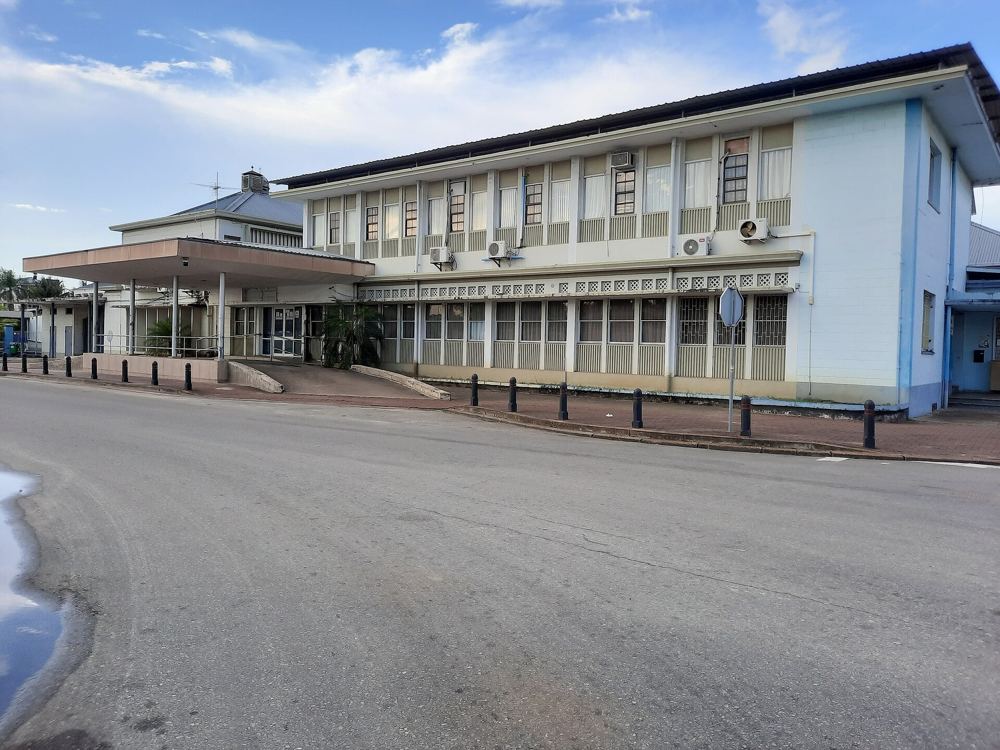
’s Lands Hospitaal is Suriname’s oldest hospital, founded as an 18th-century military hospital and opened to civilians in 1821. Its director has said care tariffs are barely adjusted while costs keep rising.
The Diakonessenhuis opened in 1962. The Sint Vincentius Ziekenhuis grew out of a Catholic nursing order’s work. It opened in 1916 on Koninginnestraat, in Paramaribo’s UNESCO-listed historic centre.
Money is the common problem. Health Minister André Misiekaba said in August 2025 that AZP debts and arrears totalled at least SRD 285 million (about US$7.5 million).
A December 2025 analysis by Suriname Nieuws Centrale added the debt of BGVS, the state medicine importer. Together the two owed more than SRD 610 million (about US$16.1 million). Regional hospitals, insurers and suppliers carry more.
The Diakonessenhuis told Vice-President Gregory Rusland in April 2026 that its income barely covered staff costs. It said the government owed it money and asked for regular payments.
Admission stops recur, Dagblad Suriname has documented. In December 2024, ’s Lands Hospitaal, Sint Vincentius and the Diakonessenhuis announced one until the state fund paid arrears.
Staff are leaving. Misiekaba said in May 2026 that almost 1,000 nurses had gone abroad since 2019. Fewer than 300 new care workers were trained in that time.
At that point only three of the AZP’s ten operating theatres were fully working. Nurses from the Philippines are being hired through agencies to fill gaps, the minister said.
Medicine supply is the other weak link. BGVS, founded in 1983, is meant to buy and distribute essential medicines on a national list, the klapper.
The minister says BGVS was hollowed out as the medicine trade was commercialised. By June 2026 about 95 percent of its debt to foreign suppliers was cleared, but hospitals still owed it large unpaid bills.
Misiekaba told parliament in August 2026 that a new national medicine list is being drafted. He expects shortages to end by the close of 2026, a forecast rather than a result.
The number of pharmacies has grown, and the ministry has paused new licences within a five-kilometre radius while it sets policy. Uninsured patients pay far more at pharmacies, the minister has warned.
The National Basic Health Insurance Act (BZV) took effect on 9 October 2014. It obliges everyone living in Suriname, foreigners included, to hold at least basic cover.
Insurers must accept applicants regardless of existing illness. Employers must pay at least half of the premium for their staff, according to the government.
The law caps basic monthly premiums at SRD 55 (about US$1.45) for children up to 16. Adults aged 21 to 59 pay up to SRD 165 (about US$4.35). Those aged 60 and over pay up to SRD 240 (about US$6.33).
The state pays the premium for Surinamese nationals aged up to 16 and for those aged 60 and over. That exemption does not extend to foreigners.
Dagblad Suriname noted in 2025 that these amounts date from when a dollar cost under 10 SRD. The basic package also sets yearly limits on some treatments.
The State Health Fund (Staatsziekenfonds, SZF) is the largest health insurer. Since mid-2023 its voluntary personal policy has had a base premium of SRD 785 (about US$21) monthly for ages 21 to 40.
The base premium is SRD 850 (about US$22) at 51 to 60 and SRD 1,650 (about US$44) from 61. Foreigners must pay 12 months up front, and a pregnancy surcharge of SRD 20,000 (about US$528) applies to pregnant applicants.
Private insurers include Assuria, whose AZPAS range runs from a basic plan to international Platinum and Diamond plans with worldwide cover. Self Reliance and Parsasco also sell health policies.
Local plans cap cover abroad. Assuria’s mid-range AZPAS Plus pays up to SRD 100,000 (about US$2,640) for surgery abroad on medical grounds.
The US government urges visitors to buy medical evacuation insurance. Britain warns that some facilities do not accept insurers’ payments, so patients may have to pay first and claim later.
The VMS medical association sets maximum family-doctor fees in US dollars. Patients pay in SRD at the central bank’s daily rate. A regular weekday consultation is capped at US$16.25.
Out-of-hours and weekend visits are capped at US$25.19. Non-residents pay a separate rate of 35 euros (about US$40), or 70 euros (about US$80) outside regular hours.
One Paramaribo practice charges self-paying patients SRD 800 (about US$21) for a regular visit. Non-residents pay SRD 1,600 (about US$42), and the practice warns that prices move with the exchange rate.
Hospitals add small charges. From September 2024 the National Hospital Council added an outpatient fee of SRD 50 (about US$1.30) per specialty per month. In September 2026 the health minister called about US$200 per hospital day a market rate and said tariffs would be revised.
Ambulances are not free. A lawmaker said in January 2026 that a run of under 20 minutes costs SRD 8,000 to 9,000 (about US$210-240).
The RGD raised its district ambulance fares in March 2026, citing fuel prices. Its director admitted that not every patient can afford them.
Treatment abroad is where bills jump. In February 2026 a patient sent to Colombia under the state scheme faced about US$5,168 in uncovered costs. These covered flights, lodging, transport and insurance.
Suriname is Dutch-speaking, and the shared language is one reason most doctors who specialise train partly in the Netherlands. The US Embassy notes that some emergency operators may not speak English.
Suriname has no complete specialist training of its own. Under a framework agreement between the two health ministers, Surinamese doctors may do up to half their specialist training in Dutch hospitals.