Is Prof. Soludo inadvertently working for Peter Obi?
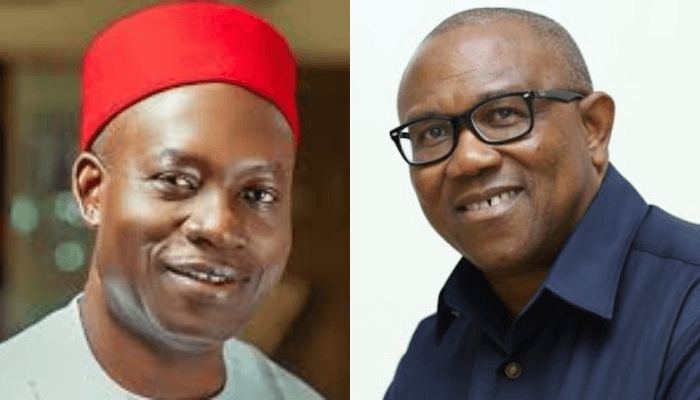
Governor Chukwuma Charles Soludo, economist, former CBN governor and current chief executive of Anambra State, threw himself into the centre read more Is Prof. Soludo inadvertently working for Peter Obi?
Governor Chukwuma Charles Soludo, economist, former CBN governor and current chief executive of Anambra State, threw himself into the centre of Nigeria’s political discourse this past week when, like the build-up to the 2023 presidential election, he dragged Peter Obi into the conversation again.
For irredeemable ethnic chauvinists of Igbo extraction, the question was simple: why would a fellow full-fledged Igbo man drag his brother all over the place to discredit him over a Yoruba candidate, Asiwaju Bola Ahmed Tinubu? Many were outraged that Soludo is not just some random Igbo political leader, but a man who shares the same political parentage under the All Progressives Grand Alliance (APGA), birthed by the Ikemba and Biafra warlord, Chief Odumegwu Ojukwu.
The cock symbol of the party crows unmistakably that APGA, or “APUGA”, as it is sometimes distorted in pronunciation, is a party that promotes the socio-cultural ideals and economic emancipation of the Igbo race, wherever they are domiciled across Nigeria. Chief Ojukwu proudly aggregated and approximated that aspiration, and it was under that shadow that Peter Obi emerged as its flag-bearer, supported by the Ikemba himself, and won the highest political office in the state.
For many Ndi Anambra, the Ikemba could not have made a better choice. After Peter Obi’s eight years in office, he literally left a trail of legacies behind him, and that became the platform on which his successor, Willie Obiano, rode into the Government House. Obi’s handover notes and personal call for the EFCC to check his books came across as a very strange call from a governor. No governor before him had exhibited such temerity. That is not fashionable in our political landscape.
Chief Willie Obiano can testify to the kind of heat one could get from the EFCC when your books are allegedly not found to be in order. He did not invite the EFCC like Obi did, but they came after him anyway because allegations of wrongdoing had emerged around the Government House.
It took Prof. Soludo to abandon ship with the PDP and cross over to APGA to realise his governorship dream. After all, no man could come and mess up Chief Ojukwu’s legacy and the solid foundation laid by his anointed, Peter Obi.
So, on the back of that, Soludo strolled into the Government House at Awka, with a now-viral video making the rounds, saying that based on Peter Obi’s performance, the people gave him the mandate. For the memories and respect of the Biafra progenitor and his endorsement of Peter Obi, indeed, Soludo would probably not have been there.
Yet, close to the 2023 presidential election, not a few were shocked when Soludo came for the jugular of Peter Obi in support of Asiwaju Bola Ahmed Tinubu. The 2023 presidential campaign was one smeared by character assassination and irresponsible name-calling. The worst hit were Atiku Abubakar and Asiwaju Tinubu. Both camps crossed the lines as insults bordering on who was the most corrupt and unfit for office ruled the airwaves. Of course, Peter Obi jumped into the fray, demanding that other contestants come out clean on their past.
For every demand on Peter Obi’s character and public records in governance, he told his critics to go and verify from the state records and treasury. He had no structure, except about “20 data boys locked up in a room somewhere, tweeting” and disturbing, even terrifying, almost every other candidate. The Obi phenomenon was like an harmattan fire. The “Obidient Movement”, the enfant terrible foot soldiers, was a thorn in the flesh. They shouted down every opposing voice to go and VERIFY whatever Obi claimed.
It was in the heat of that moment that any credible voice against any of the frontline contenders would be a market advantage. Then Prof. Charles Soludo sauntered into the battlefield armed with alleged damaging transcripts of a lying Obi. He hauled ballistic missiles at Peter Obi’s claims from a very advantageous position, an insider with verifiable proofs.
The mission appeared simple: discredit and demystify the “saintly” Obi. Create a common pool of tainted contestants so that, after all, politicians were hewn from the same stock. That would no doubt level the playing field for the unassuming voter. But it came across to many as a mission impossible.
Soludo, in clear terms, told Nigerians who cared to listen that Obi was overrated and exaggerated his governance profile as governor of Anambra State. He threw a litany of accusations across key sectors of the state’s economy. He went on to support candidate Tinubu, who eventually won the election and is today the President, seeking to renew his mandate under the Renewed Hope agenda.
But with Soludo’s harsh criticism of Obi, did he win his ward, polling unit, local government or the state for President Tinubu? The records are there for verification. But the outcome of that exercise reminds one of Barr. Nyesom Wike’s characterisation of some governors as lazy governors or politicians.
There were indications that Soludo’s frontal attacks on Peter Obi did more harm than good to the chances of the incumbent president in the South-East during the last election. But that claim requires some caution. Electoral behaviour is rarely determined by one politician’s attacks on another. What is not in doubt, however, is that the attacks did little to diminish Obi’s electoral strength in Anambra. The official results showed Obi winning the state overwhelmingly.
Fast forward to 2026, and Prof. Soludo is at it again. This time around, he is alleging that Peter Obi left a debt profile of over $120 million that is being serviced by the Anambra State Government today. Again, the Professor has stirred the hornet’s nest, and the feedback is not looking good so far.
A segment of the public, especially Obi’s “data boys”, are tearing his allegations apart, picking holes in the governor’s claims and, in some instances, putting some of his spokespersons on the defensive during live television appearances.
To say Soludo should not speak up if he has legitimate evidence against Peter Obi would amount to mob action and herd bullying. If there is concrete evidence that indicts Peter Obi and questions his integrity and claims, as Obi himself has often challenged his critics to do, that evidence should be put before the public.
Obi has admitted that he is not a “saint”. But virtually every claim he has made about his stewardship has been presented as evidence of a record he believes compares favourably with those of his political opponents. Whether those claims stand scrutiny is a matter for facts, records and independent verification, not political sentiment.
While Governor Soludo has not left anyone in doubt about his support for President Tinubu, the Professor of Economics must know that Nigerians will not entertain him being economical with the truth. Indeed, he stands a better chance of drying Obi’s dirty linen in public if he digs a bit harder and presents the evidence convincingly. But the present attempt seems to be doing something else: keeping Peter Obi firmly in the political conversation. And that is where the irony lies.
Critics are accusing Professor Soludo of being jealous and doing everything possible to relegate Peter Obi to the background, allegedly because of his own ultimate ambition of becoming the first Igbo democratically elected president. Much more, it is also being touted as part of a grand scheme to weaken Obi’s supposed clean image and disrupt his chances at the 2027 presidential polls. Those are political interpretations, not established facts.
But the growing question for some intelligent observers, given the backlash that often trails Soludo’s attacks, is this: is he inadvertently working for Peter Obi against Tinubu?
Could the constant attacks be keeping Obi’s name alive, energising his supporters and giving him another platform to present himself as a victim of political establishment attacks? Could an attempt to demystify Obi actually be helping to reinforce the very political mythology Soludo appears determined to dismantle? Or could it be that this is part of a broader strategy to upset the Igbo electorate even further and push them to affirm their support for their fellow “countryman” at the polls?
Prof. Soludo may need to interrogate his econometrics more critically, given the outcome of some of his seemingly flawed political projections. The exigency for stock-taking is inevitable. And indeed, the APC leadership should look closely again at its coalition in Anambra and ask whether it is serving the purpose for which it was assembled.
Prof. Soludo reserves the right to raise issues bothering on integrity, accountability, transparency and fidelity concerning Peter Obi. Nobody should deny him that right. But politics, like economics, requires evidence, balance and an appreciation of unintended consequences.
The question therefore remains: in trying so hard to diminish Peter Obi, could Prof. Soludo actually be helping to keep him politically relevant, and, inadvertently, working for him against President Bola Ahmed Tinubu?