Naira records gains in black market despite rate cut
The naira appreciated slightly in the parallel market, also known as the black market on Wednesday, despite the Central Bank read more Naira records gains in black market despite rate cut
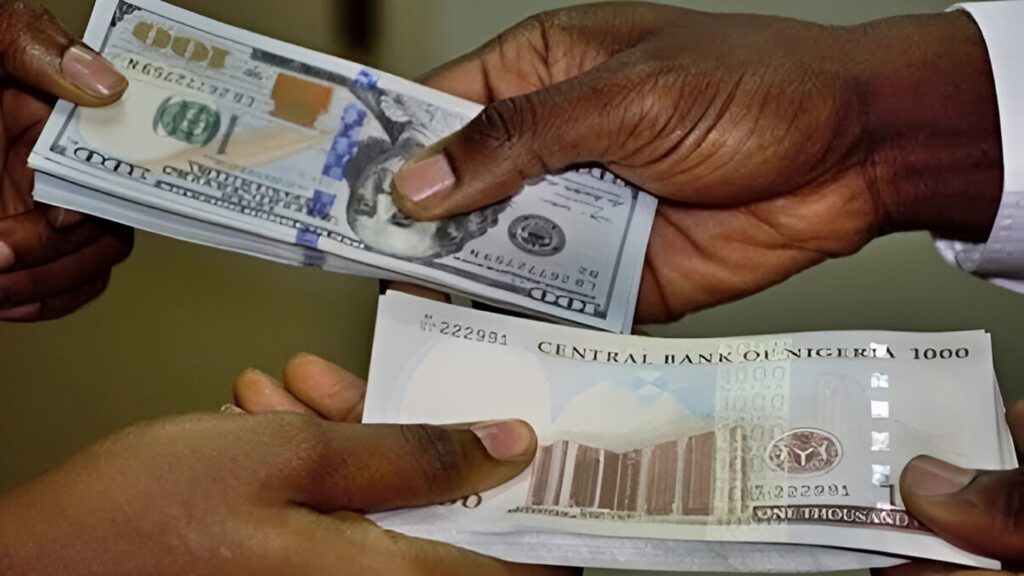
The naira appreciated slightly in the parallel market, also known as the black market on Wednesday, despite the Central Bank of Nigeria’s (CBN) decision to cut its Monetary Policy Rate (MPR) by 350 basis points.
Data collated from parallel market operators showed that the naira strengthened by N5, as the dollar was quoted at N1,385 on Wednesday, compared with N1,390 quoted previously.
The gap between the official and parallel market rates narrowed slightly to N58, or 4.37 percent, on Wednesday from N61, or 4.59 percent, on Monday.
In the official FX market, the naira appreciated marginally by N2.02 to close at N1,327.78 on Tuesday, representing a gain of 0.15 percent from N1,329.80 quoted on Monday at the Nigerian Foreign Exchange Market (NFEM), according to data published by the CBN.
Liquidity conditions improved as total turnover at the NFEM window jumped by 107.02 percent to $694.58 million on Tuesday from $335.51 million recorded on Monday. The number of deals also rose to 367 on Tuesday from 290 deals on Monday, representing a 26.55 percent increase.
At the interbank segment of the FX market, the number of deals increased by 27.45 percent to 130 on Tuesday from 102 deals on Monday. However, total turnover at the interbank segment declined by 14.81 percent to $99.17 million on Tuesday from $116.41 million recorded on Monday.
Read also: CBN rate cut lowers returns for savers as deposit rate falls to 6.9%
Nigeria’s external reserves, which provide the CBN with the firepower to support the naira and meet external obligations, have maintained a steady growth trajectory, rising to $54.79 billion as of September 21, 2026. This represented a 30.36 percent increase compared with $42.03 billion recorded on September 19, 2025, according to data published on the CBN website.
Olayemi Cardoso, governor of the CBN, said gross external reserves stood at $55.25 billion on September 18, 2026, the highest level in the last 18 years and sufficient to finance approximately 11.3 months of imports of goods and services.
Announcing the outcome of the two-day Monetary Policy Committee (MPC) meeting in Abuja on Tuesday, Cardoso said the committee decided to reset the MPR at 23 percent.
The committee also recalibrated the Standing Facilities Corridor to +50/-300 basis points around the MPR and retained the Cash Reserve Requirement (CRR) for Deposit Money Banks at 45 percent, Merchant Banks at 16 percent and non-TSA public sector deposits at 75 percent.
Read also: CPPE calls for lower lending rates after CBN MPR cut
Analysts said that despite the potential benefits of the rate cut to equities and the wider economy, the sharp reduction also creates risks for portfolio flows and the foreign-exchange market.
Muda Yusuf, chief executive officer of the Centre for the Promotion of Private Enterprise (CPPE), said the divergence between Nigeria’s monetary policy direction and tightening by some major central banks could affect interest-rate differentials and the relative attractiveness of naira-denominated financial assets.
He said this could increase the risk of portfolio-flow reversals and renewed pressure on the foreign-exchange market.
However, the CPPE said Nigeria was entering the policy transition with stronger external buffers than in previous episodes of monetary easing, citing improved foreign reserves and greater stability in the foreign-exchange market.
Hope Moses-Ashike is an Associate Editor, Banking and Finance, with more than a decade of experience reporting on Nigeria’s financial system and broader economy. She closely tracks market movements, monetary policy decisions, company disclosures, regulatory actions, economic indicators, and global developments, and interprets what they mean for businesses, investors, policymakers, and households. Her reporting helps readers understand complex issues such as inflation trends, foreign exchange market dynamics, interest rate decisions, bank performance, and investment risks. She also covers major international events and periodically travels to Washington, D.C., to report on the World Bank/IMF Spring and Annual Meetings. Her dedication to financial journalism has earned her multiple recognitions and invitations to high-level professional development programmes. She is an alumna of the International Visitors Leadership Programme (IVLP) in the United States and holds an Advanced Financial Journalism Certificate from the Press Association Training in London, UK. Her other notable achievements include completing the Lagos Business School CMC Programme, the Bloomberg Media Africa Initiative Programme, and a Master Class in Journalism at Rhodes University in South Africa.