The World's First Autocallable ETF
Matt Kaufman, Global Head of ETFs at Calamos Investments joins Scarlet Fu and Eric Balchunas on "Bloomberg ETF IQ." They discuss what autocallables are and the firm's own laddered fund (ticker: CAIE).
Matt, you're going to have to explain it to me like I don't know anything about ETFs or call options. What is an autocallable?
Yeah, for sure. Eric, you did great. Yeah, good overview. Uh, if we have to dumb down what an autocallable is, you can think of it a lot like a bond that's tied to the equity markets. This is derivative income. It fits squarely into that category. We are tying equity markets to your income payment and you're going to collect that income. You're going to get that 14.3% as long as the equity markets are not down too far, below a set barrier is what what the the term you would want to know here is.
Let's talk about that barrier. So, I own this, where do where do things go wrong? Okay, I get my coupon, it's nice and it's big, but when would I not get that?
It's a it's a 40% drawdown in a month, then you're in trouble.
Yeah, that's right. So this is a derivative income product. If you look at covered calls, you're selling off your upside to collect an income payment for that. You hope the market doesn't go down too far. Here, this is like a long-dated put writing strategy where you're collecting an income, selling off your upside. These are long-dated put instruments and you're going to get paid that as long as the market you're tied to is not down by 40%. We ladder that out 52 or more times, a weekly ladder, that diversifies out your risk. So I know that's where it gets a little complicated, but you're getting a ladder portfolio of a derivative income strategy now, very diversified. So you're diversifying the maturity and the coupon risk.
Sure. So if the market falls 40% in a month. Yeah, or more, then the coupon will turn off for one of your yield notes. If you have 52 or more, you know, think of how often the market has fallen significantly over the course of, you know, several months. Maybe you lose coupon on a few, but you're not losing it on the whole basket. And so that's the point. We're taking this, you know, 150 billion dollar structured note market. Autocallables makes up the largest slice of the structured note space. We have a lot of advisors who are using structured products, they're using notes, and they were asking for a delivery mechanism for autocalls in the ETF. That's what we brought to the market.
So, if you look at how you get yield in this market, right? You've got bonds which are like 4%. Stocks are like 2, 3%. Unless you go into like utilities or whatever. Then you've got JEPI, right? That was the original boomer candy. That gives you like 9%. This is 14%. So this is like next level boomer candy. And it's the fastest growing segment of that. Um, I guess my question is, what else where where do you go from here? Is 14% like what I should expect to have good yield but also be safe or are they going to get crazy and give you like 30, 40 and then you got to worry that it's the drawdowns are less?
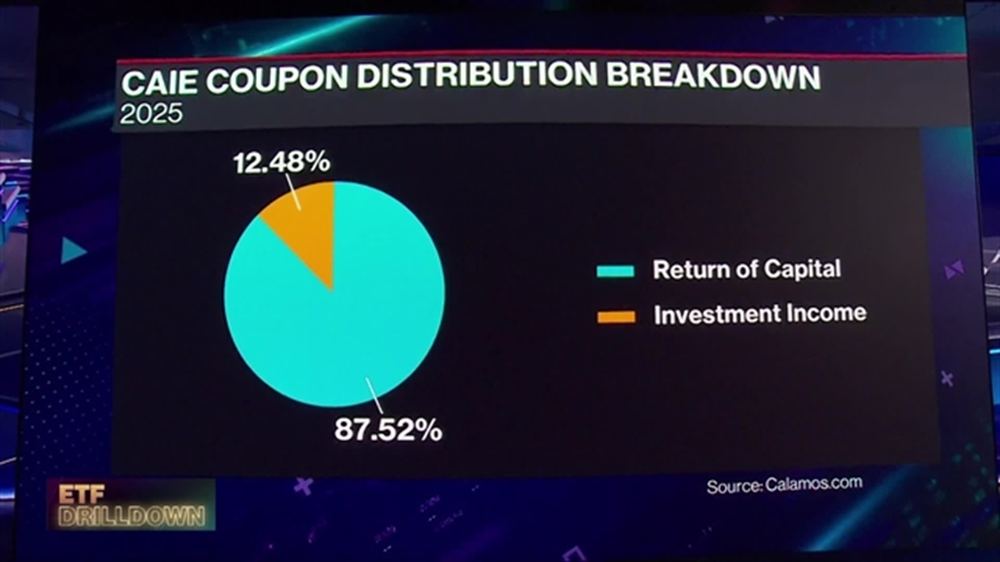
Sure. I'm sure there's going to be issuers that go for the crazy. That's not Calamos. Our goal with the first autocallable ETF was to deliver high, stable and tax efficient income. We're about 100% of this income is treated as return of capital, tax deferred income that you'll pay long-term capital gains on eventually. Uh but how we delivered this is 14% income, again, high, stable income. And the goal, uh the reason we were able to do that is by diversifying that out, structuring these notes in a way that would have paid you historically in a really highly reliable fashion.
So the benchmark that you would compare yourself to, the one that makes the most sense is the is the S&P 500 SPY?
Yes, by design, if you are comfortable with equity market-like risk, S&P 500-like risk, you can turn that in for a high, stable income. If you look at our distributions, it's been about 31, 32 cents per share going back to since we launched, very stable income.
So, you're out there talking to an advisor in Kentucky, right? And they're like, I get JEPI, right, I get a call option. But then you start explaining autocallables. Is education a problem or does the yield just, they're like, well, I trust Calamos, I'm in. Or does the advisor kind of bulk because then they don't, they might not be able to explain it to the client. How's that going?
Yeah, education is key. It's not the problem, but it is something we were really focused on. We want people to understand the risk they're taking on. You know, if you look at some covered calls, you might have NAV over time or NAV decay over time. Uh what we have done is we've traded equity market tail risk for this high stable coupon. Uh we did the Trillions podcast about a year ago. You were really early uh to the autocall game, so congrats on that. Uh this is going to be a very large space. I think we'll get to 100 billion over the next five to 10 years. It is that large. Uh look at what we did with the buffers. You know, we took a $60 billion market, now we have 60 billion in ETFs. We got the same opportunity here.
So, when I look at the fact sheet for your fund, um JP Morgan comes up a lot. What's the role that JP Morgan plays in these funds?
Oh, sure. So JP Morgan is our swap counterparty. We also have an index provider in MerCube, a very prominent index provider in the market around the world. Uh they do a lot with structured notes. So MerCube is the index provider. We trade that index, which houses all 52 or more autocallables. We trade that with JP Morgan. One of the benefits here is it largely eliminates counterparty risk. If you were to buy a note, we all remember, you know, maybe Lehman 08, if you buy a note today, you have a subordinated debt instrument. If you buy this in the ETF on swap, we can largely eliminate that counterparty risk because now you have a collateralized swap. Your money sits at the custodian, that is your money. Uh it takes away a lot of that risk.
Yeah, so let me ask you one quick question. There's now a bunch of autocallables. Some have the word barrier in there, yada yada. So there's 100. If I'm an investor and I'm looking to pick one out, what should I look for? Like what are one or two metrics that like should be a red flag or should I just rely on the brand?
You mentioned JEPI before, Boomer Candy, and how this is kind of boomer candy, you know, times five or whatever. Does this mean that...
Uh, maybe. Um, I I think with JEPI, again, it's easy to understand and people are willing to have they like that downside buffer. In this case, there is no buffer, but will the market really go down 40% in a month? And...
Yeah. I think that's the issue and why JEPI might still be chosen is for more conservative investors.
Well, I think what you're seeing uh right now is a framework for non-listed option strategies to make their way into the ETF world. What did you have over the last 10 years? We're tied to S&P, tied to Nasdaq, single stocks. Those are listed instruments. Now we have a framework through the development of Kai where we can take non-listed options and tie income to that. And so that is the massive growth that you're going to see over the next several years here.