World’s Best-Performing ETF Is Up 4,427% in 2026 Alone. Blame the Iran War.
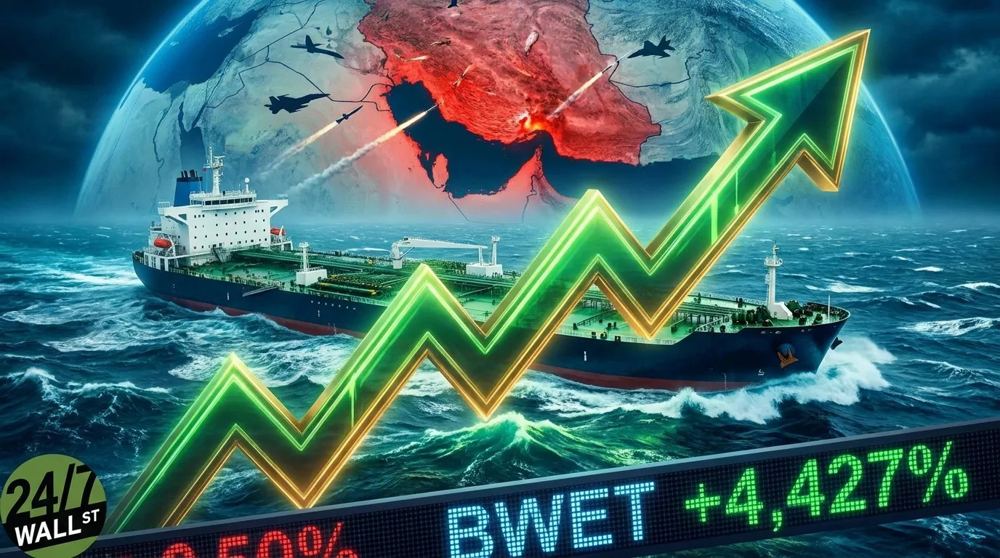
BWET surged 4,427% in 2026 as Iran's Strait of Hormuz closure sent daily tanker charter rates past $470,000.
The ETF runs zero leverage, and the underlying tanker-rate futures market itself repriced from $19 to $700 per share.
A 16% single-session drop inside a 3,500% year proves BWET is a tactical speculation, not a core holding.
Two retirees, same $1 million, same 4% rule, buy one finished with $1.4 million, the other hit $0 in 12 years. Our free reader guide explains the flaw that separated them, and the income-first method built to avoid it.
Tanker shipping is having its 2020-oil-in-the-storage-tank moment, and one obscure freight-futures fund is the purest expression of it. Breakwave Tanker Shipping ETF ( NYSEARCA:BWET ) has become the world's best-performing exchange-traded product of 2026, riding a collapse in Persian Gulf tanker traffic set off by the Iran war and the de facto closure of the Strait of Hormuz earlier this year. Daily charter rates for very large crude carriers rocketed past $470,000 as buyers scrambled to reroute Middle Eastern and West African barrels to Asia, and the fund's futures book has repriced accordingly.
The catalyst dates back months. Military action that began on February 28 effectively shut the strait, through which nearly 20% of global oil supply previously flowed. The U.S. Energy Information Administration's May outlook estimated Persian Gulf producers shut in 10.5 million barrels per day of crude output in April, pushing Brent to an average of $117 per barrel that month and pulling front-month WTI as high as $105.67 on April 3. Wet freight rates spiked with the disruption, and BWET, which owns futures tied to those rates, is now the aftershock trade the market is still digesting.
Every retiree knows about the 4% rule, but it frames retirement as a slow liquidation and still causes retirees with seven-figure accounts to agonize over a dinner out.
There's a different way to run the math that makes more sense today. Build an income floor, dividends, interest, and Social Security that cover your essential bills every month, and you never have to sell shares into a down market just to pay them.
Our free reader guide, The 4% Rule Is Broken , walks through it in about 15 minutes. Access the report here.
BWET is a commodity pool that holds a portfolio of near-dated freight futures contracts referencing the cost of moving crude on benchmark tanker routes, including Middle East and West Africa liftings bound for Asia. It is a single-theme derivatives vehicle whose net asset value moves with the settlement prices of tanker-rate futures on benchmark crude tanker routes. That mechanism is why the fund can outrun leveraged semiconductor and oil products without using any leverage of its own: the underlying market itself has repriced by an order of magnitude.
The scoreboard shows what that looks like in practice. Shares last traded at $700, up 3,533.61% year to date from a December 31 close of $19.26, and up 4,647.57% over the trailing 12 months. The headline figures the fund's sponsor and traders have been circulating this year, +4,427% in 2026 and +5,820% over 12 months, were struck at higher intraday marks before this week's pullback. There have been no stock splits to distort the comparison; the move is real, and it is the futures curve doing the work.
Same-session action is a useful reminder that a rate-linked futures fund cuts both ways. BWET is off 16.07% in Tuesday's regular session, sliding from $834 to $700 on delayed-intraday data, and down 9.06% over the past week from a September 14 close of $769.72. Zoom out and the trend still dominates: the fund is up 49.44% over the past month, with the August 21 close at $468.41. Those numbers are provisional and can move again by the close.
The oil tape helps explain the wobble. WTI has come off its spring highs, printing $70.48 on July 3 before recovering to $91.18 on September 4, as traffic through the strait resumed after the U.S. announced a ceasefire in early April and shut-in barrels began returning. The EIA still expects it will take until late 2026 or early 2027 for pre-conflict production and trade patterns to normalize, which is why tanker-rate futures remain elevated even as spot crude gives back gains.
A freight-futures fund that has quadrupled and then some in nine months is a tactical instrument built for a specific geopolitical shock, not a core holding. The same mechanism that translated a Persian Gulf shutdown into a historic gain will translate a peace deal, a rebuilt export corridor, or a demand slump into an equally violent unwind. The EIA has already trimmed its 2026 global oil demand growth estimate to 0.2 million b/d, down from 1.2 million b/d in its February outlook, on the assumption that high prices and fuel shortages destroy demand in Asia. Fewer barrels moving means fewer tanker charters to bid on.
BWET is doing exactly what a wet-freight futures ETF is supposed to do in a shipping crisis: convert a chokepoint closure into a straight-line return no equity fund can replicate. It is also doing what those products do when the crisis fades, which is why a 16% down day inside a 3,500% up year is the more instructive number for anyone thinking about chasing it here. Tactical instruments like this belong in the fun-money sleeve with real sizing rules, the same discipline we laid out in a free speculation playbook.
Take your essential monthly expenses and subtract your guaranteed income, Social Security, plus any pension. What's left is your income gap , and how you close it determines whether retirement runs on share sales or on a paycheck your portfolio writes you every month. Our free reader guide, The 4% Rule Is Broken , shows exactly how to close that gap with portfolio income: a worked example (one retiree needed about $480,000 in income-producing assets to cover his essentials for good), an eight-point conversion checklist, and the 20-year numbers comparing dividends to withdrawals. It's free and takes about 15 minutes to read. Get the guide here before you take your next withdrawal.
Contact editorial@247wallst.com for any questions or corrections.