Mid-market gyms feel the heat in Singapore's 'golden age' of fitness
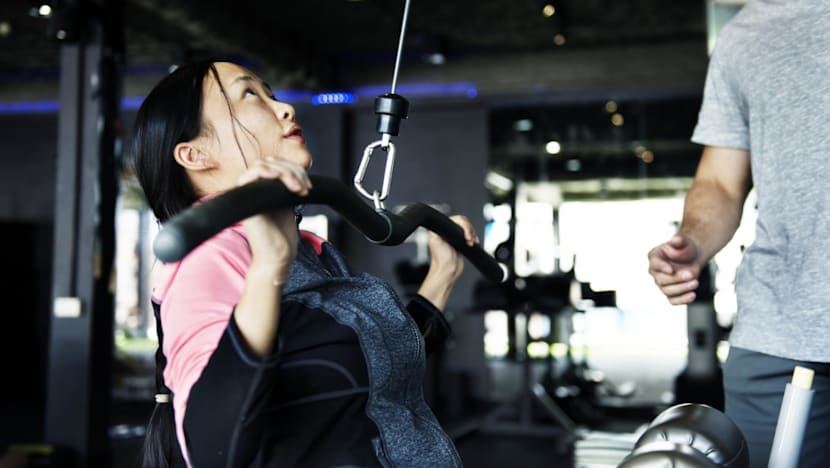
Even as more Singaporeans exercise regularly, big box gyms are losing ground to boutique studios and budget 24-hour chains.
Even as more Singaporeans exercise regularly, big box gyms are losing ground to boutique studios and budget 24-hour chains.
SINGAPORE: When personal trainer Sharon H started taking clients in April, she offered them the option of training in ActiveSG gyms, their own homes or her flat, which has a dedicated exercise space.
The 29-year-old told CNA she wanted to fill the “gap in the market” for clients who prefer more privacy and convenience, as the fitness scene is “saturated” with big box gyms.
About half of her 10 to 15 active clients work out at her flat. The rest train with her in ActiveSG gyms or their homes.
Hindrances like queues for machines at ActiveSG gyms and limited equipment in condominium gyms are counterbalanced by greater affordability and convenient locations.
When the trainer herself started exercising regularly around 2018, she followed videos on YouTube. She still primarily works out at home.
CNA Games Guess Word Crack the word, one row at a time Buzzword Create words using the given letters Mini Sudoku Tiny puzzle, mighty brain teaser Mini Crossword Small grid, big challenge Word Search Spot as many words as you can Show More Show Less This mix of home workouts and shared facilities exemplifies the "increasingly fierce" competition cited in True Fitness and True Yoga's abrupt closure of all their studios in Singapore earlier this month. Parent company Kontafarma cited "unprecedented" challenges: the growing popularity of boutique studios, more residential gyms reducing the need for external memberships and the rise of online training options. But taking a wider view complicates this explanation. “We are in what the industry calls the ‘golden age of fitness and wellness’. There has never been greater awareness (of) the importance of exercise,” said Mr Sean Tan, co-founder and president of the non-profit Singapore Fitness Alliance. More people in Singapore are keeping active. Sport SG data showed that 76 per cent of residents exercised at least once a week last year, a figure that has risen almost every year since before COVID-19, when it stood at 66 per cent in 2019. With the market growing, fitness studio owners pushed back against the idea that industry-wide headwinds were what ailed True Fitness and True Yoga. “If a free gym downstairs is enough to make someone switch, it raises the question of what else that gym is offering beyond access to equipment,” said Mr Samuel Gallo, co-founder of Surge Strength & Results. “The market itself has never been bigger,” he said. “Demand is not the problem. Being nothing in particular is the problem. Not the cheapest, not the best, so people drift out of the middle.”
This mix of home workouts and shared facilities exemplifies the "increasingly fierce" competition cited in True Fitness and True Yoga's abrupt closure of all their studios in Singapore earlier this month.
Parent company Kontafarma cited "unprecedented" challenges: the growing popularity of boutique studios, more residential gyms reducing the need for external memberships and the rise of online training options.
“We are in what the industry calls the ‘golden age of fitness and wellness’. There has never been greater awareness (of) the importance of exercise,” said Mr Sean Tan, co-founder and president of the non-profit Singapore Fitness Alliance.
More people in Singapore are keeping active. Sport SG data showed that 76 per cent of residents exercised at least once a week last year, a figure that has risen almost every year since before COVID-19, when it stood at 66 per cent in 2019.
With the market growing, fitness studio owners pushed back against the idea that industry-wide headwinds were what ailed True Fitness and True Yoga.
“If a free gym downstairs is enough to make someone switch, it raises the question of what else that gym is offering beyond access to equipment,” said Mr Samuel Gallo, co-founder of Surge Strength & Results.
“The market itself has never been bigger,” he said. “Demand is not the problem. Being nothing in particular is the problem. Not the cheapest, not the best, so people drift out of the middle.”
Conventional big box gyms like True Fitness sit in the middle of the market, between boutique gyms offering specialised or premium experiences on one end, and low-cost 24-hour gyms with convenient heartland locations on the other.
Big box gyms tend to be upwards of 15,000 sq ft and offer all kinds of training under one roof, from treadmills and elliptical machines for cardio, to pin-loaded machines for strength training, said Mr Tan.
These gyms usually provide personal training and have studios for group classes, recovery facilities like saunas or cold plunge baths, as well as showers, changing rooms and even swimming pools, he said.
True Fitness’ TFX club in Millennia Walk was the epitome of this, at more than 41,000 sq ft, it was the largest gym in Singapore before it closed.
“Large gyms carry significant fixed costs in rent, equipment, staffing, utilities and maintenance, so profitability becomes a challenge when utilisation falls,” Mr Tan said of this business model.
“Operating costs remain high, while consumers have more alternatives these days and can switch providers with ease, making membership revenue less predictable.”
In contrast, boutique gyms with smaller footprints of 1,000 to 2,500 sq ft are less costly to set up. They usually offer only a single modality, such as pilates or indoor cycling, and may not have showers or toilets.
Such gyms that offer specialised training and small- to mid-sized studios with premium wellness services are more resilient, said Mr Damien Lee, senior lecturer in sport and wellness management at Nanyang Polytechnic.
This is because they offer unique expertise, personalisation, a strong sense of community and measurable fitness outcomes, he said.
The other growing segment comprises lower-budget, 24-hour franchises like Anytime Fitness, Snap Fitness and 24/7 Fitness. Sized around 4,000 to 6,000 sq ft, they may offer personal trainers and group classes.
It costs much less to rent and outfit these smaller gyms, which are also able to open closer to where their members live. They save even more by not providing showers or toilets, the most expensive part of a gym's built facilities, said Mr Tan.
“Their lean operating model allows them to compete effectively on convenience and affordability without the overhead burden that weighs on larger operators,” added Mr Lee.
In short, consumers are now gravitating towards either value and convenience, or specialised training and premium experiences, he said.
"Operators in the middle could face greater challenges in setting themselves apart from their competitors.”
Even then, just being "small versions of the same commercial gym" does not cut it for a boutique fitness studio, according to Mr Gallo.
Boutique studio operators emphasised the service layer they build on top of gym hardware. This usually involves fitness or wellness experts who work closely with clients and keep them accountable to their goals.
Surge goes all in on one-to-one personal training, with no group classes or gym memberships. It has three locations, but Mr Gallo said the company’s biggest investment is its people, because “the coaches are the product”.
“Last year alone we invested over S$50,000 in our team’s education. This year we plan to do the same,” he said.
Fitness studio UFIT, which has four locations, similarly eschews a pay-per-use or gym membership model, but for a different approach, a wider take on wellness that it calls a “circle of care”.
It has about 700 active clients who attend personal training or group fitness classes, and can also tap on the services of a physiotherapist, podiatrist or nutritionist as needed.
“We work more with clients who are paying for expertise and accountability, not just access to equipment and facilities,” said founder and COO Dean Ahmad.
In stark contrast to the recent gym closures, Mr Ahmad said 2026 has been UFIT’s best year of business in the past five years. Event-based competitions and marathons are helping to drive people into gyms, but he also credited a focus on client retention by delivering measurable outcomes.
Mr Ahmad added that ActiveSG and condominium gyms are a form of "healthy market segmentation" and not a threat to boutique studios.
“They have absorbed a real slice of that demand, but it’s a very specific slice of that demographic that are price sensitive or that are convenience-based users, who are never going to pay for coaching or they’re not interested in that coaching model in the first place.”
Differentiation through service is also increasingly necessary because the way people exercise in Singapore has changed.
“Today’s consumers are far less likely to anchor their fitness routines around a single gym membership,” said Nanyang Polytechnic’s Mr Lee.