Bilfinger CEO on Trimmed Outlook, Job Cuts
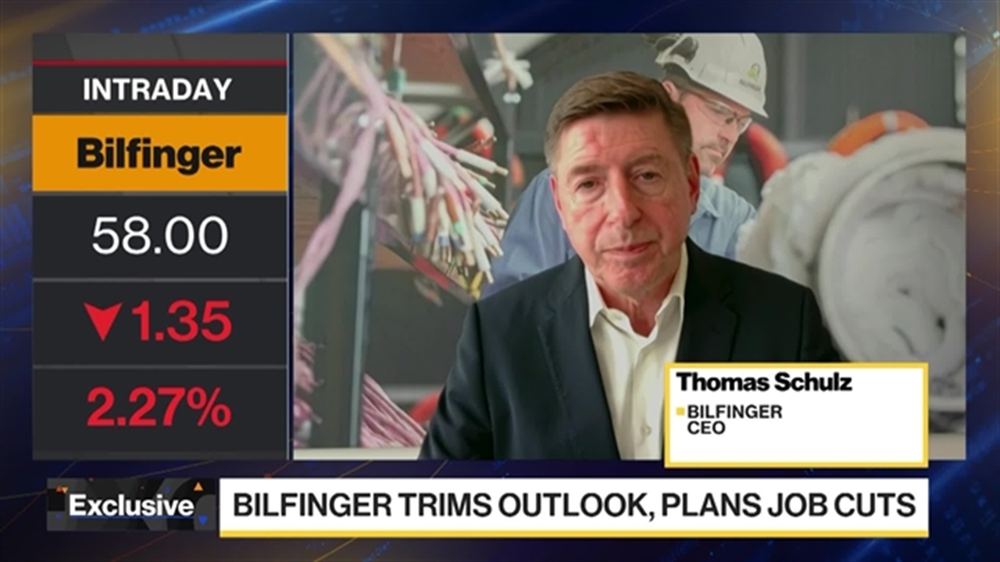
German industrial services giant Bilfinger has had a tough week after delivering a surprise guidance cut. The firm is blaming uncertainty coming from the Iran conflict for the warning and is now saying that it may cut 1500 jobs. CEO Thomas Schulz spoke exclusively with Guy Johnson on "Bloomberg Brief."
We were all surprised by this, Thomas. Why didn't we get any warning? How quickly has this happened?
So as we said actually in the Q2, um we need a very strong second half of the year and how the situation is in the market regarding all the geopolitical uncertainties and some uh uncertainties on not movement in the German market.
Uh what we saw in the last few weeks and especially from the last weekend uh coming as a big impact in Saudi Arabia, that customers are prolonging necessary technical work into next year.
When we have that, then of course our um contribution margin cross profit line goes slowly down and that is actually the level what we call a lower leverage or kind of a slight under absorption and that is exactly what we have to the market.
But when did this happen? Because I yes, we've seen the pressure that has been building. But we were all surprised, I mean you look at the share price, it got really hit hard yesterday. The market did not see this coming, Thomas. So A, why didn't you warn us? And B, kind of has this happened in the last few weeks? What what has been the story?
Actually what we calculated into the outlook is of course up to the end of the year. We as the Bilfinger group normally have a significant stronger second half of the year. With that what happened in the last few days in the geopolitics with a very high energy cost triggered with a lot of customers to postpone necessary turnarounds and technical maintenance activities. And you don't need a lot in that case um to prolong that you then slip out already at the beginning of the or in the middle of September slip out of this year, which then hits the financial year. That's actually the reason why we downgrade the outlook on the profitability.
You talk about a lot of customers. Is it a lot of customers doing this or is it just a few big customers doing this?
Uh we have quite a lot of uh bigger blue ship ones. There we see the general trend to do so and we understand that. There is this uncertainty was already an uncertainty when the Iran war started and that actually that uncertainty is a way in a few weeks and months but it's not enough when you are in September to get that then over the finishing line in this year. Because when we do the work with hundreds, thousands of our colleagues, then of course, it takes a month, two months, three months, four months, and then you are automatically into next year. So we see that as a temporarily and it is a temporary thing for 2020.
So so this is you don't see a structural shift here. This is just a short-term phenomenon.
This is not a structural shift because we saw in the last few years us as a group and of course our customers performing in the absolute right direction with a sustainable profitable growth. But this year, uh three things actually came together for us as a group. Um starting with a slower activity level based on a longer winter time, more than normal, then you can't do a lot of maintenance work on customer side. Second, the start of the Iran war at the end of February and now the increased tension what we have since last weekend. All the three events together created then a postponing of necessary technical work on the sides. You can't postpone these technical work for too long. And that's the reason why this is a temporary thing.
Okay. Just one final quick question. We have anticipated that we are going to see a significant pickup in German growth. It has not happened in the way that many people thought it would. What are you seeing?
It it's a little bit part of it, uh a kind of a stall in the year that the pickup what was expected for the German industry slight pickup didn't happen, but we see out of the political issues what happened, elections, talk, media, um that the current government, especially the chancellor will now have to act faster and quicker with the reforms and the necessary activities. The activities are already known for quite a while. It's about the execution.