South Korea's Kospi Extends Rally to Four Sessions on Semiconductor Strength
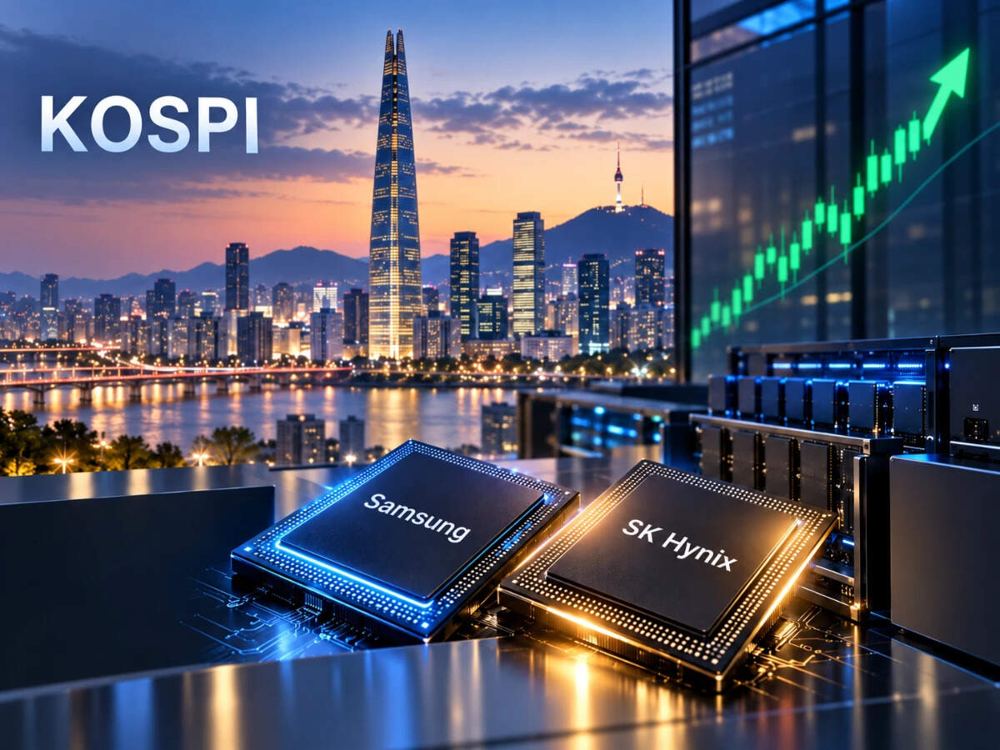
South Korea’s benchmark equity index climbed to its highest intraday level in weeks as easing doubts over artificial intelligence investment demand renewed investor appetite for major chipmakers.
The benchmark Kospi index rose 133.95 points, or 1.91 percent, to 7,129.34 as of 0217 GMT, marking a fourth consecutive session of gains. The index also touched its highest intraday level since August 18, driven primarily by a resurgence in technology stocks.
Semiconductor manufacturers led the advance as market participants grew more confident about the longevity of artificial intelligence infrastructure spending. Samsung Electronics climbed 2.59 percent, while SK Hynix surged 3.98 percent, reversing the sector pressure observed last month.
Despite the headline index gains, broader market participation remained mixed. Of the 909 stocks traded, 405 advanced against 452 decliners. However, foreign investors contributed supportive momentum by purchasing a net 129.1 billion won, equivalent to $96.51 million, in South Korean shares.
Traditional industrial and battery sectors faced headwinds during the session, highlighting a narrow rally. LG Energy Solution dropped 1.38 percent, while automakers Hyundai Motor and Kia retreated 0.64 percent and 0.47 percent, respectively. POSCO Holdings and Samsung BioLogics also slipped fractionally.
Underpinning the market environment, fresh economic data confirmed that South Korea’s economy expanded by 0.6 percent in the second quarter from the previous period. This figure matched the central bank’s advance estimate released in late July, providing a stable macroeconomic backdrop for equities.
The local currency appreciated alongside the equity rally, with the South Korean won strengthening 0.73 percent to trade at 1,336.9 per dollar. In the fixed-income market, yields retreated as the three-year Korean Treasury bond yield fell 2.7 basis points to 3.877 percent. The benchmark 10-year yield also declined 1.5 basis points to 4.366 percent.
With Wall Street closed for a public holiday, regional Asian markets were left to price in sector-specific developments rather than following US cues. For global institutional investors, the renewed strength in South Korean chipmakers signals a critical test of whether AI-driven capital expenditure can sustain valuations across the broader technology supply chain. Sustained foreign inflows will be necessary to validate this rotation back into high-multiple semiconductor names.