Tim Cook's Final Full Quarter as CEO Saw iPhone Revenue Hit $56.99 Billion and Services Revenue Hit a Record $30.98 Billion. Does That Mix Make Apple Stock a Buy as John Ternus Takes Over?
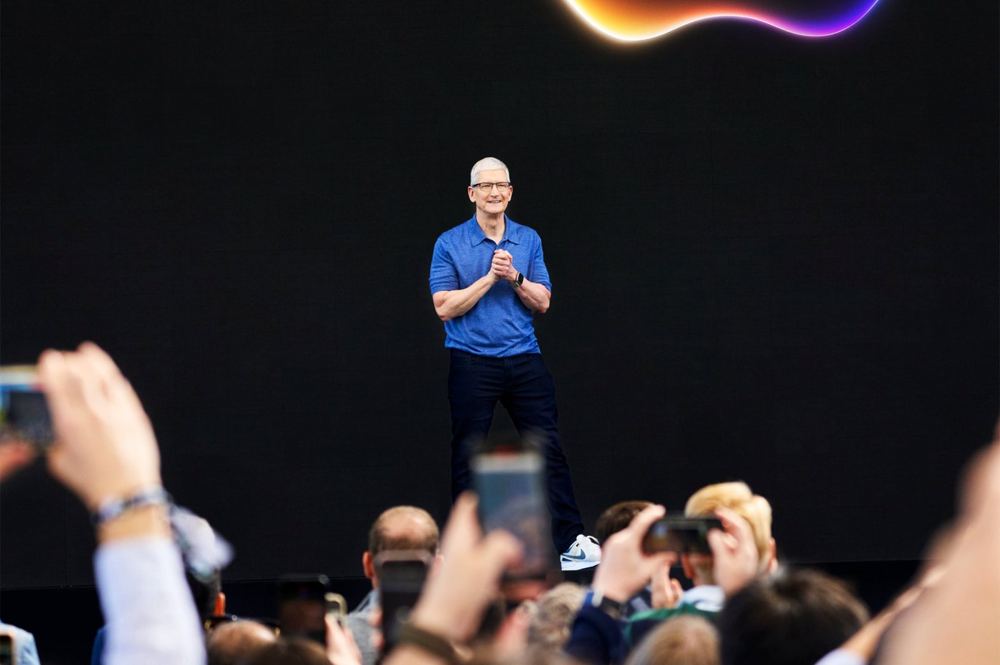
In my opinion, Apple (NASDAQ: AAPL) is pretty much always a buy. The company keeps finding ways to grow revenue, and the numbers speak for themselves. Tim Cook's final full quarter saw $109.42 billion in revenue, up 16.4%. The iPhone pulled in $54.25 billion, while services hit a June-quarter record of $30.74 billion. That mix is a big reason why I'm bullish on Apple.
In Q3 for Apple , iPhone revenue grew 21.7% year over year, driven by the iPhone 17 family, with June-quarter records in every geographic segment and a record quarter for upgraders. Services grew 12.1% and now represents 28.1% of total sales, setting records across every category, including all-time highs in cloud and payment services.
Missed Nvidia in 2009? This Rare Signal Is Flashing Again. In 2009, a "Double Down" signal flashed for a little-known chipmaker called Nvidia. For the first time in years, that same "Total Conviction" signal is flashing for a company 1/100th the size of Nvidia. Continue »
The reason this matters is margin structure. Services had a gross margin of 76.5% in the December quarter, roughly double that of hardware. Every point Services gains in the revenue mix lifts consolidated profitability without Apple selling a single additional device. Net income hit $29.8 billion, up 27%, on revenue that grew 16%. That gap is the mix working.
John Ternus will take over on Sept. 1. He's a 25-year Apple veteran who led hardware engineering across iPhone, iPad, Mac, Apple Watch, AirPods, and the Apple Silicon transition. Cook moves to executive chairman, staying involved in policy and long-term priorities. Johny Srouji becomes chief hardware officer.
This is continuity, not upheaval. Cook added $3.6 trillion to Apple's market value over 15 years, and the succession was planned rather than reactive. Ternus inherits a company generating $34.4 billion in quarterly operating cash flow.
Apple's biggest overhang was artificial intelligence, and the company resolved it with a pragmatic decision. In January, Apple signed a multi-year deal with Alphabet , (NASDAQ: GOOG) (NASDAQ: GOOGL) reportedly worth nearly $1 billion annually, to power the next Siri with Gemini models. At Apple's Worldwide Developers Conference in June, the company unveiled Siri AI with a stand-alone app, visual intelligence, on-screen awareness, and cross-app actions, which will ship in iOS 27 this fall.
Everything runs through Private Cloud Compute, so Google performs the computation without receiving identifiable user data. Apple chose capability over pride, licensing frontier AI rather than shipping an inferior in-house model two years late. For a company with a privacy brand to protect and 2.5 billion devices to upgrade, that was the right call.
Apple is tracking as many as 16 new products by year's end, one of its busiest stretches in years. The Sept. 9 event brings the iPhone 18 Pro and Pro Max with the A20 Pro chip and next-generation C2 modem, alongside the first foldable, expected to be branded iPhone Ultra with a 7.8-inch inner display. Analyst estimates put foldable pricing between $2,000 and $2,500.
A premium tier above the Pro models raises average selling prices without cannibalizing existing lines, the same playbook that worked with iPhone Air. Apple's market cap is near $4.67 trillion after the stock closed near $320, up 16.15% over the past 12 months. It is not cheap. It rarely is.
But a business growing revenue by 16%, earnings by 27%, with a 76.5% margin, segment expanding faster than the total, and 2.5 billion devices to sell into, does not need to be cheap to work. The mix of businesses that Cook handed Ternus is the strongest in Apple's history
The Motley Fool Stock Advisor analyst team just identified what they believe are the 10 best stocks for investors to buy now… and Apple wasn't one of them. The 10 stocks that made the cut could produce monster returns in the coming years.
Consider when Netflix made this list on December 17, 2004... if you invested $1,000 at the time of our recommendation, you'd have $435,803 !* Or when Nvidia made this list on April 15, 2005... if you invested $1,000 at the time of our recommendation, you'd have $1,334,577 !*
Now, it's worth noting Stock Advisor's total average return is 966%, a market-crushing outperformance compared to 211% for the S&P 500. Don't miss the latest top 10 list, available with Stock Advisor , and join an investing community built by individual investors for individual investors.
Micah Zimmerman has no position in any of the stocks mentioned. The Motley Fool has positions in and recommends Alphabet and Apple. The Motley Fool has a disclosure policy .