Xi in Egypt to Boost Influence in Mideast, ‘to Safeguard Shipping’
The Chinese president urged countries to oppose "external interference" in the Middle East and said Beijing was ready to work with regional states to safeguard vessels threatened by the US-Iran war. The post Xi in Egypt to Boost Influence in Mideast, ‘to Safeguard Shipping’ appeared first on Asia Financial .
The Chinese president urged countries to oppose “external interference” in the Middle East and said Beijing was ready to work with regional states to safeguard vessels threatened by the US-Iran war.
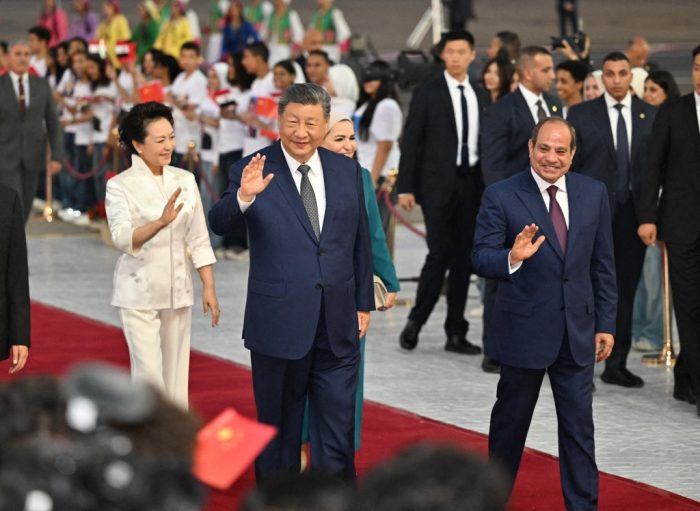
Chinese President Xi Jinping has made a rare trip to Egypt to attempt to bolster his country’s presence in the Middle East and maybe help regional states safeguard shipping.
He urged countries to oppose “external interference” in the Middle East and said Beijing was ready to work with regional states to safeguard vessels threatened by the US-Iran war.
Xi’s remarks to his Egyptian counterpart Abdel Fattah al-Sisi, on his first visit to Cairo in a decade, come as Beijing seeks a greater foothold in the region, expanding investment while managing fallout from the war.
“We must uphold the principle that the people of the Middle East are the masters of their own affairs, oppose external interference (and) support regional countries in strengthening dialogue on peace and security,” Xi said in a meeting with Sisi, according to Chinese state news agency Xinhua.
Xi was greeted by Sisi and a 21-gun salute for talks at the opulent Ittihadiya presidential palace in the Egyptian capital.
The talks covered the six-month US-Iran conflict, with both presidents urging “diplomatic solutions” to reach a “comprehensive agreement to end the war”, according to a statement from Sisi’s spokesperson.
Sisi’s office also said the two BRICS members signed an agreement to launch the third phase of the Egyptian-Chinese industrial zone at the Suez Canal, which officials say already hosts 200 companies and investments worth around $4 billion.
The new investments, for which Egypt has not announced a figure, give Beijing even greater influence in the canal zone, a critical artery of global trade, as conflict in the region chokes other conduits.
Xi said China “stands ready to work with countries in the region to safeguard the security of international shipping lanes, advance development cooperation… and eliminate the breeding grounds for conflict”.
A series of additional agreements were also signed, though Egyptian officials did not provide details.
Beijing is eyeing a greater foothold in the Middle East, at a time when “the United States looks like it can’t really make up its mind whether it wants to withdraw from the region or be more engaged”, Mirette Mabrouk, a senior fellow at the Washington-based Middle East Institute, told AFP.
China sees Egypt as a key partner and an entry point to more regional influence.
For Egypt, closer ties with China are part of a broader effort to diversify partnerships rather than align with a single power, Mabrouk said.
Sisi, in an op-ed published in Egyptian media on Tuesday, highlighted Cairo’s “independent foreign policy”, days after the Emirati branch of Egypt’s second-largest bank, Banque Misr, was targeted by US sanctions.
Washington vowed last month to isolate Iran economically, threatening expanded sanctions that could also hit Chinese banks, among others.
China, a major buyer of Iranian oil, has vowed to safeguard its interests.
In the lead-up to an expected meeting between Xi and US President Donald Trump this month, it has also sought to shore up ties with US-friendly regional nations.
Cairo is one of the largest recipients of US military aid, and historically a key Middle East mediator.
Egypt, which under Sisi’s administration became one of the world’s top weapons buyers, hosted major joint air combat exercises with the Chinese military in August, featuring Beijing’s powerful J-16 fighter jet.
China is a major exporter to Egypt, with its trade surplus reaching $12 billion in the first seven months of 2026, according to Chinese customs data.
Across Cairo, a megalopolis home to over 26 million people, major streets have been lined with Chinese and Egyptian flags, as well as billboards showing Sisi and Xi.
Meanwhile, the United Nations said on Wednesday the 1.5C target would be missed and outlined how global temperatures might be brought back down in a first-of-its-kind assessment met with dismay in climate-vulnerable nations.
UN Secretary General Antonio Guterres last year acknowledged the inevitability of overshooting 1.5C in the next few years but this assessment is the first by a UN agency to unambiguously state the target would be breached.
Scientists agree that warming above 1.5C relative to pre-industrial times poses grave risks and nearly 200 nations committed a decade ago to try and keep global temperature rises to this safer threshold.
But in a much-anticipated report, the UN Environment Programme (UNEP) said the best remaining option had shifted “from avoiding overshoot to navigating it”.
“It’s a reality check. We have to live with this warmer world… but there’s still a lot we can do to limit warming,” said report co-author Richard Betts from the University of Exeter.
The report “was about responses rather than just sort of saying it is happening”, he told journalists.
Fellow author Debra Roberts said it was important for policymakers “to realise the rules of the game are now changing”.
“We now have to reconfigure our climate governance around dealing with an overshoot pathway. None of our plans are prepared for that,” said Roberts from the University of KwaZulu-Natal.
This latest report states in no uncertain terms that “global action to cut greenhouse gas emissions has not been fast enough to avoid global warming crossing 1.5C”.
Climate activists have rallied around 1.5C since it was affirmed as the more ambitious goal of the Paris Agreement a decade ago, and the UNEP report was met with frustration and disappointment.
“This is a heartbreaking moment, but overshoot is not the reason to give up and surrender 1.5C”, said Jasper Inventor from Greenpeace International.
Rachel Cleetus from the Union of Concerned Scientists described the failure to meet 1.5C as “heartbreaking and infuriating” and “a monumental climate injustice”.
The world has already warmed roughly 1.4C since 1850-1900 mostly from the burning of fossil fuels and the last three years have been the hottest on record.
Scientists say any overshoot of 1.5C threatens more extreme weather and risks irreversible changes like the loss of ice sheets and coral reefs.
UNEP executive director Inger Andersen said there “are no good outcomes if we remain above 1.5C”.
“Let’s be very clear, that 1.5C target is still the goal. But now, we need to approach it differently: from above,” Andersen told journalists.
Even under the report’s most optimistic scenario, global temperatures would still peak at 1.8C before falling to 1.5C by the end of the century.
But to achieve this, carbon dioxide removal, the process of pulling carbon from the air, would be required at enormous scale alongside major, rapid cuts to greenhouse gas emissions, the report said.