Bitcoin falls to $63,600 on Iran strikes, US-China fears
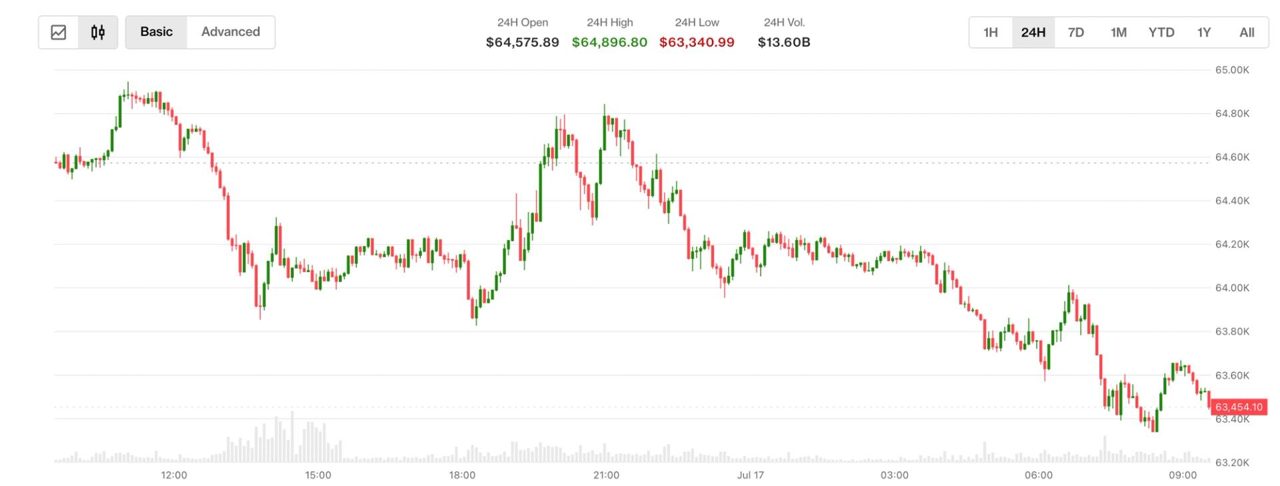
Bitcoin slipped below its 50-day moving average as U.S. airstrikes on Iran and renewed U.S.-China tensions triggered a broad sell-off in global risk assets.
Bitcoin fell to $63,600, dropping below a closely watched 50-day simple moving average after U.S. military strikes on Iran and fresh allegations of Chinese election interference triggered a broad sell-off in risk assets. The decline extends a 1.4% slide from Thursday, when the token traded at $65,000.
The immediate catalyst was a military escalation in the Middle East. U.S. airstrikes hit five bridges and a maritime control tower in Iran's southern Hormozgan province, according to the semi-official Fars news agency. Despite this escalation, WTI oil futures held steady at around $79 per barrel.
Without the buffer of rising energy prices, investors fled to safety, dragging down equities across Asia. Japan’s Nikkei plunged nearly 3%, hitting its lowest level in over a month. Wall Street’s tech-heavy Nasdaq dropped more than 1.6% on Thursday, and futures for the index fell an additional 0.8%, while Australia’s ASX 200 slipped 0.5%.
The risk-off mood intensified following comments from Donald Trump. He declassified intelligence reports alleging Beijing obtained 220 million U.S. voter records, a claim China's embassy flatly denied. While the dispute itself did not move markets, the implications for upcoming diplomacy did.
The Australian dollar weakened against the greenback as investors priced in the risk of renewed U.S.-China frictions. The commodity-sensitive currency serves as a G7 proxy for Chinese economic health. InvestingLive’s Chief Asia-Pacific Currency Analyst Eamonn Sheridan warned that the accusations threaten a recently stabilizing relationship ahead of a planned September meeting between Trump and Xi. “The rhetoric itself could complicate the diplomatic runway into September regardless of the underlying facts,” Sheridan said.
The weakness in the Australian dollar underscored how quickly diplomatic friction can bleed into broader risk sentiment, ultimately dragging down digital assets like bitcoin alongside equities. For market professionals, the price action reinforces bitcoin's status as a highly correlated risk asset rather than an independent safe haven. Breaching the 50-day moving average signals a loss of near-term momentum, leaving the cryptocurrency vulnerable to further macroeconomic volatility.
This macro-driven pullback contrasts with recent structural improvements in crypto market liquidity. Centralized exchange trading volumes rose for the first time in five months during June. Spot volumes climbed 15.3% to $1.11 trillion, while real-world asset perpetual volumes surged to a record $311 billion. However, that underlying market strength appears insufficient to shield digital assets from sudden geopolitical shocks.