Nigerian tier-two banks improve margins as bad loans rise
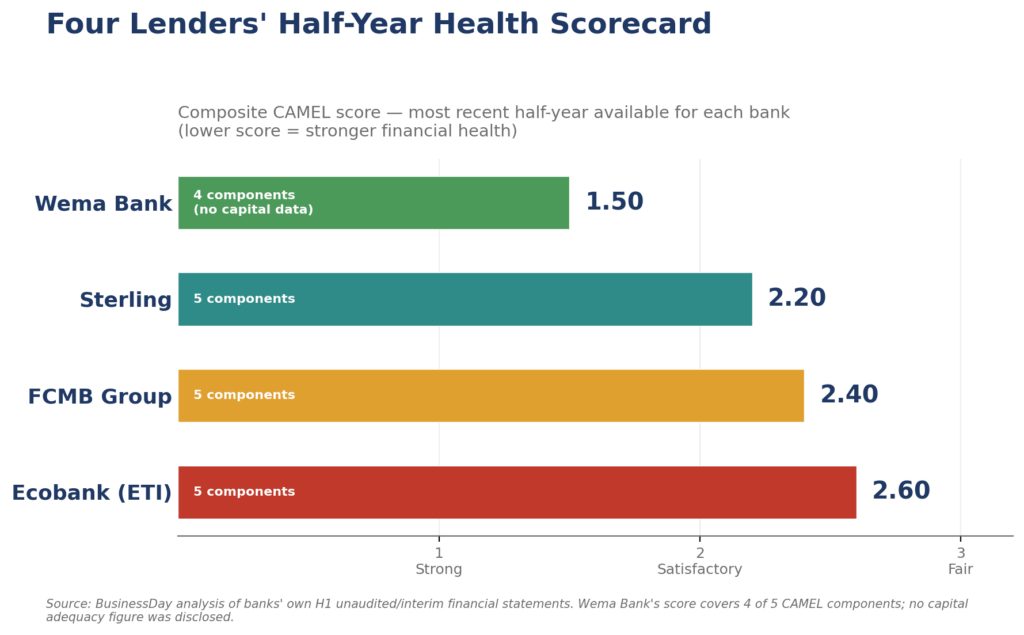
Half-year results show Nigeria’s mid-tier lenders are driving down operating costs and boosting profitability, but patchy disclosures and rising non-performing loans leave investors questioning the sustainability of the rally.
Nigeria’s four tier-two banks have significantly reduced operating costs and boosted profitability in the first half of 2026, though a review of their results highlights growing risks within their loan books. Wema Bank led the operational turnaround, while Ecobank Transnational recorded the sharpest deterioration in asset quality among the group.
The efficiency gains across Ecobank, FCMB Group, Sterling HoldCo, and Wema Bank signal a broader structural improvement in the sector's cost management. Wema Bank slashed its cost-to-income ratio from 81 percent in the first half of 2022 to 42 percent by mid-2026. This was driven by rapid expansion in fee, commission, and trading income rather than severe cost-cutting.
Ecobank maintained its position as the most efficient lender, improving its ratio from 56 percent to 48 percent. Sterling HoldCo gradually narrowed its gap, moving from 77 percent to 59 percent, while FCMB Group saw volatile improvements linked to foreign-exchange income following the June 2023 naira devaluation.
Despite these operational victories, credit quality remains a primary concern for investors. Ecobank’s non-performing loan ratio climbed to 7.6 percent from 6.2 percent, breaching the 5 percent regulatory threshold for a healthy loan book. Sterling’s ratio also peaked at 5.1 percent before easing slightly to 4.7 percent.
The financial picture is further complicated by inconsistent interim reporting. FCMB and Wema Bank omitted non-performing loan ratios from their half-year filings, forcing analysts to rely on proxy metrics for credit quality. Similarly, only Ecobank disclosed its capital adequacy ratio during the period, showing a comfortable 16.7 percent.
Earnings quality and valuations present a mixed picture for market participants. Wema Bank generated an annualised return on equity of 39.8 percent and trades at a cheap 2.4x price-to-earnings multiple, suggesting the market has yet to fully price in its operational turnaround.
FCMB reported a 27.9 percent return on equity and trades at 3.0x earnings. Conversely, Sterling commands the richest valuation at 5.1x earnings despite an implied return on equity of just 18 percent following a N96.6 billion share offer.
Ecobank’s group-level profitability masks regional disparities, with its Nigerian unit posting a mere 3.0 percent return on equity compared to the wider group's 21.1 percent. Across all four lenders, customer deposits grew in line with or faster than loan books, providing a reassuring baseline for liquidity despite the lack of formal statutory ratio disclosures.