Millions of Teslas, Chinese EVs Recalled For Safety Concerns
Millions of Teslas and Chinese EVs are being recalled over safety issues, while Taiwan charges 9 over Nvidia chip smuggling, and Shein is set for a Hong Kong listing The post Millions of Teslas, Chinese EVs Recalled For Safety Concerns appeared first on Asia Financial .
Millions of Teslas and Chinese EVs are being recalled over safety issues, while Taiwan charges 9 over Nvidia chip smuggling, and Shein is set for a Hong Kong listing
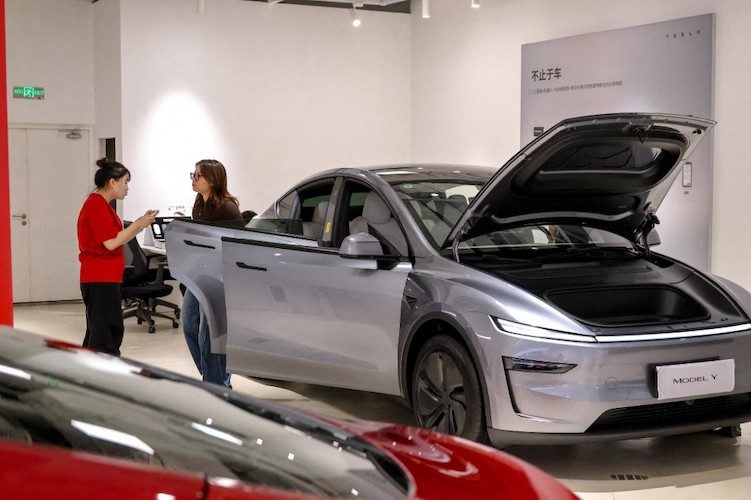
Tesla is the latest carmaker to face a mass recall in China because of concerns over interior door handles that may hamper people’s ability to get out of EVs in an emergency.
Nearly three million Tesla EVs in China are being recalled because of these worries, Beijing’s national market watchdog said.
Eight Chinese carmakers have also filed recalls over similar safety risks, China’s State Administration for Market Regulation (SAMR) announced on Friday.
Some recalls were effective immediately, while others began over the weekend and on Monday, AFP reported.
Tesla’s recall involves 2.9 million locally made units of its Model 3 and Model Y electric cars and begins on September 25.
The US carmaker, which operates a huge factory in Shanghai, is also recalling around 46,000 imported units of its Model 3, Model X and Model S cars, the SAMR announcement said.
The recalled cars have inner emergency mechanical handles “similar in colour to the interior, making them difficult to identify and operate” in emergencies, the watchdog said.
In Tesla’s Model 3, for example, passengers must reach into a compartment inside the door pocket and find a release cable to manually open the rear door, according to the company’s website.
“In extreme situations such as severe collisions causing the vehicle’s low-voltage system to fail, (the handles) may affect passengers’ ability to quickly open car doors for escape and rescue operations outside the vehicle,” SAMR said.
SAMR said Tesla was separately recalling 2.7 million domestically-made Model 3 and Model Y EVs over issues with monitoring systems while a driver is using steering assist functions.
It was not clear whether some Teslas were counted in both recalls.
Chinese EV makers such as Xiaomi , XPeng, Geely, Chery and Leapmotor are also recalling cars with handles that blend in with their interior.
Xiaomi began recalling around 390,000 units of its 2024 SU7 series on Friday, and XPeng started recalling nearly 265,000 cars on Saturday.
Beijing-based BAIC BluePark, a subsidiary of state-owned automaker BAIC, on Saturday began recalling around 46,000 Arcfox Kaola EVs over a “lack of dedicated text prompts” near the emergency mechanism on its right rear sliding door.
Beginning on Monday, Geely is recalling around 92,000 cars from its luxury brand Zeekr.
Companies offered to attach warning labels near the handles for free, and some said they would remotely upgrade software involving lowering windows after a crash.
Safety concerns have risen in China recently over sleek car designs that are prone to losing operability in the event of a crash.
The mass recalls are in line with China’s plan to ban hidden door handles on cars from January 1, 2027, local media reports said.
Those rules, announced in February by the Ministry of Industry and Information Technology, will require door handles to have both interior and exterior mechanical releases.
Electronic door handles were introduced with Tesla’s 2012 launch of the Model S, later becoming popular with Chinese EV brands prioritising high-tech features.
Folding into the body of the car, such door handles provide a slight boost to efficiency by reducing drag while the vehicle is in motion.
Nine people in Taiwan, including a Nvidia worker, were charged on Monday over the illegal export of artificial intelligence servers to China , Taiwanese prosecutors said.
The indictments follow an investigation into the shipment of “high-end” AI servers made by Nasdaq-listed Super Micro Computer and containing advanced Nvidia chips to China in violation of US export controls.
Eight of the nine defendants were charged with breach of trust and forging documents to smuggle 74 servers containing Nvidia chips to China, Keelung District Prosecutors’ Office said in a statement.
Of those servers, 50 were transhipped through Indonesia, eight were sent via Japan and the rest were exported directly to China. An additional 56 servers were seized at Taiwan’s border, the statement said.
Three of the defendants have been charged with embezzlement.
The United States restricts exports to China of the most cutting-edge silicon chips used to power artificial intelligence systems, designed by industry leader Nvidia.
But it is not a criminal offence in Taiwan, a situation lawmakers and experts say needs to change, with Taiwanese prosecutors relying on other laws to go after offenders.
The nine accused include two employees from Super Micro and one from Nvidia as well as one from Taiwan-listed Albatron Technology and another from Chief Telecom, prosecutors said.
Neither Nvidia nor Super Micro immediately responded to AFP’s request for comment.
Prosecutors said they were seeking sentences of up to five years in jail for seven defendants who were “driven by the pursuit of exorbitant profits” to collude in the illegal export of the servers.
“This not only increased corporate compliance costs but also severely damaged the nation’s international image,” the prosecutors said.
They were seeking more lenient sentences for the other two defendants who had confessed to all charges and cooperated with the investigation.
Shein will debut on the Hong Kong stock exchange on September 1, the fast-fashion retailer said on Monday, in a long-awaited listing that would value the group at up to US$27 billion.
The online retailer plans to offer 280 million shares at a price between HK$47.60 and HK$49.50, raising up to HK$13.86 billion (US$1.7 billion), it said in a filing to the bourse.
The final price will be announced on August 31, but the higher figure would value the company at around US$26.8 billion.
Founded in China and now headquartered in Singapore, Shein finally won Beijing’s approval last month to make its initial public offering in Hong Kong.
Plans to list in New York and London had been held back in recent years by regulatory hurdles, according to media reports.
With most of its factories located in China, Shein sets itself apart from its competitors because of the speed of its product design and efficient production and supply chain.