Battery Storage Displaces Gas Peakers, Suppressing US Evening Power Prices
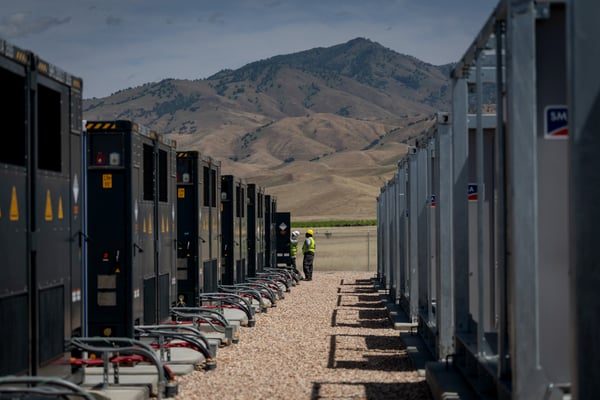
Rapid deployment of grid-scale batteries in California and Texas is undercutting natural gas peaker plants, structurally lowering wholesale electricity prices and redirecting utility capital expenditure.
Grid-scale batteries are actively displacing natural gas peaker plants during evening demand surges in California and Texas, fundamentally altering wholesale electricity pricing. By discharging cheap, midday solar energy when demand peaks, battery fleets are now setting the marginal price of power and undercutting the most expensive conventional generators.
The scale of this shift is rapidly accelerating. California’s grid operator now commands at least 13,000 megawatts of battery capacity, regularly delivering over 6,000 megawatts during peak hours in 2025, which is six times the volume recorded three years earlier. Texas followed a steeper trajectory, adding more than 6,000 megawatts of capacity in a single year and hitting a record output of over 8,000 megawatts in a single hour in October 2025.
This dynamic presents a clear structural threat to the economics of gas-fired generation. Gas peakers already sat idle for more than 86 percent of the year, and building new facilities now costs between $131 and $242 per megawatt-hour over their lifetime, according to Lazard’s 2025 analysis. In contrast, a four-hour battery system costs just $78 per megawatt-hour, reflecting a 27 percent year-over-year decline.
Capital Reallocation and Revenue Shifts
Utility planners are already adjusting their long-term capital commitments to reflect this new reality. PacifiCorp has anchored its 2025 draft resource plan on 1,818 megawatts of new battery storage by the end of 2027, with 7,668 megawatts slated through 2045. The utility is even classifying its proposed hydrogen peaking facilities as storage rather than conventional generation.
The revenue model for storage operators has pivoted alongside this capacity boom. According to Modo Energy, energy trading accounted for roughly 90 percent of battery revenue in California’s wholesale market and 76 percent in Texas by June 2025. The Texas figure represents a tripling in just 12 months as operators abandoned saturated grid-balancing markets for direct energy arbitrage.
The macroeconomic impact of this transition is already visible in wholesale markets. Total wholesale power costs in California fell to $8.5 billion in 2025, a 6 percent decrease from the prior year. As batteries capture an increasing share of peak demand, the traditional financial viability of gas peaker plants will continue to erode.