StanChart trims Nigeria rate-cut outlook on sticky inflation
Standard Chartered has halved its forecast for Nigerian interest rate cuts this year, signaling that elevated borrowing costs will persist for businesses as unanchored inflation expectations force the central bank to maintain its cautious stance.
Standard Chartered now expects the Central Bank of Nigeria to cut rates by just 150 basis points in 2026, ending the year at 25 percent. The lender raised its 2026 average inflation forecast to 15.5 percent from a previous estimate of 12 percent, and lifted its 2027 projection to 14.7 percent from 13.8 percent. “We now see inflation averaging 15.5 percent in 2026 compared with 12 percent previously,” said Razia Khan, Standard Chartered’s chief economist for Africa and the Middle East.
The downgrade carries immediate implications for Nigerian debt markets and corporate borrowers, who must now price in a higher-for-longer rate environment. The central bank has kept its benchmark rate at 26.5 percent since a solitary 50-basis-point cut in February. A prolonged tightening cycle restricts credit growth in the real economy and limits the government's ability to cheapen its debt burden.
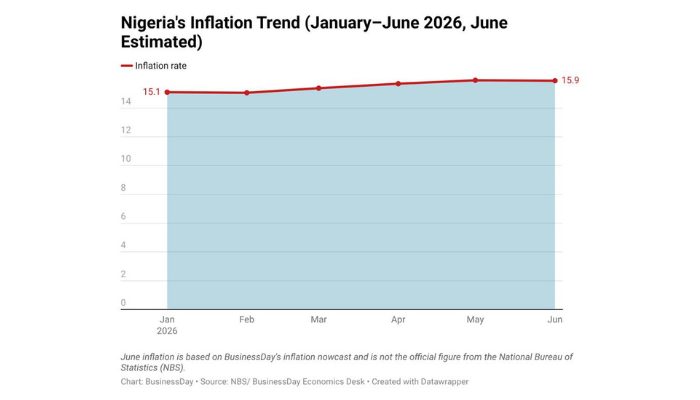
Policymakers face renewed pressure ahead of the July 20 and 21 Monetary Policy Committee meeting. The National Bureau of Statistics is set to release June inflation data on Wednesday, which analysts expect to show a fourth consecutive monthly increase. United Capital Research projects headline inflation rising marginally to 15.95 percent from 15.93 percent in May, driven largely by food prices.
The core problem for the central bank is that inflation expectations remain unanchored despite moderating monthly price gains. The bank’s own June survey showed its inflation perception index edged up to 45 points from 44.8 points, with respondents blaming high energy costs, insecurity, and exchange rate movements. While the Financial Markets Dealers Association expects month-on-month inflation to ease to 1.65 percent, it warned that rising cooking gas and household energy costs are keeping underlying pressures elevated.
Near-term hurdles are compounded by global volatility, though some external pressures have recently eased. Global oil prices have retreated below $79 a barrel after spiking above $114 during the recent Iran conflict, offering some relief from imported inflation. Looking further ahead, Standard Chartered anticipates a more aggressive easing cycle after January’s general elections, forecasting cumulative cuts of 700 basis points in 2027 and a further 350 basis points in 2028.