Arms Control Erosion Drives Spending on Verification Tech
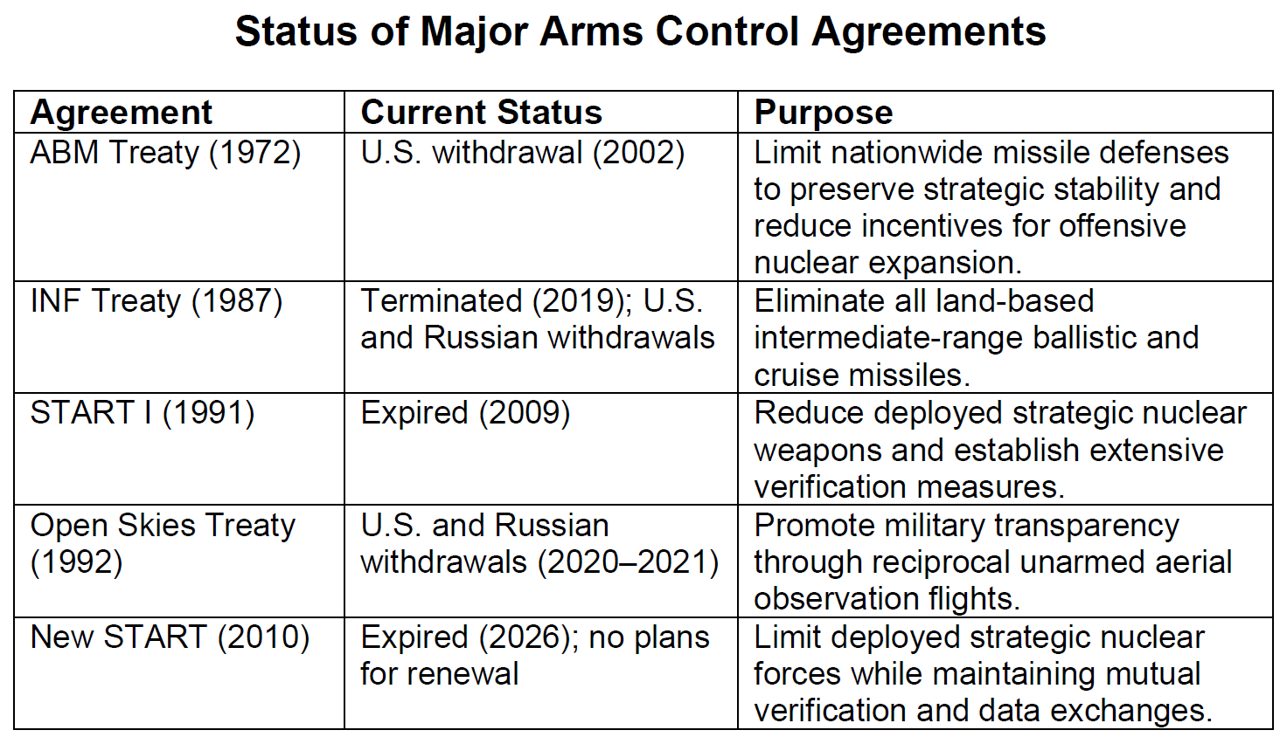
The structural collapse of traditional arms control treaties is permanently expanding military budgets across new technological domains, creating sustained demand for satellite, AI, and sensing infrastructure.
The global arms control framework is deteriorating as major treaties expire, verification disputes intensify, and new military technologies outpace diplomatic agreements. This erosion is not merely a symptom of worsening diplomatic relations, but a function of the structural dynamics inherent in the international security system.
For investors and defense executives, this represents a structural shift in how global military budgets are allocated. Military competition is migrating rapidly beyond traditional hardware into cyberspace, autonomous weapons, and outer space. The escalation operates as a self-reinforcing mechanism where strategic uncertainty stimulates armament, new weapons generate further uncertainty, and that uncertainty encourages secrecy which undermines trust.
This cycle creates persistent organizational incentives for defense industries and national security bureaucracies to favor continued military competition over institutional restraint. Instability does not require centralized coordination; it emerges from the cumulative interaction of individually rational responses to uncertainty. States seeking greater security adopt measures that reduce the security of others, driving a positive feedback loop that expands military procurement across the board.
Technological adaptation ensures this procurement cycle continuously regenerates. The historical pattern shows that defensive innovations simply generate incentives for offensive adaptation. During the Cold War, limiting missile defenses under the Anti-Ballistic Missile Treaty temporarily stabilized mutual vulnerability. However, advances in missile defense spurred the development of multiple independently targetable warheads and penetration aids. Today, maneuverable hypersonic weapons are emerging to complicate terrestrial missile defenses.
As hypersonic weapons challenge existing systems, strategic attention is turning toward mid-course interception and space-based defensive systems. Those developments directly generate incentives for counter-space capabilities. The strategic frontier continually advances because each technological solution creates new opportunities for competitive adaptation, pulling capital into successive new domains.
The proposed solution to this cycle relies not on new treaties, but on engineering verifiable trust through specific technologies. This requires persistent satellite observation, distributed sensing, artificial intelligence, global communications, and advanced evidence integration. Future stability will depend on constructing this trust infrastructure. For the private sector, this points to durable demand in aerospace, satellite communications, and AI as governments attempt to build the verification capabilities necessary to monitor an expanding array of threats.