Bitcoin Volatility Squeezes to January Lows Amid Slumping Trading Volumes
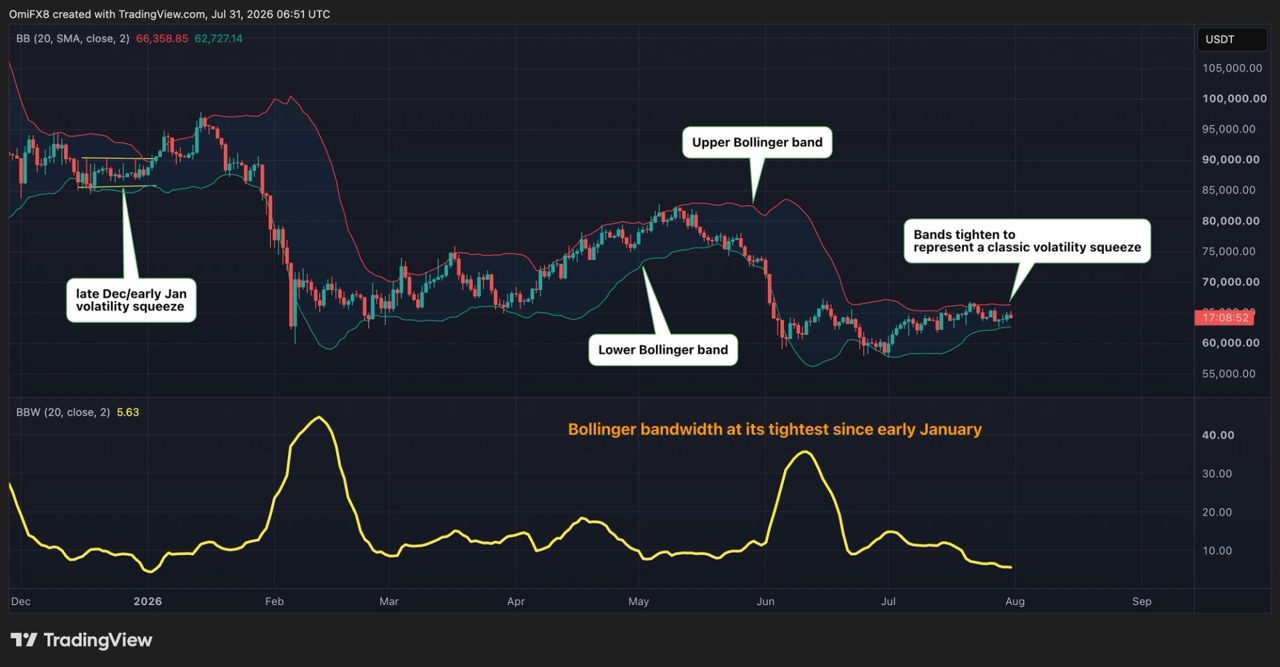
Bitcoin’s daily price swings have contracted to their narrowest levels since January, signaling to investors that a significant and unpredictable market breakout is likely approaching.
Bitcoin has entered one of its quietest trading periods since January, with prices confined to a tight band between $62,000 and $65,000. This compression marks a distinct shift for the cryptocurrency market, leaving institutional and retail traders struggling to identify clear directional bets.
Market indicators clearly reflect this ongoing stagnation. The Bollinger bandwidth on bitcoin’s daily price chart, a technical tool measuring the extent of daily price swings, has dropped to 5.66 points. This represents the narrowest gap since the start of the year, signaling a severe squeeze in market volatility.
Trading activity has concurrently dried up across major exchanges. According to research from K33, daily transaction volumes have fallen to $2.2 billion this month. This trajectory is on track to be the lowest level since November 2023, a stark contrast to the $5.1 billion daily average seen during the previous consolidation phase.
Historical market patterns suggest this current calm is merely temporary. In January, bitcoin similarly traded in a narrow range between $86,000 and $90,000 following a quiet second half of December. That specific period of low volatility was quickly followed by a sharp upward move to nearly $98,000 by mid-January, before retreating to around $60,000 in early February as trading volumes rose.
This cyclical behavior has consistently mirrored bitcoin’s broader price action since at least 2018. Extended periods of tight trading ranges typically act as a coiled spring in financial markets, preceding forceful price movements in either direction once the compression breaks.
For market participants, the current environment offers little immediate opportunity. Momentum trades have effectively dried up, forcing range traders to settle for minimal price movements while the market refuses to cooperate. While the exact timing and direction of the next breakout remain uncertain, the prolonged nature of the current lull suggests the eventual unwind will be highly significant for investors.