Dangote refinery pegged at 10% of US capacity as Nigeria pivots to fuel exports
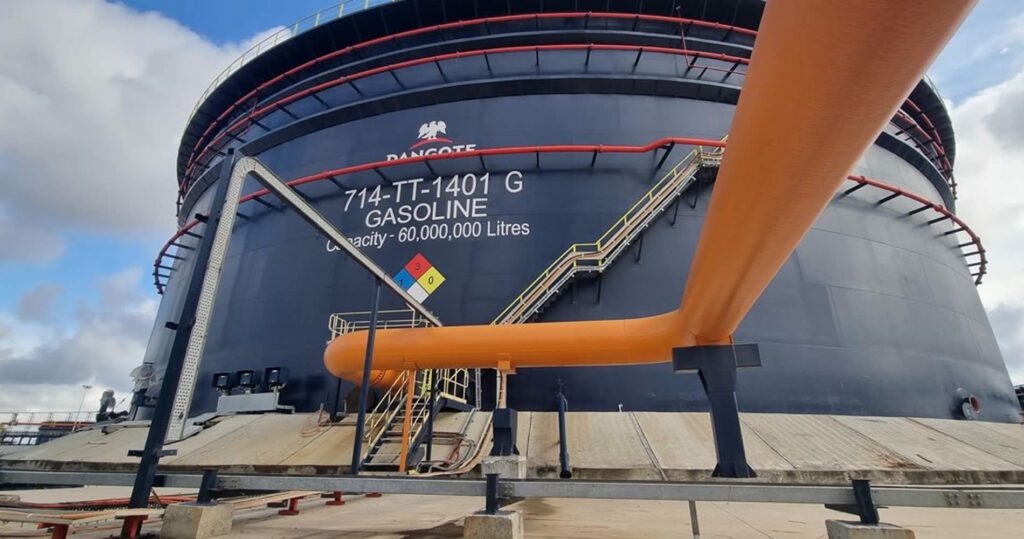
Nigeria's government framed the 700,000 barrel-a-day Dangote refinery as the cornerstone of its $1 trillion economy target after the facility's owner revealed the plant will process the equivalent of 10% of US refining capacity at full tilt, a scale that recently allowed the company to price debt below the sovereign benchmark.
Nigeria’s Minister of State for Industry, John Enoh, toured the Dangote Petroleum Refinery in Lagos on Wednesday, as the facility’s owner quantified its immense scale for the first time. Operating at its full capacity of 700,000 barrels a day, the plant will equal roughly 10% of United States refining capacity and consume about 2.5% of globally traded crude. “What we have achieved here has never been done before on this scale,” said Aliko Dangote, president of Dangote Industries.
The government is positioning the refinery as the engine for a macroeconomic shift. Enoh noted the plant has already helped flip Nigeria from a perennial importer of refined fuel to an exporter, pointing to recent shipments that reached the Middle East during global supply disruptions. “The more a country adds value to its products, the more respect it earns globally,” Enoh said.
For fixed-income investors, the operation's financial footprint is proving as notable as its physical scale. Dangote highlighted a recent unsecured, unrated bond that priced below Nigeria’s sovereign benchmark as evidence of strong appetite for credible private-sector borrowers. He argued that local success acts as a beacon for foreign capital. “When local investors thrive, they send a powerful signal that the environment is conducive for investment,” Dangote said.
The visit also served to address lingering technical concerns among market watchers regarding the plant’s single-train configuration. Enoh pushed back on those worries, stating that scheduled upkeep has not disrupted output. “The issues surrounding the single-train configuration are much clearer now. Even during scheduled maintenance, operations continued,” the minister said.
Abuja is tying the facility's output directly to its broader industrial policy, which aims to lift manufacturing’s share of GDP to about 20% by 2030 and 25% by 2035. Enoh framed the refinery as central to President Bola Tinubu’s target of building a $1 trillion economy. To support this, the government pledged continued engagement through its Industrial Revolution Work Group, with improved financing access for manufacturers flagged as a priority.
Dangote, who called the refinery the biggest business risk of his career, warned that attracting further capital will require regulatory predictability. He noted that policy consistency matters more to investors than direct incentives. “There is no way to create jobs and prosperity without industrialisation,” he said, adding: “Once one person succeeds, many others will be encouraged to follow.”