AI Boom Makes Chipmaker CXMT China’s Most Valuable Company
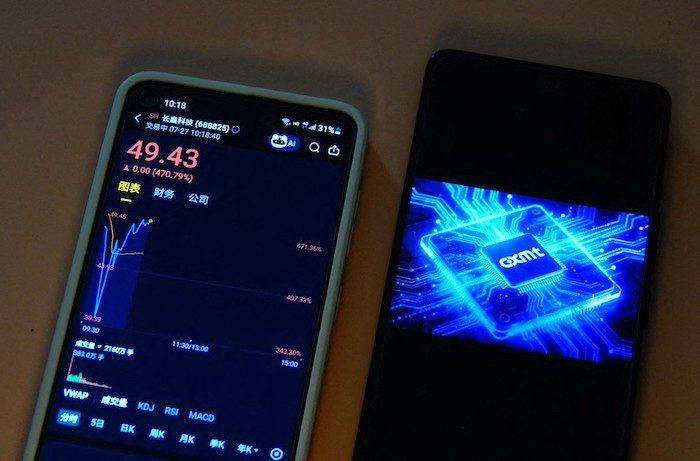
Shares of ChangXin Memory Technologies, China's leading memory chipmaker, soared 530% after its IPO on Shanghai's Star Market. Meanwhile, oil has dropped amid a pause in the Middle East war. The post AI Boom Makes Chipmaker CXMT China’s Most Valuable Company appeared first on Asia Financial .
Shares of ChangXin Memory Technologies, China’s leading memory chipmaker, soared 530% after its IPO on Shanghai’s Star Market. Meanwhile, oil has dropped amid a pause in the Middle East war.
China’s leading memory chipmaker CXMT became the most valuable company on the mainland after soaring more than 500% on its initial public offering (IPO) in Shanghai on Monday.
ChangXin Memory Technologies is the world’s fourth-largest maker of DRAM memory chips, although currently it only has 8-9% of the global market share. Samsung (36%), SK Hynix (29%) and Micron Technology (24%) dominate the memory chip market, according to Counterpoint Research data.
But CXMT’s stunning market debut shows how explosive AI demand is boosting the chip sector. And with Beijing anxious for local companies to rival their South Korean and other rivals, its potential is clearly significant.
The race to build data centres that power artificial intelligence has fuelled a global memory chip shortage, while causing an extraordinary boom for the companies that produce them.
The firm’s shares rocketed 530% on Monday, taking its market capitalisation to 3.65 trillion yuan ($540 billion), surpassing megabank ICBC as mainland China’s most valuable company.
The interest “reflects investors’ overwhelmingly bullish sentiment toward China’s flagship domestic memory chip firm”, Larry Yang, chief economist of First Seafront Fund Management, told AFP.
China’s government is increasingly counting on homegrown hardware to boost its position in the AI race against the United States.
Going public allows CXMT to secure capital that will “lay a solid foundation” for expanding production capacity and spending on chip development, Yang said.
“Meanwhile, it will boost the company’s global influence and help lift its market share in the worldwide memory chip sector.”
That view was shared by Zhang Guobin, founder of Chinese specialist website eetrend.com.
He called the initial public offering a “turning point in the global storage industry landscape and the development trajectory of China’s semiconductor sector”.
CXMT, founded in 2016 and based in the eastern region of Anhui, had raised 66.6 billion yuan ($9.8 billion) in a blockbuster IPO, Bloomberg News reported.
That marked China’s biggest-ever mainland tech share sale, beating the 46.3 billion yuan raised by Semiconductor Manufacturing International Corp (SMIC) in 2020.
Advanced memory chips are in huge demand for their key role in AI servers, alongside other powerful data-crunching semiconductors made by the likes of Nvidia.
That has created a major shortage of the less flashy DRAM chips used in laptops, phones and other electronics, pushing up prices.
US giant Apple, feeling the pinch of shortages, is reportedly testing CXMT’s DRAM chips for use in its products.
CXMT is on the Pentagon’s list of Chinese companies with alleged military ties , although that does not prohibit US firms from doing deals with them.
“Broadly speaking”, CXMT is a viable challenger to the top three memory chipmakers, said Ellie Wang, an analyst at Taiwan-based market intelligence firm TrendForce.
“As customers diversify their supplier base amid the shortage, CXMT should gain further opportunities”, she told AFP.
Although the IPO should support CXMT’s long-term capacity investments, “it is unlikely to ease the current shortage immediately,” as such expansion typically takes around a year or longer, Wang added.
CXMT is not the only memory chipmaker whose shares have benefitted massively from the AI boom.
This month, SK Hynix soared 13% on its first day of trading on Wall Street, capping one of the world’s biggest ever stock sales. Its market capitalisation on Seoul’s Kospi index soared past $1 trillion in May.
That milestone was also recently hit by Samsung Electronics and US chipmaker Micron, with AI thrusting the three memory chip firms into a previously exclusive club of around a dozen companies, nearly all American.
Meanwhile, oil prices tumbled on Monday as a pause in tit-for-tat strikes between the United States and Iran boosted hopes for a return to their ceasefire and negotiations on reopening the Strait of Hormuz.
After 13 days of attacks on sites in the Islamic republic, the United States held fire over the weekend and Donald Trump’s UN envoy said the US president was “giving talks some space”.
Tehran, in turn, said it would stop its retaliatory attacks on regional neighbours, handing Gulf shipping and the oil industry a respite.
The two resumed hostilities this month, breaking a fragile truce, after Iran attacked ships passing through Omani waters in the Strait of Hormuz, sparking a pattern of escalation.
That derailed diplomatic efforts between Washington and Tehran, but the conflict then expanded beyond the vital energy corridor and saw Iran-backed Houthi rebels in Yemen strike Saudi vessels in the Bab al-Mandeb Strait, a crucial passage into the Red Sea.
Crude prices soared on the flare-up, with Brent breaking back above $100 a barrel last week for the first time since May. News that shipping continued in the Red Sea helped investors pare the gains on Friday.
However, Trump’s decision to hold off on more strikes and Iran’s claims on Sunday that it had made progress in talks with Oman on management of the Strait of Hormuz provided some much-needed relief.
The discussions focused on “common principles and operational mechanisms” for ensuring the safe passage of shipping through the strait while respecting the sovereign rights of the two states, Iran’s foreign ministry spokesman Esmaeil Baqaei said.
In related news, a report said mediator Pakistan was looking at resuming US-Iran peace talks, following a push initiated by China.
Both main oil contracts sank on Monday, with Brent shedding more than 7% at one point to briefly drop back below $90.
“It looks as if developments in the Middle East have moved in a positive direction over the weekend, adding some credibility to the notion that oil above $100 a barrel seems to induce de-escalatory behaviour from both sides,” wrote National Australia Bank’s Sally Auld.
The positive developments eased worries about a reignition of inflation and a fresh round of interest rate hikes, in turn helping equity markets higher.
However, concerns about the sustainability of the AI boom and questions over the eye-watering sums pumped into the sector continue to dog traders, as tech firms bear the brunt of selling.
Seoul, which has led the rout in recent weeks, rose 1% with chip giants SK Hynix and Samsung enjoying some much-needed buying interest.
Tokyo rose, though tech firms Advantest and Kioxia suffered more hefty selling pressure.
Hong Kong, Sydney, Shanghai, Wellington, Singapore, Wellington, Mumbai and Manila were also up.