African VC diversifies in H1 as Big Four share falls to 58%
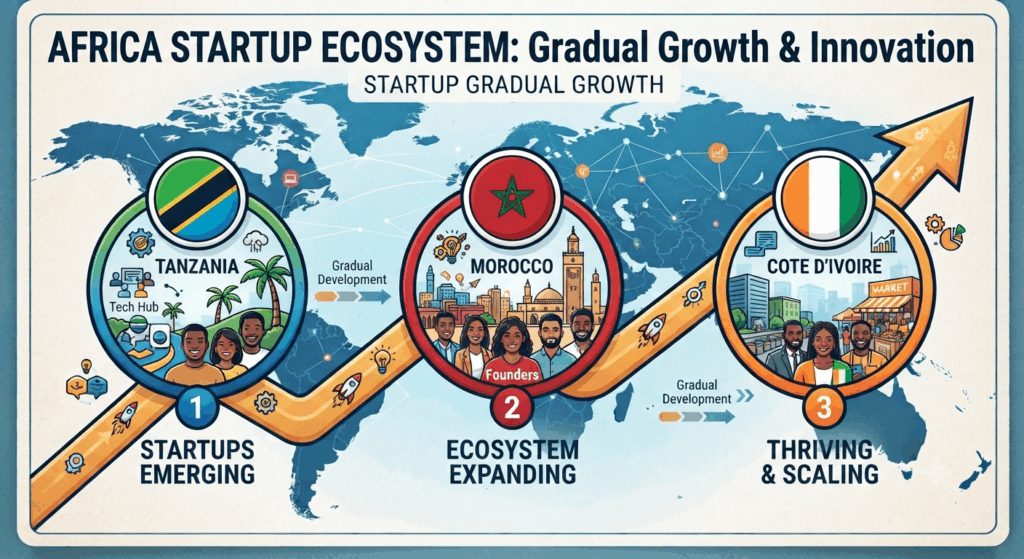
Africa's traditional startup funding hubs saw their dominance erode in the first half of 2026 as venture capital broadened into peripheral markets, though early-stage capital remains acutely squeezed.
Africa’s traditional startup funding hubs saw their dominance erode in the first half of 2026, as venture capital broadened into previously peripheral markets. The four largest ecosystems—Nigeria, Egypt, Kenya, and South Africa—accounted for 58% of total funding across the continent. While they still hosted the largest individual rounds, their combined share has declined from previous years.
“Beyond the Big Four, three markets attracted more than $25 million in total funding in H1: Tanzania, Côte d’Ivoire and Morocco,” said Max Cuvellier Giacomelli, founder of data tracker Africa: The Big Deal. This threshold marks a notable shift in investor appetite. Morocco, Tanzania, and Ghana also demonstrated underlying entrepreneurial momentum, each recording at least 10 startups raising $100,000 or more during the period.
The established leaders remain firmly ahead in absolute terms. Egypt led the continent with $327 million in total funding, followed by Nigeria at $254 million. Kenya raised $126 million, while South Africa secured $83 million. However, Nigeria took the top spot for pure equity investment at $214 million, edging out Egypt’s $183 million, and continues to lead Africa in the sheer number of startups securing capital.
For institutional investors, the geographic spread offers a mechanism to reduce portfolio concentration risk. Valuations in smaller markets are becoming more attractive, supported by improving digital infrastructure and regulatory changes. Fund managers are increasingly compelled to scout beyond Lagos, Cairo, Nairobi, and Johannesburg to deploy capital efficiently and build a wider pipeline of investable companies.
Yet the headline diversification masks a structural weakness in the broader funding recovery. Capital is increasingly concentrated in larger, mature companies rather than being distributed across the ecosystem. “The drops we are seeing in the rest of the Big Four echo the concerns we have been raising repeatedly since the beginning of the year about the concentration of the money on larger deals and the lack of early-stage tickets, especially at the lower end of the range,” Giacomelli noted.
This dynamic suggests that while capital is reaching new geographies, it is failing to sufficiently seed early-stage ventures. For emerging markets like Tanzania and Morocco, the current influx is a milestone. However, without a robust pipeline of early-stage capital, these geographic gains risk stalling before these new hubs can produce the next generation of scalable enterprises.