Indian stocks face selloff as Hormuz fears, yields spike crude
Indian equities are poised for a sharply lower open after escalating US-Iran strikes drove crude prices higher and US Treasury yields to 16-month highs, threatening to reverse the market's recent constructive trend.
Indian benchmark indices are on track to open significantly lower on Monday, with Gift Nifty trading at 24,056, a 186-point discount to Friday's close. The sudden shift in sentiment follows a weekend escalation in the US-Iran conflict that pushed oil prices sharply higher and drove US stock futures down.
The US expanded strikes on Iran over the weekend, targeting broader areas across southern and western Iran according to state media reports. While the US insists the Strait of Hormuz remains open, Iran claims to have closed the vital shipping chokepoint. The conflicting reports drove Brent crude up 3.88% to $78.96 a barrel and WTI up 4.01% to $74.27.
The inflationary pressure from surging energy costs rippled through sovereign debt markets. The US two-year Treasury yield climbed 3 basis points to 4.24%, its highest level since February 2025, on speculation the Federal Reserve will need to tighten policy. The 10-year yield added 2 basis points to 4.58%. Japanese government bonds moved in the opposite direction, with the 10-year yield falling 2.5 basis points to 2.735%.
The risk-off mood contrasted with a strong Friday session on Wall Street, where the S&P 500 gained 0.42% to close at 7,575.39 and the Nasdaq rose 0.29% to 26,281.61. Semiconductor stocks were a notable bright spot, highlighted by SK Hynix's Nasdaq debut. The South Korean chipmaker raised over $26 billion through American Depositary Receipts priced at $149, with shares closing 12.76% higher at $168.01.
Indian markets had closed Friday on a high note, with the Sensex jumping 1.08% to 77,569.39 and the Nifty 50 settling 1.02% higher at 24,206.90. However, the sudden surge in crude prices poses a particular risk to India as a net oil importer. “While the broader trend has turned constructive again, we continue to advocate a stock-specific approach with a ‘buy-on-dips’ strategy, favouring relatively stronger sectors such as banking, pharma, realty and pick selectively from the others,” said Ajit Mishra, SVP, Research, Religare Broking Ltd.
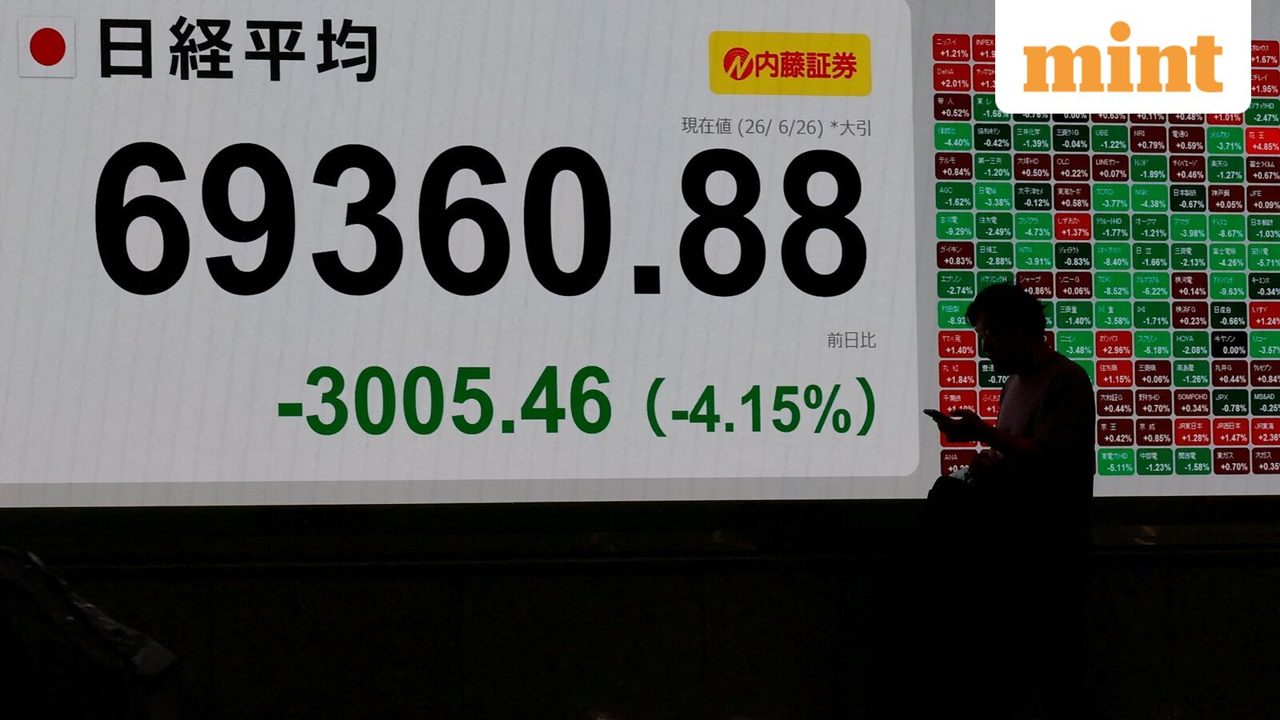
The dollar held steady at 101.07 against a basket of six currencies, while gold and silver prices dropped as rate hike prospects outweighed traditional safe-haven demand. Spot gold fell 1.2% to $4,072.78 per ounce. In early Asian trading on Monday, Japan’s Nikkei 225 fell 0.61% and South Korea’s Kospi declined 1.74%.