PJM grid auction hits $325 cap, socializing AI power costs
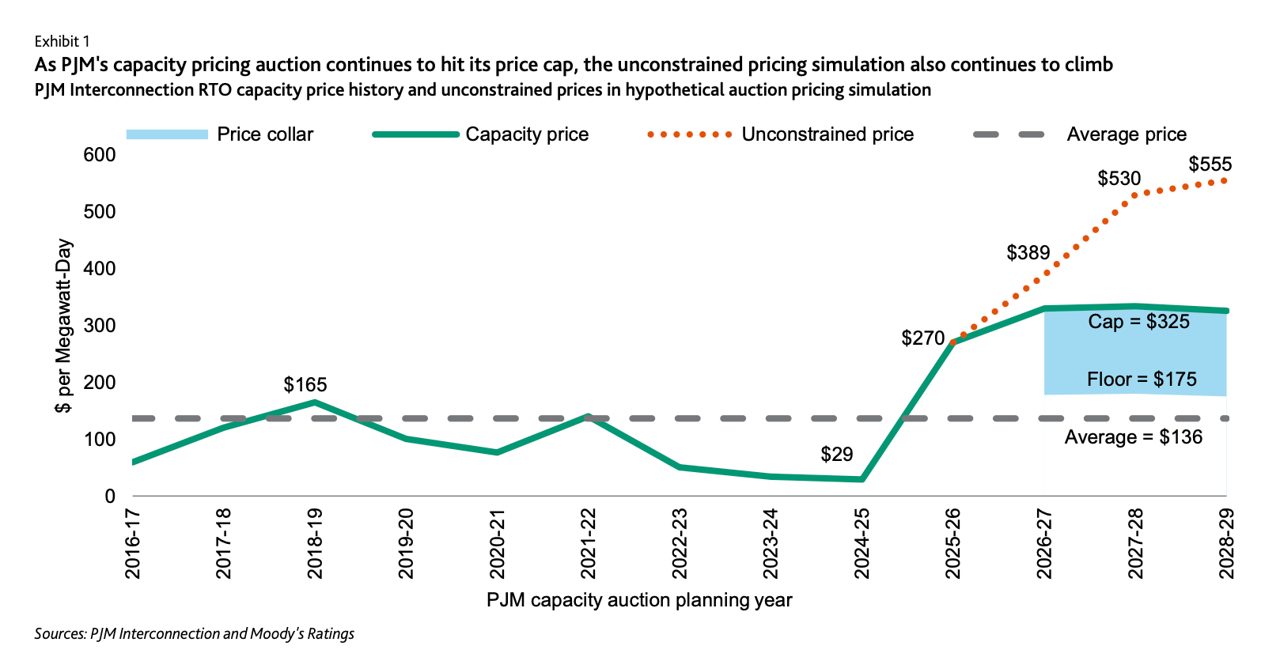
PJM Interconnection's latest capacity auction cleared at its maximum price for the third consecutive time, signaling to investors that surging AI data center demand is structurally shifting billions in power infrastructure costs onto residential ratepayers.
On July 14, PJM Interconnection announced its 2028-29 capacity auction cleared at $325 per megawatt-day, the maximum allowed under its price cap. This marks the third straight auction to hit the ceiling for the grid operator, which serves 67 million people across 13 states. Supply fell about 6.8 gigawatts short of the level needed to maintain grid reliability.
Data centers are driving this unprecedented demand squeeze. PJM's market monitor, Monitoring Analytics, attributes roughly $6.3 billion of the auction's $16.4 billion in total capacity charges directly to data center load. New generation capacity that cleared the auction plunged to just 525 megawatts, roughly half the volume of the prior event. This occurred even as regional peak demand hit a record 168.2 gigawatts on July 2.
The scarcity is exposing a structural flaw in how new power infrastructure is funded. Moody’s Ratings warned in a July 22 report that “the current system lacks adequate mechanisms to ensure that the cost of building new supply is borne by the new entrants and instead socializes new build costs across all customers.” The credit agency noted that other US power markets force large new loads to secure direct supply contracts, a mechanism PJM lacks.
Without the price cap, PJM's own simulations show the unconstrained capacity price would have reached $554.72/MW-day, and $776.69/MW-day in the Chicago-area ComEd zone. The financial pressure is already bleeding into consumer bills. Consulting firm ICF projects households and businesses in PJM territory could see rates jump up to 60% over the next five years as Big Tech's buildout accelerates.
The mounting costs are triggering a political and regulatory backlash that investors must monitor. State legislatures are scrutinizing utility profit margins alongside rising bills, while Harvard Law’s Electricity Law Initiative highlights how both infrastructure socialization and market scarcity pricing are hitting residents simultaneously. In response to the supply deficit, PJM has asked the Federal Energy Regulatory Commission to approve an emergency "backstop" capacity auction for September.
Some market participants and regional governors have proposed forcing hyperscalers to sign long-term contracts for new generation to solve the funding gap. However, critics argue this may not build power fast enough and risks distorting broader power markets. Until grid rules change, the financial burden of the AI buildout will continue to rely on a consumer-funded framework that faces increasing political risk.